
Around 100,000 protest Gaza war in Bangladesh, beat images of Netanyahu, allies
DHAKA, Bangladesh Tens of thousands of protesters rally in Bangladesh’s capital to condemn Israel’s actions in the Gaza Strip.


100,000 People Protest Gaza War and Burn Images of Netanyahu and Allies at a Mass Rally in Bangladesh, Dhaka, April 12, 2025 In one of the largest pro-Palestinian demonstrations in recent memory, an estimated 100,000 people took to the streets of Dhaka, Bangladesh, on Friday to protest Israel’s ongoing military offensive in Gaza. People from all walks of life, including students, activists, supporters of political parties, and religious groups, came together at the rally, which was called the "March for Gaza," to demand justice and solidarity with Palestinians. The demonstration was held at Suhrawardy Udyan, a historic location in the center of Dhaka that has previously hosted significant political movements. Protesters expressed their outrage at the humanitarian crisis in Gaza by waving Palestinian flags, carrying symbolic coffins, and chanting phrases like "Free, Free Palestine" and "Down with Zionism." A particularly striking element of the protest was the public burning and beating of effigies and images representing Israeli Prime Minister Benjamin Netanyahu, U.S. Narendra Modi, the Indian Prime Minister, and President Joe Biden. Demonstrators accused these leaders of complicity in what they called “war crimes” against Palestinian civilians. "They support the oppressor while the oppressed cry for help," shouted one protester, stomping on an image of Netanyahu.
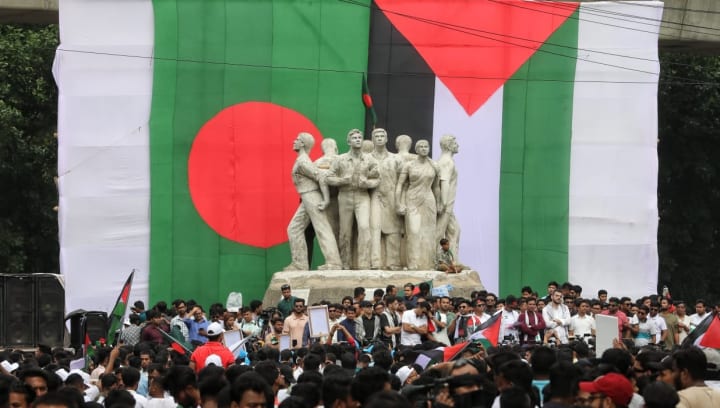
A coalition of opposition political parties, religious organizations, and civil society organizations coordinated the protest. One of the most prominent voices in support of the protest was the Bangladesh Nationalist Party (BNP), which is led by former Prime Minister Khaleda Zia. In addition, a number of Islamist organizations joined, highlighting Bangladesh's long-standing support for the Palestinian cause and refusal to recognize Israel as a state. In their speeches, organizers demanded that Muslim-majority countries sever diplomatic and economic ties with Israel. They urged the Bangladeshi government to reinstate the historic "Except Israel" restriction on travel to Israel on passports. The inclusion of Palestinian history and the Al-Aqsa Mosque struggle in the national education curriculum, increased humanitarian aid for Gaza, and an immediate boycott of products from companies that are allegedly associated with Zionist interests were among the other demands. This is not merely a political problem. Participating university professor Farida Akhter stated, "This is a humanitarian crisis." “Our people are here today because we cannot stay silent while children die under bombs and the world watches.”
Additionally, protesters displayed potent symbolic imagery. Through the crowd, large cardboard coffins bearing the names of Palestinian civilians who had been killed in the conflict were carried. Street art and posters showed destroyed buildings in Gaza, grieving families, and messages urging global action. Volunteers handed out pamphlets with QR codes linking to donation platforms supporting Palestinian relief efforts.
Although the rally was largely peaceful, there was a heavy security presence to prevent any escalation. Police blocked nearby roads, and plainclothes officers mingled within the crowd to monitor for signs of unrest. There were no major incidents reported. Bangladesh's strong support for Palestinian self-determination is made clear by the protest. Bangladesh, a nation with a majority of Muslims but no diplomatic ties to Israel, has consistently criticized Israeli military actions in Gaza and the West Bank. The latest violence, which began in late March 2025, has left thousands dead and wounded, including many women and children.
Foreign Minister Hasan Mahmud recently reiterated Bangladesh's position, saying, "Bangladesh stands firmly with the people of Palestine in their just struggle for freedom and dignity." The Bangladeshi government has not officially commented on the protest. The crowd slowly left Dhaka as the sun set, leaving behind streets lined with flags, placards, and powerful chants. The protest was more than just a political statement for many people in Bangladesh; it was also a moral call to the world to act.
About the Creator
Keep reading
More stories from Sabbir Hossain and writers in History and other communities.
The Blue Ridge Stalker
Tom had left the Ford down the way, its spark plugs finally exhausted and no mechanics for a dozen miles back through the foothills to Strossburg. No matter, he had worn his boots—almost as if he planned for this to happen. The puzzle he sought to solve emanated from the woods clinging to the slopes above; the valley behind held no mysteries.
By Stephen A. Roddewig5 days ago in Fiction


Comments
There are no comments for this story
Be the first to respond and start the conversation.