

The subject of political science has evolved by questioning the nature and importance of concepts like state, constitution, citizenship, laws, and governments. Aristotle, famously referred to as the father of political science, had laid the bricks of the subject. In this blog, you will read about his understanding of the state, classification of constitutions and the cycle of governments. The first man to distinguish between various branches of knowledge had been Aristotle. He differentiated between meteorology, poetics, logic, biology, ethics, natural history, aesthetics, physics, rhetoric, metaphysics and even wrote extensively on these subjects. He did not only lay the foundation stone of political science but also contributed significantly to its elaboration as well. "Politics", "Ethics", and "Rhetoric" are few among many of his works that hold discussions on questions of law, equality, justice, etc. According to Aristotle, political science is a master science. He gives credit to political science as a master-art because, unlike other sciences that serve as a means to an end, political science pertains to the ends of human existence in itself. Aristotle, thus viewed political science as the end to human existence rather than as a means to it. In his book, The Nicomachean Ethics, Aristotle writes, "The supreme good... must be the object of the most authoritative of the sciences - some science which is a master craft. But such is manifestly the science of politics, for it is this that ordains which of the sciences are to exist in states, and what branches of knowledge the different classes of citizens are to learn, and up to what point." His view demonstrates that political science dominates all other sciences. It explains his "Hierarchy of Ends", implying that each branch of knowledge is merely a means and would ultimately serve the end of leading a good life. Note here that Greek philosophers and their view of politics share one common notion. They believe that the state comes into existence for the sake of life and continues for the sake of good life. Aristotle doesn't differ on this notion and is hence considered to view the science of politics as supreme to other sciences.
Aristotle and his view on State: Aristotle views the state as natural. According to him, the state is a necessary condition for all humans. Like Plato, he doesn't differentiate between state or society and, in a similar fashion, considers it to be essential for a good life. Thus, in his view, the State is a necessary condition of a good life. Any human being cannot survive in isolation, and thus, a man and a woman establish a household. A village is formed when a family expands itself, and when many such villages are formed, a state comes into existence. As and when a state is formed and society is organised, human beings can meet their needs. It is for the same reason that the state's existence is as important and natural as the presence of a family or village. However, most human associations are flawed and help to fulfil one or a few facets of the good life, but that's untrue for a state. He viewed the state as being able to meet the whole or all facets of a good life. It is important to understand why he perceived the state as natural for humans. According to him, there is no difference between an animal or a human being, other than the fact that a human being has the desire and a sense of living a good life. What it means is that human beings become different from animals only if they exist in a state. It is the same desire to lead a good life that makes the formation of a state a natural thing to occur.
About the Creator
Syed Ammar
Social Critic, learning to get rid of so-called social values, Columnist, having eagle eye on South Asian matters. Intellecting the things differently.
Keep reading
More stories from Syed Ammar and writers in History and other communities.
Aristotle
Aristotle draws a relation between organ and organism. Each organ of a living being performs a specific function; each individual performs different responsibilities in society. The body consists of different organs performing varied functions, and the body ensures harmony in its functioning. Similarly, the state ensures the communion of various individuals, where the division of labour ensures cooperation and harmony in society. Aristotle and his classification of governments and constitutions are as
By Syed Ammar2 years ago in History
The ancestors of modern Danes arrived in America over 1,000 years ago
U.S. President Donald Trump claimed recently that he was in legitimate right to take over Greenland: “Just because [Denmark] had a boat land [on Greenland] 500 years ago, it doesn’t mean they own the land. [..] I’m sure we had lots of boats go there also.”
By Aurel Stratan4 days ago in History
Is the U.S. Preparing to Attack Iran?
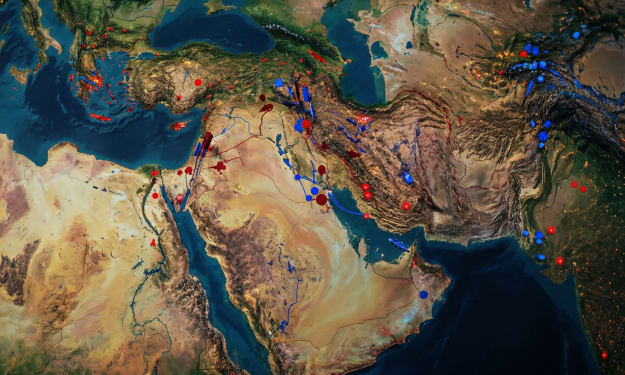
Is the U.S. Preparing to Attack Iran? Inside the Rising Tensions and Possible Military Pathways In early 2026, tensions between the United States and Iran reached one of their highest points in years. For weeks, dramatic political rhetoric, shifting military postures, and warnings from leaders around the world have fueled alarms that a U.S. military strike against Iran may be imminent. Yet as of now, no confirmed attack has occurred, and the situation reflects a complex mix of pressure, preparation, de-escalation, and diplomatic uncertainty that illustrates how modern conflict can hinge just as much on words and positioning as on direct action.
By Wings of Time about 16 hours ago in History



Comments
There are no comments for this story
Be the first to respond and start the conversation.