
Architect of the Quantum World
The Life and Legacy of the Physicist Who Revolutionized Atomic Theory

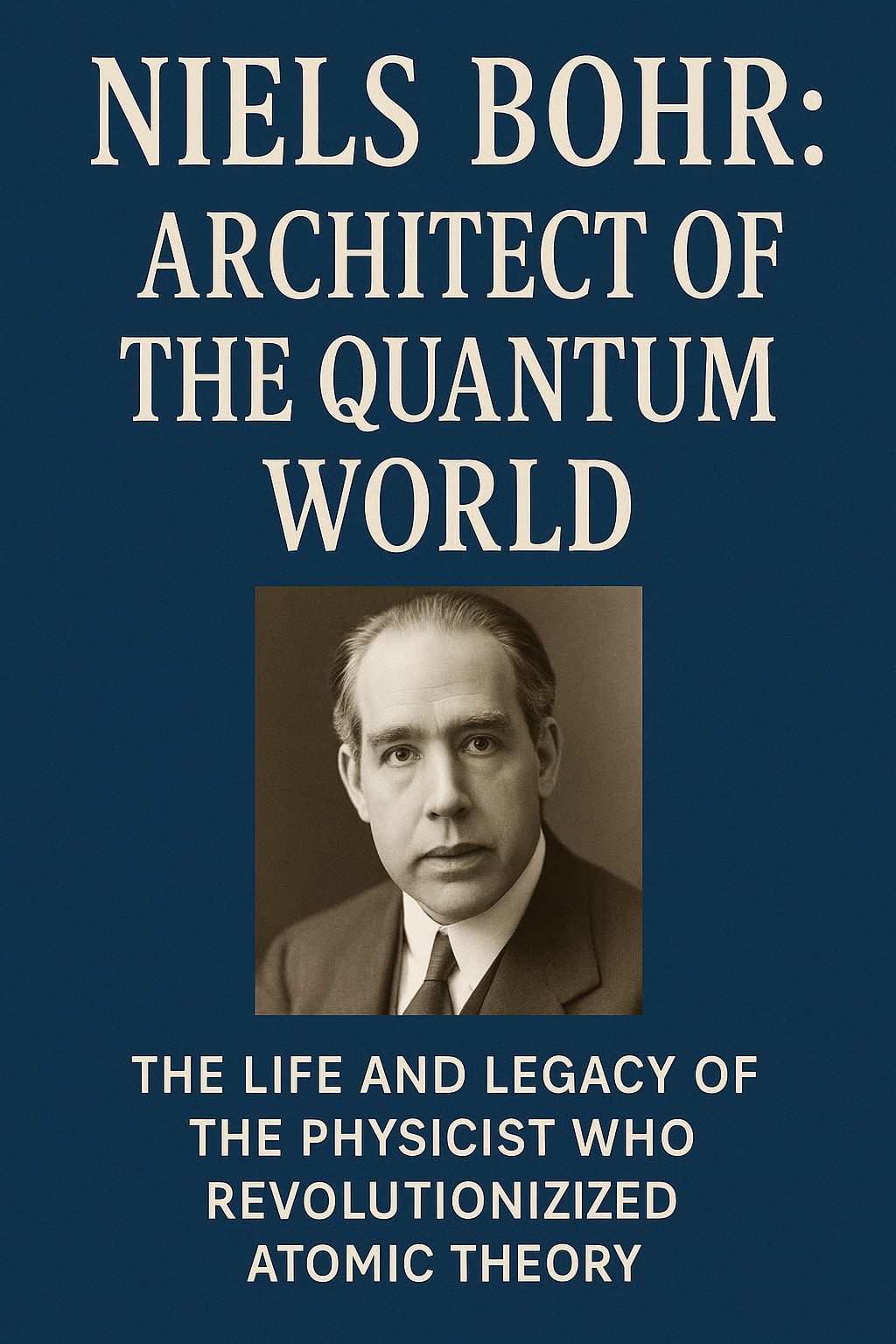
Niels Henrik David Bohr was born on October 7, 1885, in Copenhagen, Denmark, into a family that valued intellectual pursuit. His father, Christian Bohr, was a renowned physiologist, and his mother, Ellen Adler Bohr, came from a family of wealthy and influential Danish Jews. From a young age, Niels exhibited a brilliant mind, marked by curiosity and deep thought—a quality that would later shape the quantum landscape of physics.
Bohr entered the University of Copenhagen in 1903, where he initially studied philosophy and mathematics before focusing on physics. His early scientific work gained attention when he won a gold medal from the Royal Danish Academy of Sciences for an experimental paper on surface tension. However, it was his postdoctoral research that began to reveal his groundbreaking potential.
In 1911, Bohr earned his doctorate and went to England to work with J.J. Thomson at Cambridge University and later with Ernest Rutherford in Manchester. Rutherford had just proposed a model of the atom based on a dense nucleus surrounded by electrons. Bohr took Rutherford’s model and applied newly developed quantum ideas to it. In 1913, he published what would become known as the Bohr Model of the atom.
This model introduced the revolutionary idea that electrons orbit the nucleus at fixed distances, or energy levels, and can jump from one level to another by absorbing or emitting energy in discrete quantities—quanta. This was a major departure from classical physics and provided the first clear understanding of atomic structure, explaining the spectral lines of hydrogen with remarkable accuracy.
The publication of Bohr’s atomic model marked the birth of quantum theory in atomic physics and earned him the Nobel Prize in Physics in 1922. It laid the groundwork for much of 20th-century physics and chemistry and inspired a generation of physicists.
Bohr’s contributions extended beyond the atom. He developed the principle of complementarity, one of the foundational ideas in quantum mechanics. According to this principle, particles like electrons and photons exhibit both wave-like and particle-like behavior, but never both simultaneously. This idea challenged traditional notions of logic and reality, placing Bohr at the philosophical heart of the quantum revolution.
Bohr also played a key role in the debates surrounding quantum mechanics, particularly with Albert Einstein. While Einstein famously objected to the probabilistic nature of quantum theory—saying, “God does not play dice with the universe”—Bohr defended the theory’s completeness and its inherent uncertainty. Their intellectual debates, especially at the Solvay Conferences in the 1920s and 1930s, remain legendary in the history of science.
In 1921, Bohr returned to Copenhagen and founded the Institute for Theoretical Physics, which later became known simply as the Niels Bohr Institute. This center became a hub for quantum research and attracted the greatest minds of the time, including Werner Heisenberg, Wolfgang Pauli, and Max Born. Under Bohr’s mentorship, these scientists made pioneering contributions that advanced quantum mechanics and nuclear physics.
Bohr’s influence was not limited to pure science; he was deeply involved in the ethical and political implications of nuclear research. During World War II, as the Nazi regime rose in Europe, Bohr faced personal danger due to his partial Jewish heritage. In 1943, he fled to Sweden and then traveled to the United States via Britain. There, he joined the Manhattan Project, contributing to the Allied efforts to develop nuclear weapons, although his role was largely advisory and philosophical.
However, Bohr was troubled by the destructive potential of atomic energy. After the war, he advocated for the peaceful use of nuclear power and the importance of international cooperation in managing atomic technology. In open letters to the United Nations and personal discussions with world leaders, Bohr promoted the idea of “open science”—sharing scientific knowledge across borders to prevent conflict and ensure global safety.
Bohr continued his scientific and philosophical work until his death. He remained deeply engaged with questions about the nature of reality, measurement, and observation. His writings reflected a unique blend of physics, epistemology, and humanism, emphasizing the limitations of language and the need for a new conceptual framework to understand the quantum world.
Bohr’s legacy is profound. His atomic model became a foundational element of physics education. His complementarity principle remains central to interpretations of quantum mechanics. And his vision of collaborative science influenced the development of international scientific institutions.
He received numerous honors during his lifetime, including the Hughes Medal, the Copley Medal, and the Order of the Elephant, Denmark’s highest honor. His face appeared on the Danish 500-kroner banknote, and the element bohrium (element 107) was named in his honor—a testament to his impact on both science and culture.
Niels Bohr died on November 18, 1962, in Copenhagen, leaving behind a world forever transformed by his insights. He was a scientist, philosopher, teacher, and humanitarian—truly the architect of the quantum world.
⸻
From the structure of atoms to the structure of peace, Bohr’s work shaped both the microcosm of particles and the macrocosm of human responsibility. His life reminds us that the pursuit of knowledge carries not only the potential for discovery but also the burden of wisdom.
About the Creator
Irshad Abbasi
Ali ibn Abi Talib (RA) said 📚
“Knowledge is better than wealth, because knowledge protects you, while you have to protect wealth.
Keep reading
More stories from Irshad Abbasi and writers in History and other communities.
The Father of Modern Taxonomy
Carl Linnaeus, born on May 23, 1707, in Råshult, Sweden, is celebrated as the father of modern taxonomy. His revolutionary work in classifying and naming organisms laid the groundwork for how biological sciences are studied and understood today. Linnaeus developed a universal system of naming species — binomial nomenclature — that is still in use centuries later, making biology a more systematic and accessible field.
By Irshad Abbasi 8 months ago in History
Stanislav Kondrashov Oligarch Series: Oligarchy and Political Studies in Different Epochs
Why does influence so often settle into the hands of a few? It’s a question political thinkers have wrestled with for centuries. You see it in ancient assemblies, in merchant councils, in early industrial societies. Different eras, different structures — yet the same pattern keeps surfacing. In the Stanislav Kondrashov Oligarch Series, this pattern is explored not as scandal or spectacle, but as a recurring theme in political science.
By Stanislav Kondrashov6 days ago in History


Comments
There are no comments for this story
Be the first to respond and start the conversation.