
The Father of Modern Taxonomy
How Carl Linnaeus Classified the Natural World and Revolutionized Biological Science

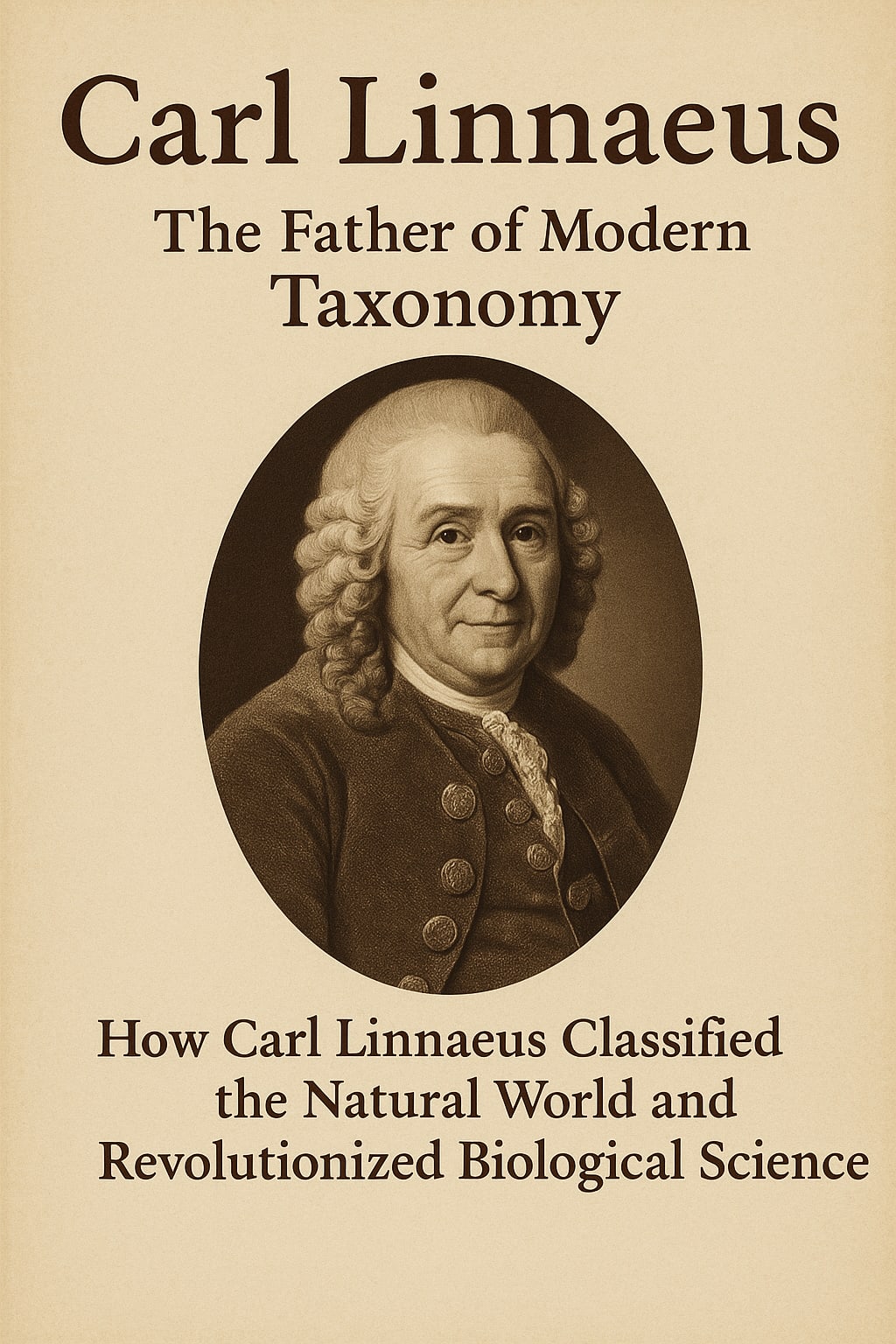
Carl Linnaeus, born on May 23, 1707, in Råshult, Sweden, is celebrated as the father of modern taxonomy. His revolutionary work in classifying and naming organisms laid the groundwork for how biological sciences are studied and understood today. Linnaeus developed a universal system of naming species — binomial nomenclature — that is still in use centuries later, making biology a more systematic and accessible field.
⸻
Early Life and Education
Carl Linnaeus was born into a family of modest means. His father, Nils Ingemarsson Linnaeus, was a Lutheran minister and an avid gardener, who introduced young Carl to the world of plants. Fascinated by nature from a young age, Linnaeus would often wander the Swedish countryside, collecting and observing flowers, trees, and insects.
In 1727, Linnaeus enrolled at Lund University, but soon transferred to the University of Uppsala, which had better facilities for natural sciences. It was there that he began studying medicine and botany, the two disciplines closely linked in that era. His early passion for classification was already evident, as he started organizing plants based on their reproductive systems — a novel idea at the time.
⸻
The Sexual System of Classification
One of Linnaeus’s most groundbreaking contributions came in the form of his Systema Naturae, first published in 1735 while he was living in the Netherlands. In this book, he proposed a classification system based on the number and arrangement of an organism’s reproductive organs. While some critics found this “sexual system” too bold or even inappropriate, it provided a practical and observable method of grouping plants.
Linnaeus’s classification was hierarchical, organizing living things into nested groups: kingdom, class, order, genus, and species. Each species was given a two-part Latin name — the first indicating the genus and the second the species. For example, humans were named Homo sapiens, meaning “wise man.” This binomial nomenclature became the standard way of identifying organisms, eliminating the confusion caused by regional or multiple common names.
⸻
Travels and Field Work
Linnaeus was not just a theorist; he was also a field biologist. In 1732, he embarked on a five-month expedition through Lapland, a remote region in northern Sweden. Equipped with little more than a satchel and notebooks, Linnaeus cataloged hundreds of plants, animals, and minerals, many of which had never been documented before.
He later traveled through other parts of Sweden and abroad to study biodiversity. These expeditions helped him refine his classification system and deepened his understanding of nature’s complexity. Linnaeus’s methodical notes and detailed illustrations from these journeys were later used in his academic work and inspired other scientists to do the same.
⸻
Academic Career and Influence
Upon returning to Sweden, Linnaeus completed his medical degree and began practicing medicine in Stockholm. In 1741, he was appointed professor of medicine and botany at Uppsala University, where he transformed the university’s botanical garden and mentored a generation of scientists. His students, known as “Linnaeus’ apostles,” were sent across the globe to collect plant and animal specimens, vastly expanding the reach and impact of his work.
Linnaeus published several key texts throughout his life, including:
• Systema Naturae (multiple expanded editions)
• Species Plantarum (1753), considered the starting point for modern botanical nomenclature
• Genera Plantarum
• Critica Botanica
His system eventually extended beyond plants to animals and minerals, making it a truly universal method of classification. He even attempted to classify humans in the animal kingdom, placing them among primates — a controversial move at the time, but one that foreshadowed evolutionary theory.
⸻
Personal Life and Character
Linnaeus married Sara Elisabeth Moræa in 1739, with whom he had seven children. Known for his disciplined work ethic and sharp intellect, Linnaeus also had a strong religious faith. He saw the order and complexity of nature as evidence of divine creation, and his scientific endeavors were often infused with a spiritual sense of wonder.
Despite his success, Linnaeus could be somewhat rigid in his thinking. He strongly defended his classification system and was known to dismiss opposing ideas. Yet his influence was undeniable, and his methods were widely adopted and adapted by later naturalists, including Charles Darwin.
⸻
Legacy and Lasting Impact
Carl Linnaeus died on January 10, 1778, but his legacy lived on. His contributions to taxonomy fundamentally changed how science approached the natural world. By creating a consistent and rational system for naming and organizing life, he made it possible for scientists from all over the world to communicate clearly and effectively about biological diversity.
Today, Linnaeus’s system has been expanded and modified to incorporate evolutionary relationships, genetic information, and molecular biology. However, the basic structure he devised — especially binomial nomenclature — remains the cornerstone of taxonomy.
In honor of his achievements, Linnaeus has been commemorated in countless ways. His name lives on in numerous plant and animal species, academic institutions, and scientific societies. He was ennobled in 1761 and given the title Carl von Linné, which he used for the rest of his life.
⸻
Conclusion
Carl Linnaeus was more than just a botanist or taxonomist; he was a visionary who brought structure to the natural world. His method of classification helped unify the biological sciences and set a precedent for scientific clarity and precision. Even centuries after his death, Linnaeus’s influence is deeply embedded in the language and logic of modern biology.
Through his work, Linnaeus reminded the world that behind nature’s chaos lies an elegant order — one that can be understood, named, and shared across cultures and generations. For that reason, he truly earns the title “The Father of Modern Taxonomy.”
About the Creator
Irshad Abbasi
Ali ibn Abi Talib (RA) said 📚
“Knowledge is better than wealth, because knowledge protects you, while you have to protect wealth.
Keep reading
More stories from Irshad Abbasi and writers in History and other communities.
The Life and Legacy of Eric S. Lander
Eric Steven Lander, one of the most influential figures in the fields of genomics and biomedical research, has played a transformative role in modern science. Born on February 3, 1957, in Brooklyn, New York, Lander’s career trajectory defied traditional scientific boundaries, blending mathematics, biology, and public policy to revolutionize the understanding of human genetics. From his early days as a math prodigy to his leadership in the Human Genome Project and beyond, Lander’s journey is a testament to the power of interdisciplinary thinking and the pursuit of knowledge for the betterment of humanity.
By Irshad Abbasi 8 months ago in History


Comments
There are no comments for this story
Be the first to respond and start the conversation.