

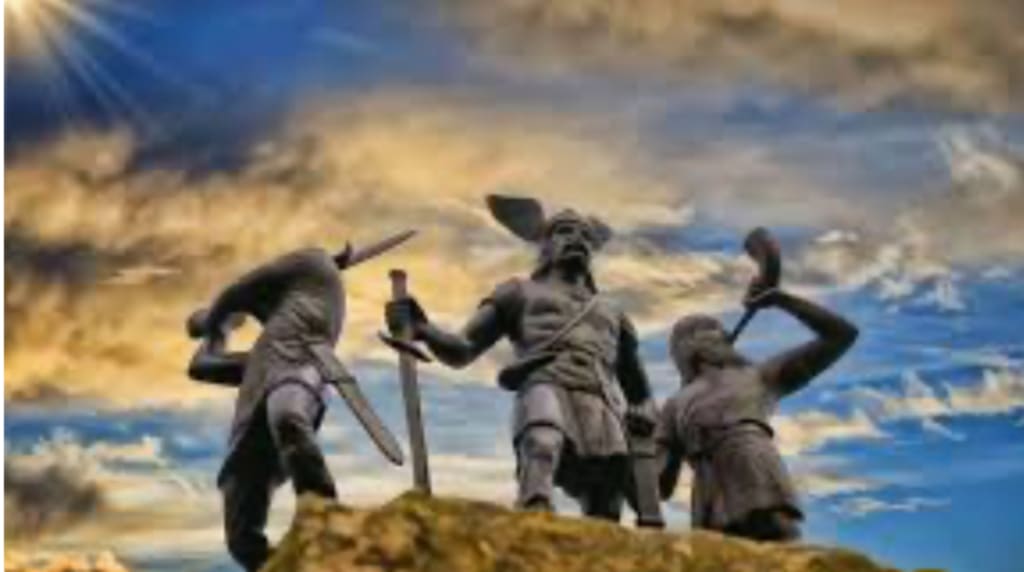
The ancient Celts and Anglo Saxon and Norse tribes worshipped pagan gods, and they are with us to this day.
Woden's Day" is an older name for Wednesday, derived from the Anglo-Saxon god Woden, who is also known as Odin in Norse mythology. In the Germanic calendar, Wednesday was named in his honor, reflecting the influence of Norse mythology on the Germanic languages and cultures.
Oðinn VS Woden : r/mythologymemesWoden and Odin are essentially the same deity, but they represent different cultural interpretations of the same god. Woden is the Anglo-Saxon name, while Odin is the Norse name. Both are prominent figures in Germanic mythology, known as gods of war, wisdom, magic, and poetry.
Here's a more detailed breakdown:
Shared Origins:
Both Woden and Odin are derived from the Proto-Germanic Wōdenaz, indicating a common root in earlier Germanic paganism.
Anglo-Saxon Woden:
In Anglo-Saxon mythology, Woden is a key god, often associated with war, victory, and magic. He is also believed to be the observer of humans, sometimes visiting them in disguise. The Anglo-Saxons also associated Woden with the runes and considered him the one who passed them on to humans. Wednesday is named after him (Woden's day).
Norse Odin:
In Norse mythology, Odin is the chief god, the Allfather. He is a god of war, death, wisdom, poetry, and magic. He is known for sacrificing an eye to gain knowledge and for his hall, Valhalla, where half of the warriors who die in battle are taken. Odin has many names and epithets, reflecting his complex nature and various roles.
Interchangeable:
While Woden is the Anglo-Saxon name and Odin is the Norse name, they represent the same god in different cultural contexts. The names Woden, Wodan, and Odin are often used interchangeably when discussing Germanic mythology.
Friday.
The gods of the Anglo-Saxons are still with us today. We still worship Frige, the mother of the gods and goddess of love, because her day means the start of the weekend. Three other days of the week are also named after some of the most important Anglo-Saxon gods.
Their gods were similar in many respects to the more recognisable Norse gods – made popular by fiction, in novels and on screen.
Woden
The chief of the Anglo-Saxon gods was Woden. As with many of the male Anglo-Saxon gods, Woden was often associated with war. Anglo-Saxon warriors would offer tribute to him before battle to gain his protection on the field and his favour to strengthen their arms and guide their spears. The spear was Woden’s sacred weapon and he is often depicted wielding it.
Woden was not only a god of war, but also a god of wisdom. The Anglo-Saxons believed that the ancient runes – the system their writing was based upon – were invented and passed to man by Woden.
The day named after him is, of course, Wednesday, or as it was once known, Woden’s day. Woden was also known Odin in Norse mythological traditions.
Frige. Friday.
Frige (or Frigg in Norse) was Woden’s wife, and she was the goddess of love, which covered all marriage, children, and the harvest. As a result, Anglo-Saxons offered her tribute to aid the harvest and thank her for good harvests, and she also appears to have been viewed as an earth goddess. Women would have also offered up tributes to her before and after childbirth.
Her day is Friday: Frige’s day, and September was closely associated with Frige because of the harvest. In Old English, the equivalent of September was known as ‘Holy Month’, possibly as a result of this connection.
Thunor. - Thursday.
Thunor (or Thor, in Norse), son of Frige and Woden was the god of the weather, particularly thunder and lightning. He was also god of the forge, and so was especially important to blacksmiths.
The Anglo-Saxons believed that the sound of thunder was Thunor striking his hammer on his mighty anvil; lightning, meanwhile, was the spark created by the strike. Archaeologists know that Thunor was one of the most popular gods as pendants showing his symbol, the hammer, have been found in many Anglo-Saxon graves.
Some believe that the tradition of a Yule Log may well stem from Thunor: he was associated with oak tree and so bringing one inside the house once a year was a means of protecting your house against lightning and fire.
This may have been because the Anglo-Saxons perceived Thunor as one of the most powerful of all of the gods due to his association with the elements: the most powerful force of nature with which many were aware of. Thunor’s day was the fourth of the week, Thursday.
Tiw. Tuesday.
The god Tiw (Tyr in the Norse tradition) was another important deity for the Anglo-Saxons as he was the god of war, swordplay and the sky. Even though the Anglo-Saxons appealed to both Thunor and Woden in matters of warfare, Tiw was the official god of war. He was also reputedly the most skilled in combat of all of the gods – despite having only one hand.
He was revered for this fact as he sacrificed his sword hand to the monstrous wolf, Fenris, who prophecy said would one day slay Woden.
The dwarves had made a special invisible chain to hold the beast so that they may stop the prophecy, but the wolf wouldn’t let anyone near unless one of the gods put their hand in his mouth. Tiw selflessly volunteered and Fenris was successfully chained, but in his fury he bit off the god’s sword hand.
Because of this heroic act, and the fact that Tiw was just as skilled with his left hand as he was with his right, Anglo-Saxon warriors widely revered him. The wolf was also his sacred animal. Tuesday was Tiw’s day.
Eostre. Easter.
Eostre was a spring goddess, associated with rebirth. Her name is closely etymologically linked with the word ‘Easter’, and her sacred month was April, when Easter is often celebrated. Anglo-Saxons would venerate her in the hope that she would bring prosperity throughout the summer months.
Some have said that the worship of Eostre is the origin of the hot cross bun – they were served as an offering, and the four quarters represent the quarters of the moon. There’s no definitive evidence for this legend however. Some have debated whether she was simply an invention of Bede as he is virtually the only source describing Eostre’s existence.
of course, the early Christians took the pagan gods and pagan celebrations and incorporated them into Christian celebrations, to make it easier to convert the pagans into Christians. And we live with them to this day.
About the Creator
Guy lynn
born and raised in Southern Rhodesia, a British colony in Southern CentralAfrica.I lived in South Africa during the 1970’s, on the south coast,Natal .Emigrated to the U.S.A. In 1980, specifically The San Francisco Bay Area, California.
The Unearthed Legacy of Pharaoh Ramesses II
Archaeologists in Egypt have made a remarkable discovery by unearthing the massive torso of a statue believed to depict Ramesses II, one of the most powerful and celebrated rulers of ancient Egypt. The discovery has excited historians and archaeologists alike, as it offers fresh insight into the artistic and architectural achievements of one of the most influential periods in Egyptian history.
By Irshad Abbasi about 17 hours ago in History
A More Human Vocal
When we launched Vocal nearly a decade ago, the world was a very different place. LLMs did not exist, and stories were created one at a time by people sitting down to write, revise, and share something personal. Many of our assumptions about publishing, trust, and participation were built for a world where effort and output were inseparable.
By Justin @ Vocal6 days ago in Resources




Comments
There are no comments for this story
Be the first to respond and start the conversation.