
Andover’s Hidden Horror: A Workhouse of Hunger and Shame
Behind the iron gates of Andover Workhouse, hunger turned to madness and shame, exposing the darkest truths of Victorian England.

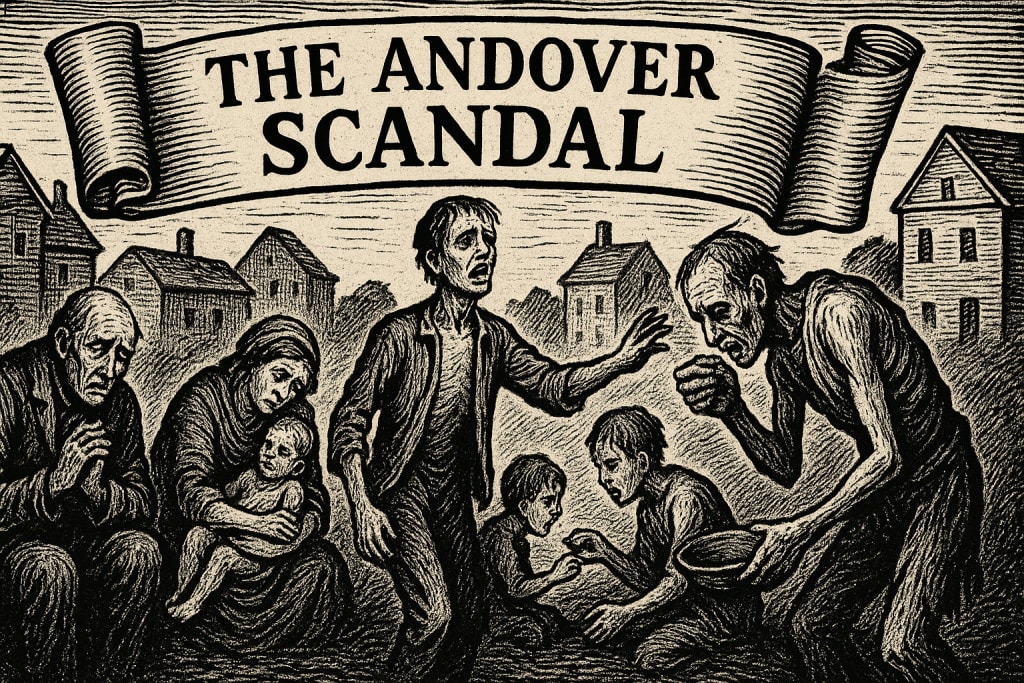
The air was heavy with damp and rot as November 1845 crept into Hampshire. Outside, the market square bustled with merchants calling out the price of fresh loaves and steaming pies, but within the stone walls of Andover Workhouse, silence ruled. The silence of gnawing stomachs. The silence of eyes that no longer lifted toward hope.
One evening, in the dimly lit bone yard, the spell of silence broke. A man, ragged as the cloth on his back, seized a splinter of rib from the heap. His teeth sank into it with a crack that echoed louder than the hammer blows that usually shattered bones into dust. At once, the others lunged for it. Elbows, fists, and clawed fingers tore at each other in the struggle for one filthy shard. The marrow inside was rancid, but for a moment it promised life.
From the shadows, a young mother pulled her child close. Her lips trembled, not from cold but from shame at seeing her fellow inmates fight like animals. Yet she knew that tomorrow, she might do the same—for her baby, for herself.
The Tyrant of Andover
At the center of this misery stood Master Colin McDougal, a former soldier whose Waterloo medals did nothing to conceal the cruelty in his governance. His command was absolute. A loaf of bread could be withheld for a wrong word. A coat could vanish into his keeping while men shivered through winter.
But bread and cloth were not his only weapons. For the women of Andover, the price of survival was far darker. Behind closed doors, whispers spoke of summonses, of liberties taken. The master’s shadow fell heaviest on the weakest.
His wife, Sarah, ruled beside him, her own temper feared by inmates. Together, they presided over a regime where complaints never left the iron gates, and the local Guardians, entrusted with oversight, turned their eyes elsewhere.
The Silent Terror of Women
It was not only hunger that stripped dignity away. For many women, degradation took the form of unspoken bargains. Refusal meant punishment—reduced rations, harder work, the looming threat of their children’s starvation.
One testimony later revealed: “She had a choice—yield to his demands or watch her children faint with hunger.”
The assaults were not loud, not marked by violence visible to the outside world. They happened in shadows, in storage rooms, in the silence of night. The next day, these women still ground bones beneath their hammers, their faces as blank as the walls around them, while inside they carried the scars of humiliation.
Hunger as a Weapon
The labor itself was grotesque. The paupers were ordered to crush heaps of bones—animal carcasses from slaughterhouses, even remnants imported from foreign battlefields where soldiers had fallen. The stench clung to their skin and hair. The dust filled their throats.
To the outside world, bone meal was gold for the fields, enriching the soil for crops. To those inside, it was a cruel joke: they starved while handling the very stuff that fed others.
When reports surfaced of paupers gnawing at marrow like desperate hounds, outrage flared. The Times described the scene as “paupers fighting with frantic eagerness over putrid bones.” The image burned itself into the public imagination.
The Inquiry That Shamed a Nation
When Parliament was forced to act, the testimonies revealed more than hunger. They exposed a system built to grind human beings into obedience. Men spoke of fighting over scraps; women, of violations endured in silence. One inspector reported that the cries of abused women were drowned out by the sound of hammers crushing bones.
The scandal was too great to be dismissed. In the press, the Morning Chronicle thundered: “A nation that permits its poor to suck marrow from rotting bones cannot call itself civilized.”
By 1847, the Poor Law Commission—long criticized for its cold, mechanical cruelty—was dissolved. A new body took its place, promising tighter oversight. Bone-crushing as labor was outlawed. Yet for many, the reforms came too late.
Shadows That Remain
Andover was not an isolated nightmare. Across England and Ireland, workhouses brimmed with the hungry and the broken, especially as the Irish Famine sent waves of desperate families seeking relief. The scandal revealed a truth long ignored: that poverty was treated as a crime, and punishment as policy.
Today, Andover’s streets are quiet, its workhouse gone. Yet the memory lingers. To walk those grounds is to walk on echoes—the echoes of men clawing over bones, of women forced into silence, of children who cried not from mischief but from hunger.
The Andover scandal remains one of Victorian England’s darkest symbols: proof that beneath the empire’s pride and progress lay cruelty so profound that even bones became a battlefield.
Resources
1. Victorian Web, “The Andover Workhouse scandal, 1845-6: Report from the Select Committee on the Andover Union (1846),” https://victorianweb.org/history/poorlaw/andover.html
2. Workhouses.org.uk, “The Workhouse in Andover, Hampshire,” https://www.workhouses.org.uk/Andover/
3. Richard John Br, “The Andover Workhouse Scandal,” WordPress blog, https://richardjohnbr.wordpress.com/2008/05/09/the-andover-workhouse-scandal/
4. Nursing Clio, “Sex, Secrecy, and Abuse in a 19th-Century Workhouse,” https://nursingclio.org/2016/08/09/sex-secrecy-and-abuse-in-a-19th-century-workhouse/
About the Creator
Jiri Solc
I’m a graduate of two faculties at the same university, husband to one woman, and father of two sons. I live a quiet life now, in contrast to a once thrilling past. I wrestle with my thoughts and inner demons. I’m bored—so I write.
Be Like Jesus... No - Don't!
My kids and I are Seventh Day Adventists. It is the closest organized religion that I resonate with... for the most part. A key thing is that Saturdays are our Sabbaths. So, today, Sabbath school lessons were not published on the website I use. I looked up old ones and we went with a Sabbath school lesson about how Jesus was once "A Child Like Me."
By The Schizophrenic Mom8 days ago in History
Antarctica Map
Antarctica is the coldest, driest, and windiest continent on Earth. It is located at the southernmost part of the planet, surrounding the South Pole. Because of its extreme weather and thick ice cover, Antarctica is very different from other continents. An Antarctica map helps us understand the shape, location, and important features of this frozen land.
By Farhan Sayed2 days ago in History



Comments
There are no comments for this story
Be the first to respond and start the conversation.