
Ancient Statue Found in Egypt May Not Belong to Ramses II
New research suggests that a recently discovered statue once believed to represent the famous Pharaoh Ramses II may actually depict another ancient Egyptian ruler.

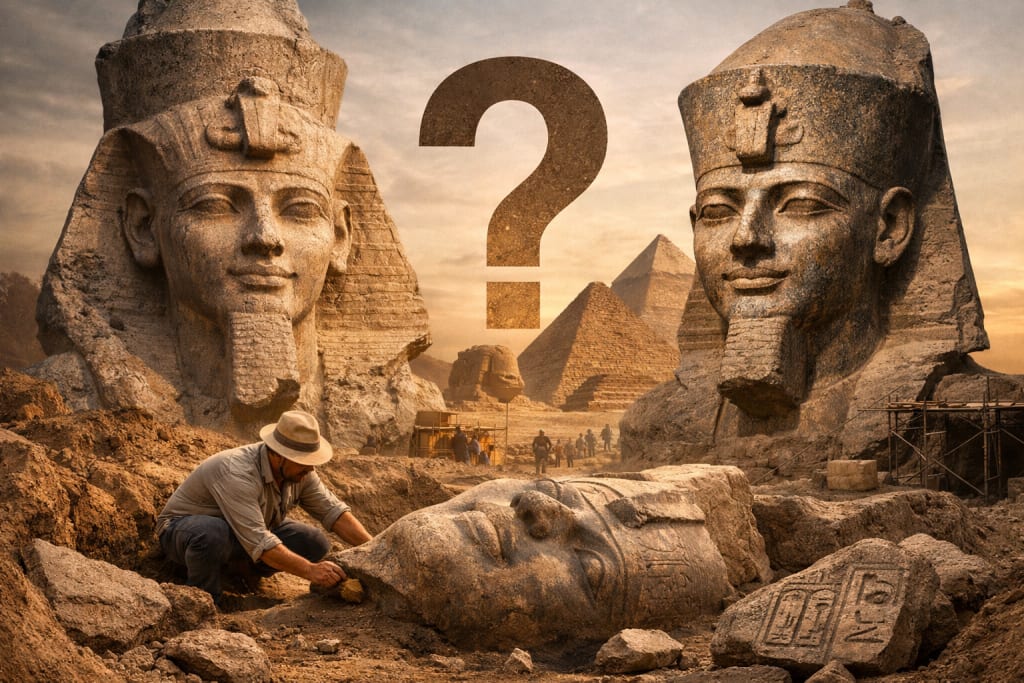
Egypt has long been a land of fascinating discoveries, where the sands of time continue to reveal secrets of one of the world’s oldest civilizations. Recently, archaeologists made an exciting discovery when they uncovered a large ancient statue in Egypt that was initially believed to represent the powerful pharaoh Ramses II. However, new research and closer examination have now suggested that the statue may not belong to him after all.
The statue was discovered during an archaeological excavation in the ancient Egyptian city of Heliopolis, an important religious center in ancient times. Heliopolis, known as the “City of the Sun,” was once one of the most significant cities in Egypt and played a central role in the worship of the sun god Ra. Over the centuries, the city became buried beneath layers of history, and modern excavations have gradually uncovered many of its hidden treasures.
When archaeologists first discovered the statue fragments, excitement quickly spread among historians and Egyptologists. The statue appeared to be massive and made of quartzite stone, standing several meters tall. Based on its artistic style and certain inscriptions found nearby, many experts initially believed that it depicted Ramses II, one of the most famous rulers of ancient Egypt.
Ramses II ruled Egypt during the 13th century BCE and is often considered one of the greatest pharaohs of the New Kingdom period. His reign lasted more than 60 years, during which he led military campaigns, built monumental temples, and established himself as a powerful symbol of Egyptian strength and authority. Because of his long reign and ambitious building projects, statues and monuments dedicated to him are found across many parts of Egypt.
For this reason, archaeologists initially thought that the newly discovered statue was another tribute to this legendary ruler. However, as researchers carefully studied the statue’s features, inscriptions, and artistic details, doubts began to emerge.
Experts noticed that certain stylistic elements of the statue did not fully match those typically associated with Ramses II. The facial structure, crown style, and some of the hieroglyphic inscriptions suggested that the statue might belong to an earlier period.
Further investigation led some scholars to propose that the statue may actually represent Psamtik I, a ruler who lived several centuries after the time of Ramses II. Psamtik I was the founder of Egypt’s 26th Dynasty and ruled during the 7th century BCE. His reign marked a period of political revival in Egypt after years of foreign domination and internal instability.
One reason for the confusion may be that later Egyptian rulers sometimes reused older monuments or created statues in the style of earlier famous pharaohs. Ancient Egyptian kings often admired their powerful predecessors and occasionally imitated their artistic styles in order to associate themselves with their glory and legitimacy.
If the statue indeed represents Psamtik I rather than Ramses II, it would highlight how Egyptian rulers sought to connect themselves with the country’s golden age. It would also provide historians with valuable insights into how political leaders used art and architecture to strengthen their authority.
The discovery also demonstrates how archaeological interpretations can change over time. When a new artifact is first discovered, researchers often make initial conclusions based on available evidence. However, as further analysis is conducted—using improved methods, additional discoveries, and deeper historical understanding—those conclusions may be revised.
Modern technology has also played an important role in this reassessment. Advanced scanning techniques, detailed photographic analysis, and comparisons with other known statues have allowed experts to study the statue more closely than ever before. These methods help researchers examine small artistic details that might reveal the identity of the ruler depicted.
Despite the uncertainty about the statue’s true identity, the discovery remains extremely important. The statue provides valuable information about ancient Egyptian art, religious traditions, and political symbolism. It also adds another chapter to the ongoing story of archaeological exploration in Egypt.
Egypt continues to attract archaeologists and historians from around the world because of its rich cultural heritage. Each year, new discoveries shed light on the lives of pharaohs, priests, workers, and ordinary people who lived thousands of years ago along the banks of the Nile River.
Whether the statue ultimately proves to represent Ramses II or Psamtik I, it reminds us that history is constantly evolving. New discoveries and fresh interpretations help scholars better understand the complex and fascinating civilization of ancient Egypt.
As excavations continue in places like Heliopolis, archaeologists hope to uncover additional clues that may finally solve the mystery of the statue’s true identity. Until then, the remarkable discovery stands as another reminder that the ancient world still holds many secrets waiting to be revealed.
About the Creator
Irshad Abbasi
Ali ibn Abi Talib (RA) said 📚
“Knowledge is better than wealth, because knowledge protects you, while you have to protect wealth.
Keep reading
More stories from Irshad Abbasi and writers in History and other communities.
Black Liberty on a Commemorative Coin: Redefining America’s Symbol of Freedom
In recent years, the United States has taken symbolic steps to reflect the diversity of its people in national imagery. One of the most notable examples came when the U.S. Mint introduced a commemorative coin depicting Liberty as a Black woman. For more than two centuries, Liberty—the personification of freedom in American iconography—had traditionally been portrayed as a white woman of classical European appearance. The introduction of a Black Liberty marked a significant shift in how the nation represents its ideals.
By Irshad Abbasi 3 days ago in History
How Can the World Prevent Another Global War?
How Can the World Prevent Another Global War? In times of rising global tensions, many people ask an important question: How can the world prevent another major war? History has shown that global conflicts cause enormous human suffering, economic destruction, and long-lasting political instability. Preventing a large-scale war—especially one that could involve nuclear weapons—is one of the most important challenges facing world leaders today.
By Wings of Time 3 days ago in History




Comments
There are no comments for this story
Be the first to respond and start the conversation.