
Ancient Amulet Found in Germany May Rewrite the History of Christianity
Discovery of 1,800-Year-Old Silver Inscription in Frankfurt Challenges Established Historical Timelines

Archaeologists in Frankfurt, Germany, have made a groundbreaking discovery that sheds new light on the spread of early Christianity in Europe. They unearthed an 1,800-year-old silver amulet with an inscription that is now considered the oldest known evidence of Christian devotion north of the Alps. This finding challenges existing timelines and reveals how deeply Christianity may have taken root in the region far earlier than historians previously believed.
A Remarkable Discovery
The amulet was found in a Roman burial site in Frankfurt’s Praunheim district, part of the ancient town of Nida. Buried with a man who lived sometime between 230 and 270 A.D., the amulet was positioned near his chin, suggesting it was likely worn as a necklace. The small capsule, made of silver and just 1.37 inches long, contained a fragile strip of silver foil folded inside.
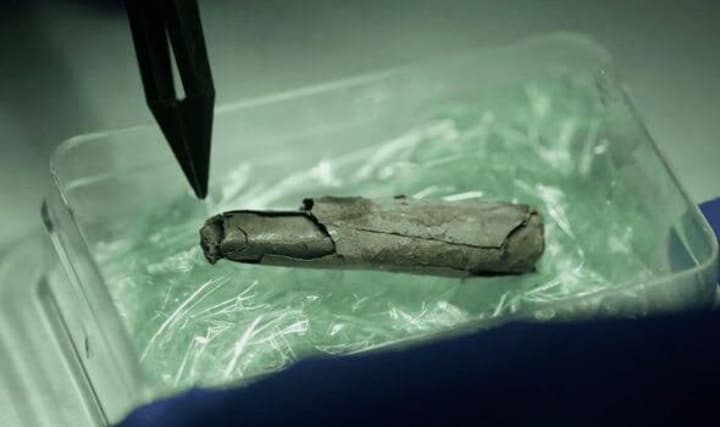
On this foil, researchers uncovered an 18-line inscription written in Latin. At first, they couldn’t physically unroll the foil due to its delicate condition, but advanced imaging technologies, like 3D modeling and CT scans, made it possible to virtually “unfold” the text. What they found inside amazed them.

The Oldest Christian Inscription in the Region
The text on the foil contains references to Jesus Christ and Saint Titus, asking for divine protection. It includes phrases from Christian prayers, such as the Trisagion, which says “Holy, holy, holy,” and parts of the Bible, particularly the Epistle to the Philippians. It’s clear that the person who owned this amulet was a devout Christian.
What makes this discovery so significant is its age. The amulet dates back to the third century, which is at least 50 years older than any other evidence of Christianity in the region. Previously, the earliest confirmed signs of Christian life north of the Alps came from the fourth century, when the religion became more established in the Roman Empire.
This artifact, now called the “Frankfurt Silver Inscription,” rewrites what we know about the spread of Christianity in the northern Roman Empire. It shows that Christians were living and practicing their faith in this area even when the religion was still relatively new and not yet widely accepted in the Roman world.
Christianity in a Time of Persecution
The third century was a turbulent time for Christians in the Roman Empire. They often faced persecution for their beliefs, as Christianity was still a minority religion and not yet legally recognized. Owning an object like this amulet could have been risky, but it also highlights the deep faith of early Christians.
Unlike many other amulets from the Roman world, which combined references to multiple deities for protection, this one is distinctly Christian. It has no references to pagan or Jewish traditions, making it a pure expression of Christian devotion. This suggests that by the third century, there were already small but dedicated Christian communities in the northern Alpine region.
Advanced Technology Unveils History
The discovery of the amulet would not have been possible without modern technology. The silver foil was too delicate to handle physically, so researchers turned to computer technology to analyze it without causing damage. Using CT scans, they created a 3D model of the foil and were able to digitally “unroll” it to read the text. This innovative approach not only preserved the artifact but also allowed researchers to uncover its secrets in incredible detail.
Why This Matters
This discovery is a game-changer for historians and archaeologists. It challenges the traditional understanding of when and how Christianity spread through Europe. Before this, most evidence pointed to Christianity reaching the northern Roman Empire in the fourth century. The Frankfurt Silver Inscription shows that the faith had already taken root here much earlier, even during a time when Christians were being persecuted.
The amulet also reveals a great deal about the lives of early Christians. It shows that they relied on small, portable objects like this one to express their faith and seek protection. This find is a rare glimpse into the personal devotion of a Christian man who lived nearly two millennia ago.
A Legacy for Future Research
As Ina Hartwig, Frankfurt’s head of culture and science, noted, this discovery will have a lasting impact on multiple fields, including archaeology, religious studies, and anthropology. It’s a reminder of how much there is still to learn about the past—and how modern tools can help us uncover secrets that have been hidden for centuries.
The Frankfurt Silver Inscription is not just a piece of history; it’s a window into the lives of the people who shaped early Christianity. Researchers are expected to continue studying this amulet for years, and who knows? It may even lead to more discoveries that further rewrite our understanding of the past.


Comments
There are no comments for this story
Be the first to respond and start the conversation.