

Even in a vacuum of basic power, another form of order is necessary. Society cannot exist in a state of prolonged disorder. When the government cannot effectively manage, the people will gradually fill the void. This is a natural law, indifferent to ambition and right or wrong.
During the Spring and Autumn and Warring States periods, it was popular for feudal lords to have many retainers. In order to showcase their generosity and attract more followers, they often accepted anyone who came seeking employment.
Meng Changjun of the State of Qi was renowned for having three thousand retainers. Regardless of their social status, Meng Changjun would personally talk to them, inquiring about their family and relatives' whereabouts, while someone behind a folding screen would meticulously record the details. Afterwards, the retainers' families would receive lavish gifts.
Now, imagine if you encountered such a benevolent employer, wouldn't you be deeply moved and work your hardest to fulfill his tasks?
Gradually, Meng Changjun became more and more powerful. Among his retainers were criminals from Qi and guests from other states. At that time, Meng Changjun's mere stomping of feet could make kings tremble. To some extent, he had filled the power vacuum at the grassroots level in the State of Qi.
His retainers could move freely throughout the State of Qi without hindrance, and both government officials and local strongmen had to make way for him.
One year, when Meng Changjun passed through the State of Zhao, King Pingyuan wanted to invite him for a meal. The people of Zhao came out to see their idol. However, when they saw Meng Changjun, they burst into laughter, mocking his short and stout appearance. This angered Meng Changjun, and he allowed his accompanying retainers to kill hundreds of people.
Such behavior might be incomprehensible to modern people, but to Meng Changjun, he was the "uncrowned ruler" of the State of Qi, controlling the operation of order at the grassroots level. Being a prince of the royal family, his influence extended both to the court and the common people, and he acted without needing to consider others' opinions.
Behind the facade of freedom, there was bloody and brutal killing. This was the "primitive jungle" of survival, where there was no order of survival and no rules of death, only strength and luck to rely upon.
In his youth, Liu Bang wished to become a retainer of the Lord of Xinling (Xinling Jun), but his wish was not fulfilled. Later, after ascending the throne and founding the Han Dynasty, Liu Bang ordered five families to guard the Lord of Xinling's tomb and offer sacrifices regularly.
Having come from a background of wandering knights, Liu Bang inevitably carried with him the spirit of wandering knights. The early Han government's ruling power remained weak, and this phenomenon contributed to the prevalence of knight-errantry during the Han Dynasty.
During the same period as Liu Bang, there was a person named Zhu Jia. It is unclear whether this person's surname was Zhu or if his given name was Zhu Jia, as recorded by Sima Qian. This person had an excellent moral character, no surplus wealth in his family, and had no interest in fine food or beautiful clothes. His only hobby was charity. If someone couldn't afford a meal, he would send them money, and if someone committed a crime, he would find a place to hide them. His actions were not much different from those of Meng Changjun.
But while Meng Changjun had wealth and power, Zhu Jia had nothing. The only explanation is that Zhu Jia held local grassroots power. People respected and believed in him, willingly contributing money and effort to help him with his endeavors.
With this local power as his foundation, Zhu Jia expanded his influence towards the Central Plains. When his influence reached its peak, wealth, power, and status all came rolling in. Zhu Jia sought power and status, while his followers sought prosperity.
Even though the wandering knights had no money, they never lacked for it.
East of Hangu Pass, everyone hoped to befriend Zhu Jia. A great knight named Ju Meng had no surplus wealth, yet when his mother passed away, a thousand chariots came to escort her for burial.
Therefore, the freedom of the wandering knights was actually a product of the times. In areas beyond the government's reach, they roamed freely. These legendary figures, their intriguing stories, and their spirit of freedom were all manifestations of the dividends of their era.
In Chang'an, there was an emperor; in various regions, there were feudal kings; at the grassroots level, there were wandering knights. In times when governance was underdeveloped, they together formed the power structure of courts and the wild, and all of these were products of historical processes.
About the Creator
Reynol Brennan
A small blogger who shares emotions, life, life insights, and short stories, and provides everyone with happiness, growth, and common sense of life.
Keep reading
More stories from Reynol Brennan and writers in History and other communities.
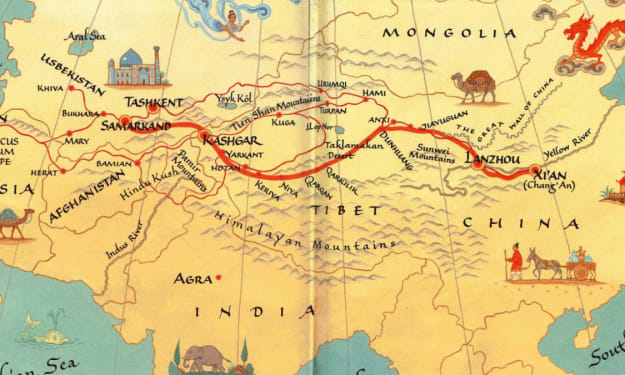
The Silk Road and Global Trade
The Silk Road stands as one of the most iconic and influential trade routes in history, connecting the East and West for centuries. Spanning over 6,000 kilometers, this ancient network of interconnected trade routes facilitated the exchange of goods, ideas, and culture between the diverse civilizations of Asia, Europe, and Africa. The Silk Road was not just a conduit for commodities; it was a conduit for knowledge, innovation, and cross-cultural understanding. This article explores the significance of the Silk Road in shaping the world's history and highlights the profound impact of cross-cultural exchange on human civilization.
By Reynol Brennan3 years ago in History
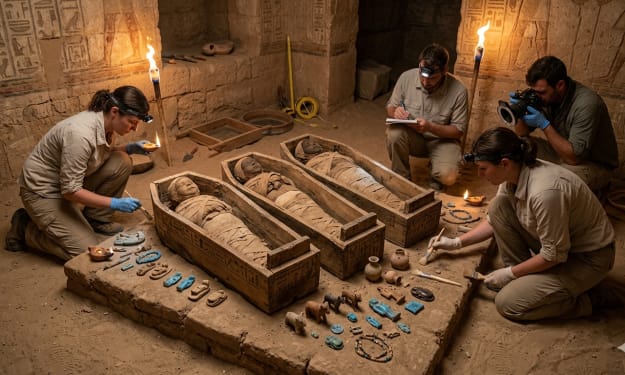
Ancient Egyptian Tomb Unearthed: 3,000-Year-Old Remains of Four Children Discovered
In a remarkable archaeological discovery in Egypt, researchers have uncovered the mummified remains of four children dating back nearly 3,000 years. The find, located in the southern region of Luxor, offers a rare glimpse into the lives, deaths, and funerary customs of young Egyptians during the New Kingdom period.
By Irshad Abbasi 4 days ago in History
Thief In The Night
To the thief in the night that took and replicated what once was mine: Honestly, I feel kind of bad for you. It’s funny, because we hardly know each other. I only know of you through the magazines you’ve written and the broadcasts you have televised in the past — as well as through the public mentions of you from your show business connections there.
By Snarky Lisa7 days ago in Humans


Comments
There are no comments for this story
Be the first to respond and start the conversation.