
Above the Law? Supreme Court Ruling on Presidential Immunity Sparks U.S. Protests"
From coast to coast, Americans rally against a controversial decision granting former presidents broad legal immunity—raising fears about democracy, accountability, and unchecked power.
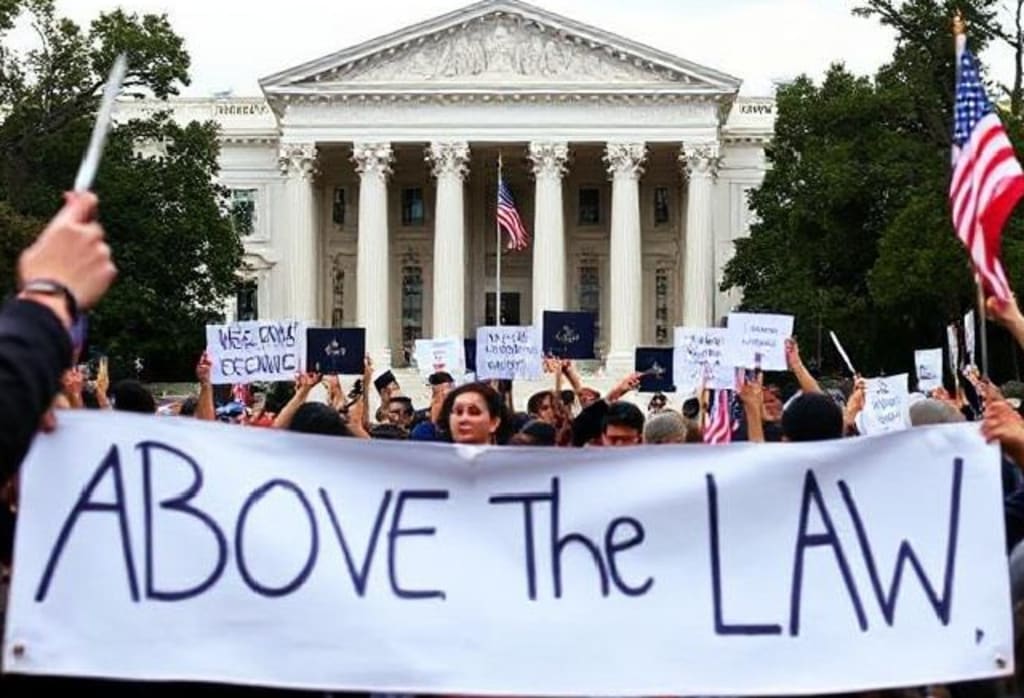
In one of the most consequential rulings in American judicial history, the U.S. Supreme Court on Monday granted former presidents substantial immunity from criminal prosecution for actions taken while in office. The decision, rendered in a 5–4 vote, has ignited a political firestorm, sending shockwaves across the country and plunging the nation into a fresh round of civic unrest.
The majority opinion, authored by Chief Justice John Roberts, stated that “a former president is entitled to immunity from criminal prosecution for conduct within the outer perimeter of his official responsibilities.” While the ruling refrains from granting absolute immunity in all circumstances, critics argue that it opens the door for future presidents to abuse power without fear of accountability.
Former President Donald Trump, who faces multiple indictments, including charges related to the January 6 insurrection, immediately celebrated the ruling as a “total victory for the Constitution and presidential power.” His legal team moved swiftly to pause ongoing cases, citing the Court’s decision.
A Nation Reacts: "No One is Above the Law"
The response from the public was swift and fierce. Within hours, protestors flooded major cities—New York, Chicago, Los Angeles, Atlanta, and beyond—holding banners that read “No Crown for Presidents,” “Justice Not Immunity,” and “Democracy Under Attack.” Organized by grassroots movements and civil rights groups, the demonstrations have largely remained peaceful, though tensions have flared in several locations.
“This is not about Trump,” said Mariah Jefferson, a law student marching in Washington, D.C. “This is about the future of every presidency. This is about whether we live in a democracy or a monarchy.”
In Philadelphia, a symbolic “funeral for accountability” was held in front of Independence Hall. Protesters dressed in colonial garb staged a reenactment of the Founding Fathers tearing up the Constitution—a visual metaphor for what many fear is happening in real time.
Political Fallout: Echoes Across Washington
On Capitol Hill, Democrats condemned the ruling as a dangerous overreach by the conservative-majority court. Senate Majority Leader Chuck Schumer called it “a seismic blow to the balance of power,” and House Democrats are reportedly considering legislative responses to clarify the limits of presidential immunity.
“This court has fundamentally misunderstood the role of the presidency,” said Rep. Jamie Raskin, a constitutional scholar. “This is not an imperial office. Presidents must be subject to the rule of law like every other citizen.”
Republicans, however, largely praised the decision, framing it as a necessary protection of executive authority. “Presidents must be able to make hard decisions without the threat of political prosecution hanging over them,” said Senator Josh Hawley. “This ruling restores constitutional clarity.”
Still, a minority of GOP lawmakers voiced concern. “Immunity must never become impunity,” said Senator Lisa Murkowski, breaking ranks with her party.
Legal Scholars Warn of Dangerous Precedent
Legal experts across the spectrum are weighing in, with many warning that the decision could reshape the nature of American governance. Harvard Law professor Laurence Tribe described it as “an open invitation for tyranny,” while former federal judge Michael Luttig, a conservative, warned it “destroys the very principle of checks and balances.”
“If a president can order the military to seize voting machines or instruct the IRS to target political enemies without legal consequence, where do we draw the line?” asked Yale constitutional law expert Akhil Reed Amar.
Others, including conservative think tanks like the Heritage Foundation, argue the decision simply reinforces the need for careful delineation of official vs. private conduct.
Media, Celebrities, and Public Sentiment
Social media exploded with commentary following the announcement. Hashtags like #NoOneAboveTheLaw, #DemocracyCrisis, and #SCOTUSFailure trended on X (formerly Twitter). Celebrities including Mark Ruffalo, Kerry Washington, and Leonardo DiCaprio voiced their concern.
“The Constitution is not a cloak of invisibility,” wrote Ruffalo. “It’s a shield for the people. We cannot let this stand.”
A nationwide poll conducted by Quinnipiac University just two days after the ruling shows that 68% of Americans disagree with the decision, including 42% of Republican voters. The numbers reflect a growing anxiety about the future of accountability in American politics.
What Comes Next?
While the ruling is final, its implications are still unfolding. Legal analysts say Trump’s trials will be significantly delayed, if not entirely derailed. Prosecutors must now revisit their cases and prove that certain actions were not “official duties”—a high bar that could be open to wide interpretation.
In the meantime, civic action is surging. Petitions, protest marches, and voter registration drives are accelerating as citizens brace for what could be one of the most contentious election seasons in U.S. history.
“If the courts won’t hold presidents accountable, then we must,” said Jasmine Delgado, a high school civics teacher speaking at a rally in Austin, Texas. “We still have the ballot box. We still have our voices.”
But as dusk falls over the Capitol and protestors light candles outside the Supreme Court, the mood remains uncertain—half defiance, half dread.
Democracy, once taken for granted, now feels like something Americans must fight for all over again.
About the Creator
Lal Sher Khan
writer
Keep reading
More stories from Lal Sher Khan and writers in History and other communities.
Fire in the Crescent: The 2025 Israel-Iran Conflict and the Fractured Path to Peace
By: Lal Sher Khan The morning of June 13, 2025, dawned like any other in Tehran. But within minutes, the sky turned to fire. What began as the faint sound of jets over the city quickly turned into an orchestrated barrage. Israel, for the first time in history, launched a full-scale direct military operation against Iran, striking deep into the heart of the Islamic Republic.
By Lal Sher Khan 7 months ago in History
Military Strength of Alexander the Great and the Chola Empire: A Historical Comparison
Though separated by more than a thousand years and operating in vastly different geographical and cultural contexts, both forces achieved extraordinary success through discipline, innovation, and strategic brilliance. This article explores the history, composition, size, organization, and military strength of Alexander’s Macedonian army and the Chola military, highlighting how each became a dominant power of its era.
By Say the truth 5 days ago in History


Comments
There are no comments for this story
Be the first to respond and start the conversation.