
"A Map of Invisible Things"
"What We Lose, and What We Carry"

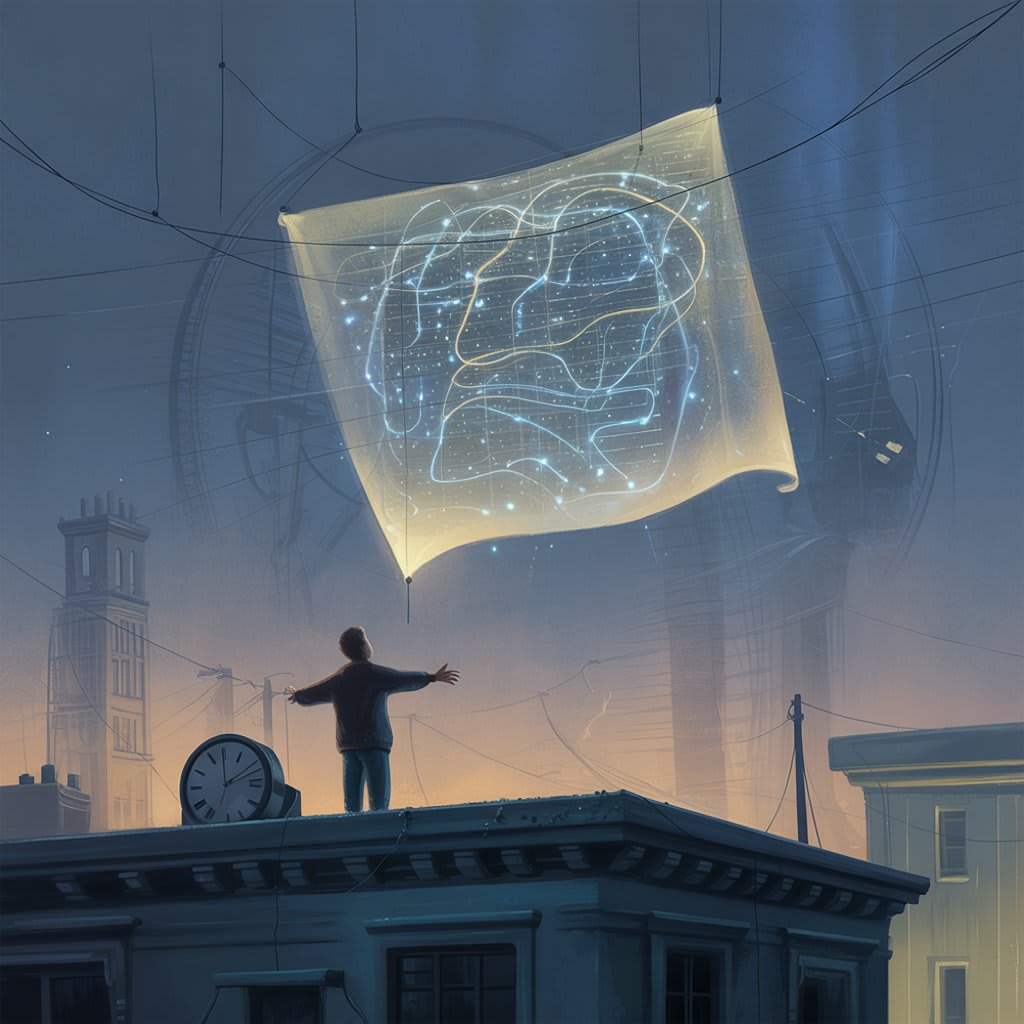
It was folded between the pages of an old ledger in his attic, tucked beneath a pile of newspapers from the 1960s. The paper was brittle at the edges, yellowed by time, but the ink was clear — delicate black lines looping and spiraling like constellations. At first glance, it looked like a child’s drawing, chaotic and nonsensical. But something about it felt… deliberate.
There were no street names, no landmarks. Only circles, arrows, and odd notes scribbled in the margins:
Where I first saw her smile
A conversation I regret
Where I lost my temper
A bench that never judged me
I sat down on the floor, my legs half-asleep, staring at the map. It didn’t make sense. Not in the way a map is supposed to. And yet, something in my chest stirred — a strange, tight ache I didn’t know I’d been carrying.
My grandfather, Elias, had never been a sentimental man. He was quiet and practical, the type to fix a squeaky door before anyone noticed it squeaked. When my parents divorced, I stayed with him for a year. He never said much, but he always left the porch light on. Somehow, I knew that meant more than words.
I folded the map gently and put it in my bag.
Over the next week, I walked the town, trying to match the loops and arrows to real places. It felt absurd at first — tracing invisible memories of someone else. But then I found the tree.
It was marked only as The apology that never came. The map's shape placed it near the edge of a park I barely remembered, and when I saw the tree, tall and cracked down the middle like a wound, I knew. This was it.
A memory returned, uninvited.
I was ten. Crying beneath that tree because my father had forgotten my birthday. Again. Elias found me there, sat beside me, and told me about his own father — a man who could build boats but couldn’t say "I’m proud of you" if his life depended on it.
"Sometimes people carry their love the wrong way," he’d said.
Back then, I hadn’t understood what he meant. Now I did.
Over the next month, I followed the map.
There was the corner near the library marked Where I almost told the truth.
A stretch of old railway tracks labeled Where I forgave myself — finally.
A rusted swing set: Her laughter echoed here for years.
Each place triggered something — not always a memory of my own, but a feeling. As if the map wasn’t just Elias’s. As if it had soaked into the soil, into the benches and tree roots, waiting for someone to listen.
It began to change how I saw the world.
I noticed the quiet couple in the coffee shop who always sat without speaking, but never without touching. The man who read the same poem aloud every morning in the park. The woman who swept her porch twice a day, as though waiting for someone to come home.
Everyone, I realized, was carrying invisible things. Regrets. Hopes. Words they never said. Apologies they rehearsed but never gave.
Maybe Elias had understood that better than anyone.
The final mark on the map was a red X, labeled simply Here I left it. I followed it to a small hill behind the church, where the grass grew wild and uncut. There was nothing there — no bench, no plaque, no secret buried under stone. Just wind and sky.
I sat down.
I stayed there a long time, listening.
I think I finally understood.
He hadn’t made the map for me. He made it for himself — to remember where he had loved, where he had failed, and where he had found peace. But in doing so, he gave me something far greater.
He gave me a way to see the world not as it is on the surface, but as it is beneath — full of invisible moments that shape us, guide us, sometimes even heal us.
I still carry the map, folded in my coat pocket. Not because I need directions, but because sometimes, when the day feels too heavy or the world too loud, I unfold it and remember:
Some of the most important places in life can’t be found on any ordinary map.
They’re written in the quiet, carried in the heart, and if you’re lucky, passed on — from one soul to another.
About the Creator
junaid ali
"storyteller with a curious mind. i write to explore emotions, moments, and ideas that connect us all. join me a journey through words, imagination,and real life reflection."
Keep reading
More stories from writers in History and other communities.
Alexander the Great: The Life, Conquests, Vision, and Legacy of History’s Greatest Warrior King
Part 1: Birth and Early Life Alexander was born in 356 BCE in Pella, the capital of Macedonia. He was the son of King Philip II of Macedon and Queen Olympias. From an early age, Alexander was surrounded by power, politics, and warfare. Olympias deeply influenced him, often telling him that he was descended from Achilles and even the god Zeus. These stories shaped Alexander’s belief that he was destined for greatness.
By Say the truth 4 days ago in History
Our Song
Evening has given way to night. Gently, I settle next to you on the comfortable, old love seat and reach for your hand. You snatch it away, again. It cuts me to the quick, but I hide the pain, understanding that the reaction is but part of your demented state. Since the accident, your presence here in our cozy home has been clouded by a haze I can't see. Nevertheless, I feel the frigidity of your expressions and it serves as an excruciating reminder of the immeasurable distance between us.
By Dana Crandell4 days ago in Fiction


Comments
There are no comments for this story
Be the first to respond and start the conversation.