
A Love Beyond the Iceberg
A Tragic Tale of Love, Loss, and Destiny on the World's Most Famous Ship
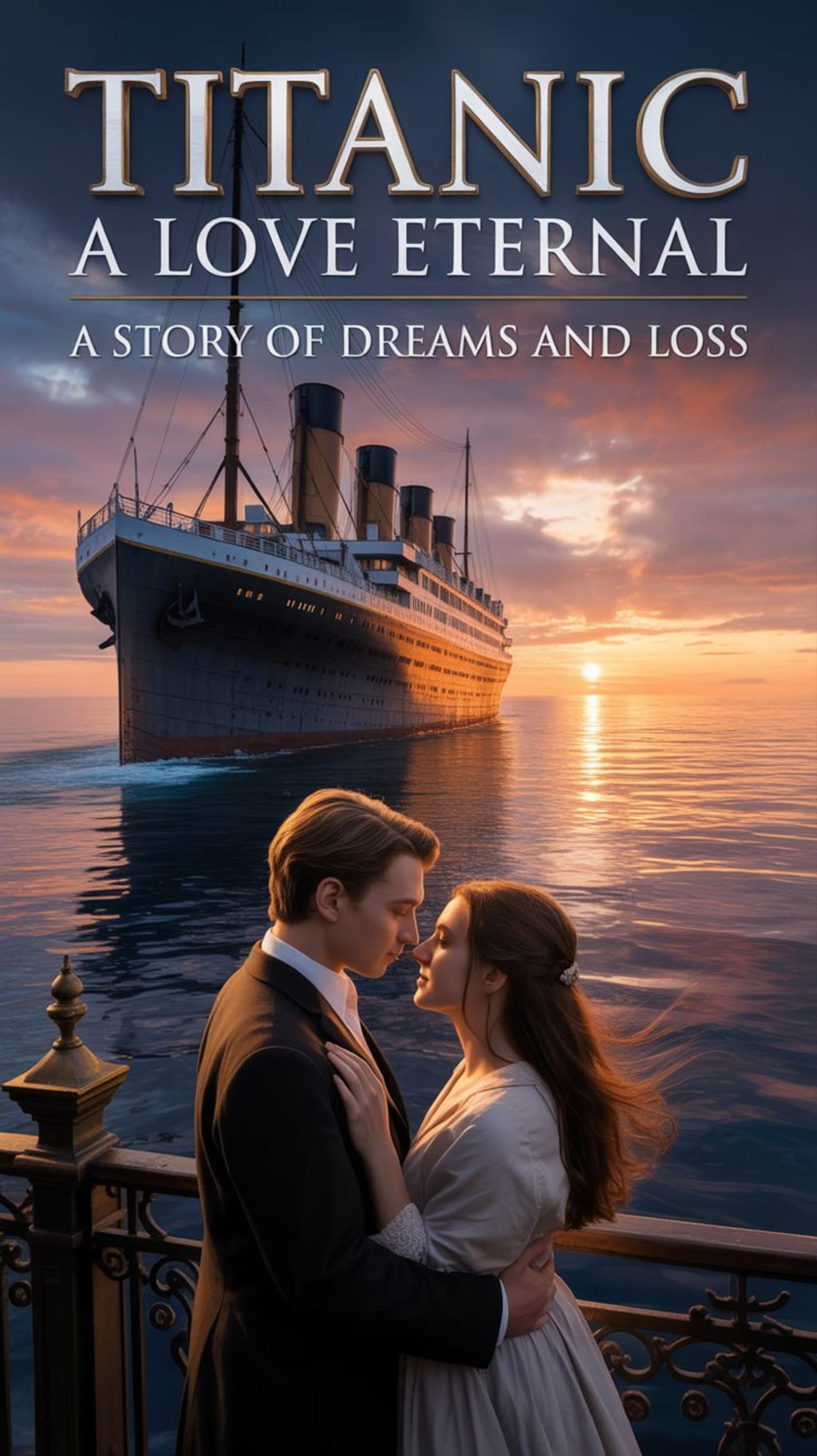
In April 1912, the Titanic, the largest and most luxurious ocean liner ever built, prepared for its maiden voyage from Southampton to New York City. Among the thousands of passengers aboard were people of all classes—some seeking adventure, others escaping the past, and a few simply returning home. But for two souls, this voyage would become the most significant event of their lives.
Rose DeWitt Bukater, a seventeen-year-old from a wealthy family, boarded the Titanic with her mother and fiancé, Cal Hockley. Although surrounded by wealth and privilege, Rose felt trapped in a life she had not chosen. Her engagement to Cal was not out of love but societal pressure and financial need.
Meanwhile, Jack Dawson, a struggling artist from Wisconsin, won a third-class ticket in a poker game just hours before departure. With nothing but a sketchbook, a heart full of dreams, and a friend named Fabrizio, Jack stepped onto the Titanic full of hope.
Their worlds collided on the third evening at sea. Rose, overwhelmed by her restrictive life and Cal’s controlling nature, tried to take her own life at the stern of the ship. Jack, walking nearby, saw her climbing over the rail and rushed to her aid. “Don’t do it!” he called. After a tense exchange, Jack managed to pull her back to safety.
Grateful and intrigued, Rose found herself drawn to Jack’s honesty and free spirit. Over the next few days, they spent time together, walking on the deck, laughing, and sharing their dreams. Jack showed Rose a side of life she had never known—filled with creativity, freedom, and passion.
Jack’s influence began to change Rose. She questioned her arranged engagement, her mother’s expectations, and the aristocratic society that cared more about appearances than happiness. Jack, in turn, saw in Rose a soul that was misunderstood and longing to break free.
One night, Rose asked Jack to draw her portrait. She wore only the Heart of the Ocean, a rare diamond necklace Cal had gifted her. The moment was intimate, artistic, and powerful. Jack captured not just her beauty but her transformation—no longer a girl trapped in expectation, but a woman awakening to her own choices.
But the bliss was short-lived.
On April 14, just before midnight, the Titanic struck an iceberg. The impact was jarring but not immediately understood by most passengers. As chaos unfolded, Jack and Rose tried to stay together. Cal, furious at Rose’s betrayal, framed Jack for theft and had him arrested. But with Rose’s help, Jack was freed just as the ship began to sink.
As water flooded the lower decks, lifeboats were launched—women and children first. Cal tried to manipulate Rose into boarding a lifeboat, but she refused to leave Jack. They fought their way through the panicked crowds, dodging rising water and falling debris.
Eventually, the Titanic broke apart and sank into the freezing Atlantic. Jack and Rose managed to stay afloat on a piece of wooden debris. But it wasn’t big enough for both. Jack, knowing the icy water was a death sentence, gave Rose the spot and held her hand, urging her to “never let go” of her dreams.
By dawn, the RMS Carpathia arrived and rescued the survivors. Jack had succumbed to the cold, but Rose lived. At the rescue ship, she gave a false name—Rose Dawson—and disappeared into a new life, away from the control of her mother and Cal.
As the RMS Carpathia steamed toward New York with the survivors of the Titanic disaster, Rose stood silently among the rescued, wrapped in a blanket. She had lost everything—her fiancé, her mother’s approval, her belongings—but what hurt most was losing Jack. Yet, in that loss, she had gained something far greater: herself.
She whispered her new name, Rose Dawson, when asked by the immigration officer. She wanted nothing to do with the life of Rose DeWitt Bukater. That name belonged to the girl who had nearly leapt from a ship’s railing in despair. Jack had pulled her back—not just physically, but emotionally, spiritually.
In New York, she wandered the city streets alone. Her mother, believing her dead, returned to Philadelphia with Cal. Rose had no money, no contacts—but she had Jack’s sketches, his words, and her determination. She pawned a hairpin for a small room and began working as a seamstress. Every stitch reminded her of survival.
Years passed. Rose studied art, worked in a cafe, and eventually moved west. She rode horses like Jack said he wanted to. She saw the Santa Monica Pier he once mentioned. She even learned to spit over the side of a boat with abandon. All the small things he’d said in passing became a checklist for her new life.
But the pain of the Titanic never truly left her.
Every April, she would light a candle in Jack’s memory. She never remarried. She loved, yes—but never the same way. No man could match what Jack had sparked in her in those brief, powerful days aboard the Titanic.
In her later years, Rose became a teacher, helping children express themselves through drawing. She kept Jack’s sketchbook hidden in a trunk, along with the famous Heart of the Ocean necklace, which she had kept all these years. She never sold it, never wore it again. To her, it wasn’t just a jewel—it was a symbol of everything she left behind.
Then, nearly 84 years later, when treasure hunters discovered the Titanic wreck and launched a televised expedition, Rose, now in her 100s, saw the footage. Memories flooded back. She contacted them not for fame—but to tell the real story of the ship. The human story. Her story.
Standing at the edge of the research vessel, she looked out at the sea. She clutched the necklace one final time and whispered, “You jump, I jump, right?” before letting it slip into the deep ocean, returning it to Jack, to the Titanic, and to the past.
In her dreams that night, Rose walked again through the grand staircase of the Titanic. The chandeliers sparkled. The music played softly. And there at the clock stood Jack, waiting, smiling.
About the Creator
The Invasion of Kuwait: Saddam’s Four-Day ‘Revolutionary Republic
On August 2, 1990, the world woke up to a geopolitical earthquake. Under the orders of Saddam Hussein, over 100,000 Iraqi troops, backed by hundreds of tanks, surged across the border into the tiny, oil-rich emirate of Kuwait. While history remembers this as the spark for the Gulf War, the first few days of the occupation featured a bizarre political theater: the creation of a short-lived puppet state known as the **"Republic of Kuwait."**
By Irshad Abbasi 7 days ago in History
Hottest in the Office
Dear Rafi, You’re very distracting to work around. For the first second I saw you the other day, I thought you were some type of executive. It took a moment to realize no, you were just the new guy, dressed up for the job he wants. Be still, my heart.
By Gabriel Shames4 days ago in Pride




Comments
There are no comments for this story
Be the first to respond and start the conversation.