
A Life of Integrity and Leadership
From Log Cabin to White House—The Remarkable Journey of America’s 16th President

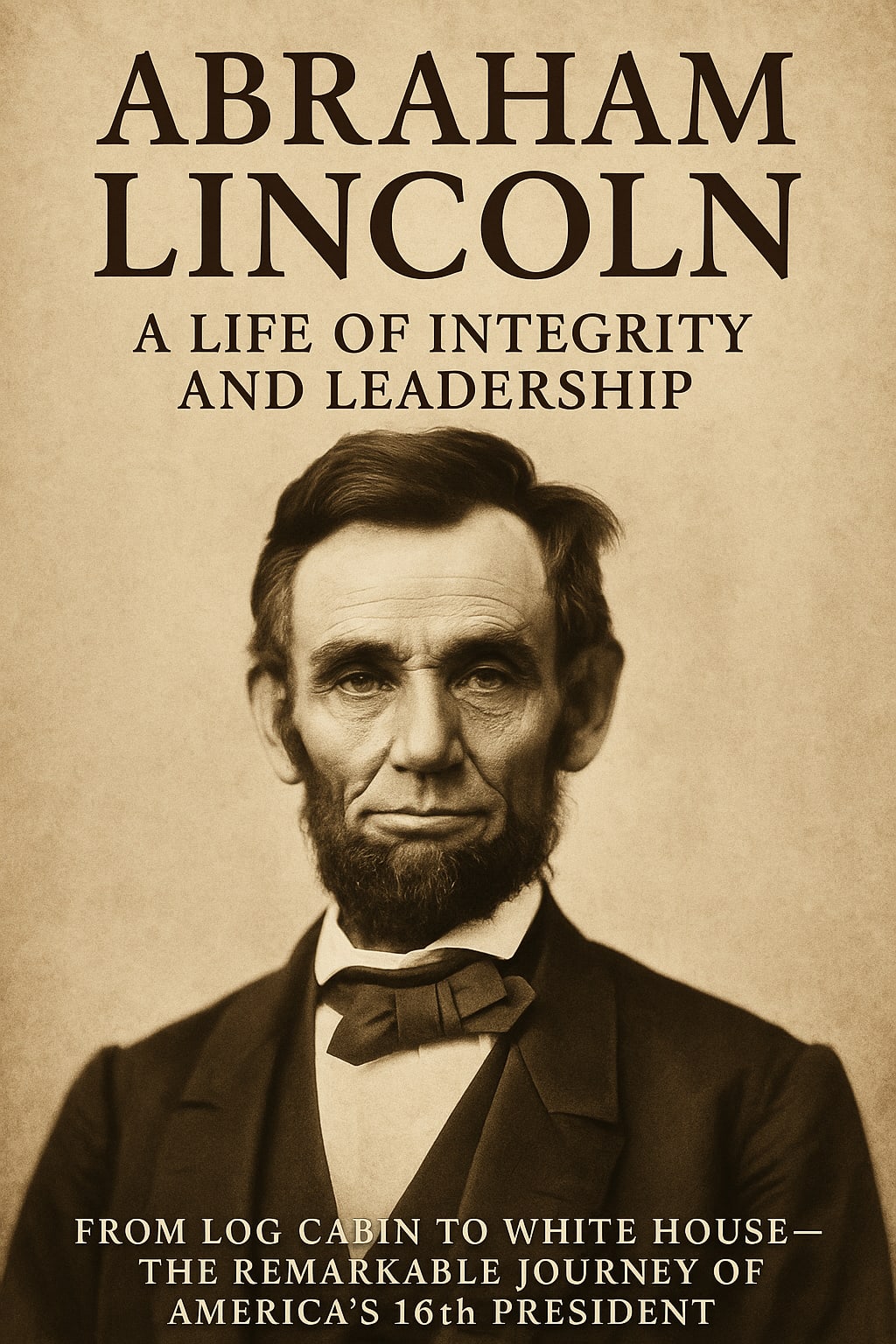
Abraham Lincoln, the 16th president of the United States, stands as one of the most revered figures in American history. Known for his steadfast moral compass, eloquent speeches, and unwavering commitment to justice and unity, Lincoln’s life is a profound story of perseverance, vision, and leadership.
#### **Early Life and Humble Beginnings**
Born on February 12, 1809, in a one-room log cabin in Hardin County (now LaRue County), Kentucky, Abraham Lincoln came from humble roots. His parents, Thomas and Nancy Lincoln, were hardworking pioneers who instilled in him the values of honesty and resilience. The family faced many hardships, including the early death of Nancy when Lincoln was just nine years old. This loss deeply affected him and marked the beginning of a lifetime shaped by adversity.
Lincoln’s early education was sparse and informal, amounting to less than a year of classroom instruction. However, his love for learning was insatiable. He borrowed books whenever he could—among them the Bible, Aesop's Fables, and Shakespeare—which fueled his intellectual growth. This self-education laid the foundation for his extraordinary command of language and logic.
#### **From Manual Labor to Law**
In his youth, Lincoln worked as a rail-splitter, store clerk, and surveyor. He also served in the Illinois militia during the Black Hawk War of 1832. Though he saw no combat, he was elected captain by his peers—an early sign of the leadership qualities that would define his future.
Lincoln eventually turned to law and politics. In 1834, he was elected to the Illinois State Legislature as a member of the Whig Party. Around the same time, he began to study law in earnest. By 1836, he passed the bar exam and began practicing in Springfield, Illinois. As a lawyer, Lincoln gained a reputation for honesty and fairness, earning the nickname “Honest Abe.”
#### **A Rising Political Star**
Lincoln's early political career was marked by his opposition to the spread of slavery. Though initially moderate in his stance, he became more vocal as tensions between the North and South intensified. In 1854, the Kansas-Nebraska Act, which allowed new territories to decide the slavery question themselves, deeply disturbed him. He re-entered the political arena with renewed urgency.
In 1858, Lincoln famously debated Stephen A. Douglas during the Illinois Senate race. Though he lost the election, the *Lincoln-Douglas Debates* elevated him to national prominence. In these speeches, Lincoln argued that slavery was morally wrong and should not be allowed to expand, though he stopped short of advocating for immediate abolition.
#### **The Road to the Presidency**
In 1860, Lincoln won the Republican nomination for president. His moderate but firm anti-slavery views appealed to a wide spectrum of Northern voters. On November 6, 1860, he was elected the 16th president of the United States. His election prompted seven Southern states to secede from the Union before he even took office.
Lincoln entered the presidency at the nation’s most perilous moment. With the country on the brink of civil war, he called for unity but prepared for conflict. When Confederate forces attacked Fort Sumter in April 1861, the Civil War began.
#### **Leading Through the Civil War**
Lincoln’s leadership during the Civil War was marked by moral clarity, political skill, and deep empathy. He faced criticism from all sides—radicals thought he moved too slowly on emancipation, while conservatives feared his policies were too drastic. Despite these pressures, Lincoln held firm in his belief that the Union must be preserved.
One of Lincoln’s most enduring achievements was the Emancipation Proclamation, issued on January 1, 1863. It declared that all slaves in Confederate-held territory were to be set free. While it did not end slavery entirely, it redefined the war as a fight for human liberty and gave the North a moral cause that rallied support both at home and abroad.
Lincoln also championed the passage of the 13th Amendment, which would permanently abolish slavery in the United States. His relentless efforts helped ensure its passage by Congress in January 1865.
#### **A Gifted Communicator**
Lincoln's oratory remains some of the most powerful in American history. His speeches, such as the **Gettysburg Address**—a mere 272 words—distilled the essence of American ideals with poetic clarity. In it, he reaffirmed the principles of equality and democracy, honoring those who died so that “government of the people, by the people, for the people shall not perish from the earth.”
His Second Inaugural Address, delivered in March 1865, offered a tone of reconciliation rather than vengeance. “With malice toward none, with charity for all,” Lincoln urged Americans to heal and rebuild a broken nation.
#### **Assassination and Legacy**
Just days after General Robert E. Lee surrendered at Appomattox Court House, effectively ending the Civil War, Lincoln was tragically assassinated. On April 14, 1865, while attending a play at Ford’s Theatre in Washington, D.C., he was shot by Confederate sympathizer John Wilkes Booth. He died the next morning, plunging the nation into mourning.
Lincoln’s death was a profound national tragedy. Yet his legacy endured and grew. He is widely regarded as the greatest American president for preserving the Union, ending slavery, and elevating the moral tone of the nation’s politics.
#### **Conclusion**
Abraham Lincoln’s life embodies the American ideal that greatness can arise from humble beginnings. Through integrity, intellect, and an unwavering commitment to justice, he guided the nation through its darkest hour. He not only preserved the Union but also redefined its meaning.
Today, Lincoln stands not only as a historical figure but as a symbol of what strong, principled leadership looks like. His legacy continues to inspire generations who believe in the power of democracy, equality, and the enduring strength of the human spirit.
About the Creator
Irshad Abbasi
Ali ibn Abi Talib (RA) said 📚
“Knowledge is better than wealth, because knowledge protects you, while you have to protect wealth.
Keep reading
More stories from Irshad Abbasi and writers in History and other communities.
The Life and Legacy of Spain's Dictator
Francisco Franco Bahamonde was one of the most controversial figures of the 20th century. Rising from a relatively obscure military background to become the authoritarian ruler of Spain, Franco shaped the country's politics, culture, and global relationships for nearly four decades. His legacy continues to spark intense debate among historians, politicians, and the public.
By Irshad Abbasi 9 months ago in History
Echoes in the Attic
When Sameer inherited his grandmother’s old house, he thought it would be just another quiet retreat from city life. The mansion, perched on a hill, had stood empty for years, its walls whispering memories of the past. But as he stepped inside, he sensed that something else had been waiting for him.
By Waleed khanabout 17 hours ago in History


Comments (1)
Lincoln's story is inspiring. His humble start and self-education show that determination can lead to great things. I relate to his love for learning.