
The Life and Legacy of Spain's Dictator
From Civil War General to Authoritarian Ruler – The Rise, Reign, and Impact of Francisco Franco on Modern Spain

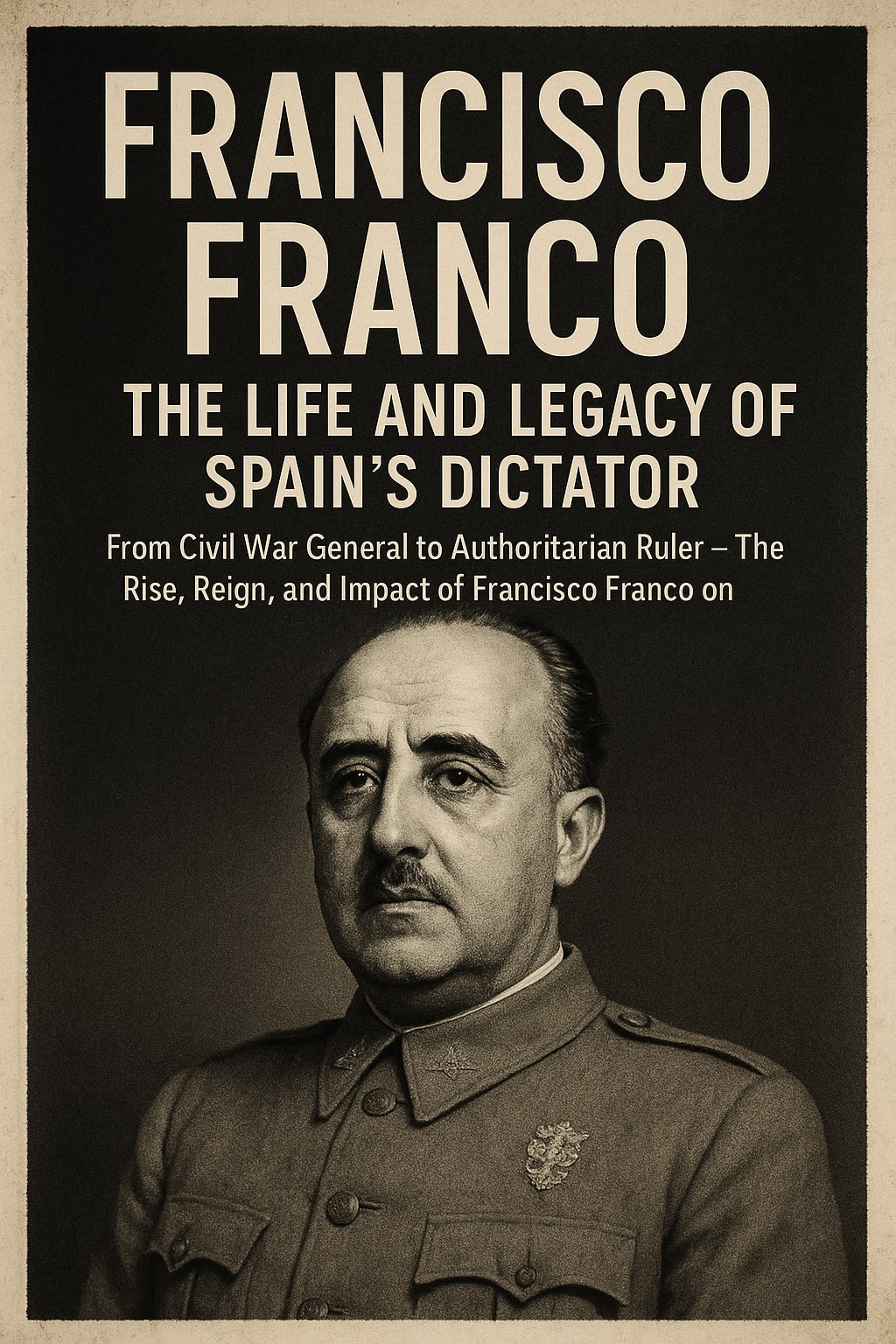
Francisco Franco Bahamonde was one of the most controversial figures of the 20th century. Rising from a relatively obscure military background to become the authoritarian ruler of Spain, Franco shaped the country's politics, culture, and global relationships for nearly four decades. His legacy continues to spark intense debate among historians, politicians, and the public.
### Early Life and Military Career
Francisco Franco was born on December 4, 1892, in Ferrol, a naval town in Galicia, northwestern Spain. Coming from a family with a long military tradition, Franco entered the Infantry Academy in Toledo at age 14. His early years were marked by ambition and discipline, setting him apart from many of his peers.
Franco's military career began in earnest in Spanish-controlled Morocco, where he gained recognition for his bravery and leadership. By the age of 33, he had become the youngest general in Europe. This rapid rise through the ranks established him as a prominent figure within the conservative military elite.
### The Second Spanish Republic and Political Tensions
The early 1930s were a turbulent time in Spanish history. The monarchy was overthrown in 1931, giving rise to the Second Spanish Republic—a progressive government that sought to implement social, economic, and agrarian reforms. However, these reforms were deeply unpopular with conservative and religious factions, including much of the military.
Franco was initially cautious during these years. He avoided overt political involvement and accepted various commands, including a brief stint as director of the General Military Academy. However, the polarization between leftist Republicans and right-wing Nationalists grew increasingly violent, setting the stage for a full-scale conflict.
### The Spanish Civil War (1936–1939)
The turning point in Franco's life came in July 1936 when a group of right-wing generals launched a coup against the Republican government. Franco quickly emerged as the leader of the Nationalist forces. With support from Fascist Italy and Nazi Germany, he led a brutal military campaign marked by atrocities on both sides.
The Spanish Civil War was a deeply ideological conflict, pitting communists, anarchists, and republicans against monarchists, fascists, and conservatives. Franco’s leadership was ruthless but effective. In 1939, after nearly three years of conflict and an estimated 500,000 deaths, the Nationalists emerged victorious.
### Franco’s Dictatorship
Upon winning the war, Franco established a military dictatorship, ruling Spain as "Caudillo" (leader). His regime was marked by severe repression, censorship, and the suppression of political opposition. Leftist sympathizers, intellectuals, and regional nationalists (especially in Catalonia and the Basque Country) were often imprisoned, tortured, or executed.
Franco banned political parties (except for his own, the Falange), trade unions, and other institutions of civil society. Spain was isolated from much of the international community during and after World War II, partly because of Franco's initial alignment with Axis powers. However, Spain remained officially neutral during the war, avoiding occupation or direct involvement.
### The Cult of Personality and Ideological Control
Franco cultivated a cult of personality, presenting himself as the savior of Spain from communism and moral decay. Nationalist Catholicism became the ideological foundation of the state. The Catholic Church regained power in education and social policy, and traditional family values were enforced by law.
Censorship was rampant, and the regime controlled all major media outlets. Education emphasized loyalty to Franco, Spanish nationalism, and Catholic doctrine. Languages other than Castilian Spanish were discouraged or outright banned in public life.
### Economic Development and the Cold War
Despite initial economic stagnation and autarky (economic self-sufficiency), Franco eventually opened Spain's economy in the 1950s and 1960s. With help from American investment—especially after aligning with the U.S. during the Cold War—Spain experienced rapid economic growth, known as the "Spanish Miracle." Tourism, industrialization, and foreign capital transformed the country, improving living standards for many Spaniards.
Franco’s anti-communist stance gained him allies in the West, especially as the Cold War intensified. In 1955, Spain was admitted to the United Nations, and in 1969, Franco even selected his successor—Prince Juan Carlos de Borbón, grandson of the deposed king Alfonso XIII—hoping to ensure a controlled transition.
### Decline and Death
As Franco aged, his grip on power loosened, but he resisted significant reforms. His government grew increasingly out of touch with younger Spaniards who yearned for democracy and openness. Nonetheless, Franco maintained tight control until his health declined in the early 1970s.
Francisco Franco died on November 20, 1975, after a prolonged illness. His death marked the end of a dictatorship that had lasted 36 years. Shortly afterward, King Juan Carlos initiated a peaceful transition to democracy, dismantling the Francoist system in a process known as the "Spanish Transition."
### Legacy and Controversy
Franco’s legacy is deeply divisive. To some, especially older conservatives and traditionalists, he is remembered as a stabilizing force who prevented the spread of communism and preserved Spanish unity. To many others, he is a symbol of authoritarianism, repression, and brutality.
Efforts to come to terms with his legacy continue. In 2007, Spain passed the "Historical Memory Law," which aimed to recognize and support victims of the Civil War and Francoist repression. Monuments, statues, and symbols honoring Franco have been removed from public spaces, and his remains were exhumed from the Valley of the Fallen in 2019 to reduce their symbolic weight in national memory.
### Conclusion
Francisco Franco’s impact on Spain is undeniable. He ruled with an iron fist, shaping nearly every aspect of Spanish life for generations. His rise from colonial officer to autocrat was marked by strategic acumen, political ruthlessness, and unwavering ideological conviction.
While Spain has since embraced democracy and moved beyond his shadow, debates about Franco’s role in history remain potent. Whether viewed as a patriot or a tyrant, his biography serves as a profound reminder of the costs and consequences of authoritarian rule in the modern era.
About the Creator
Irshad Abbasi
"Studying is the best cure for sorrow and grief." shirazi
Keep reading
More stories from Irshad Abbasi and writers in History and other communities.
The Lion of Britain
Sir Winston Leonard Spencer Churchill, often remembered as the indomitable “Lion of Britain,” led a life defined by extraordinary resilience, rhetorical mastery, and a tenacious commitment to his nation. Born on November 30, 1874, at Blenheim Palace in Oxfordshire, England, Churchill came from aristocratic lineage. His father, Lord Randolph Churchill, was a prominent Conservative politician, and his mother, Jennie Jerome, was an American socialite. From a young age, Churchill was determined to forge his own path, often at odds with tradition and expectation.
By Irshad Abbasi 8 months ago in History
"The Power of Belief: Ideology in the Roman Kingdom"
The Rise of Ideology in the Roman Kingdom In the earliest days of Rome, long before it became a republic or an empire, the Roman Kingdom was bound together by more than kings, armies, or stone walls. What truly unified Rome was a powerful and carefully shaped ideology—one that defined how Romans understood authority, duty, morality, and identity. This ideological foundation transformed a small settlement on the banks of the Tiber River into a disciplined and resilient civilization, prepared to rule others long after its kings were gone.
By The best writer 6 days ago in History
THE TREASURE IN THE FOREST
The canoe drifted quietly toward the island, where a wide bay opened beneath a blazing sky. A narrow gap in the white reef marked the mouth of a small river, its path visible by the darker green of thick forest spilling down the hillside. Beyond it, mountains rose like frozen waves. The sea was calm, almost unnaturally so.
By Faisal Khan6 days ago in History


Comments
There are no comments for this story
Be the first to respond and start the conversation.