
A Kingdom of Power and Culture
Exploring the History, Society, and Achievements of South America’s Greatest Empire

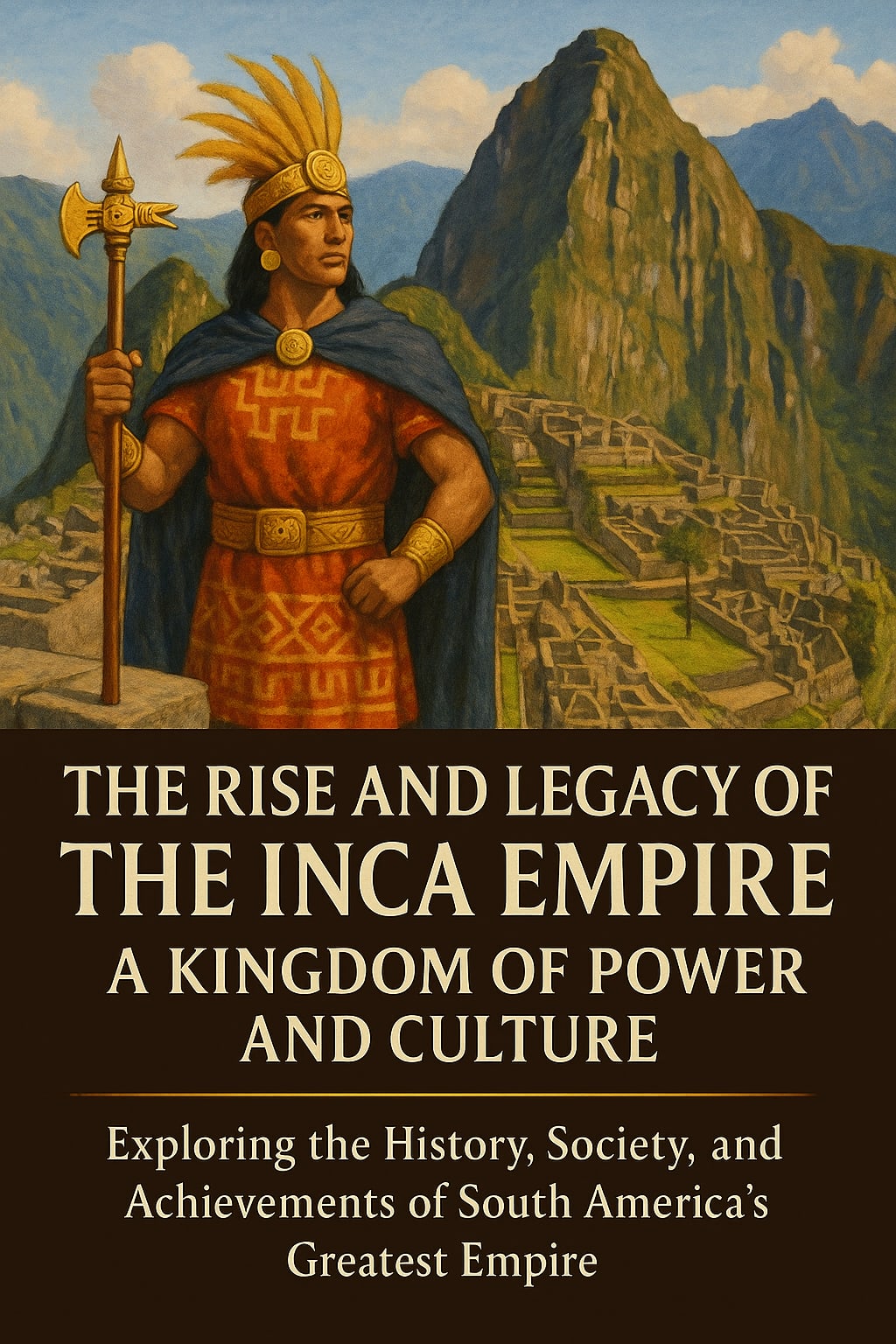
The Inca Empire, or *Tawantinsuyu* as it was known in its native Quechua language, stands as the most remarkable and expansive empire in South America before European contact. Emerging from the highlands of Peru in the early 13th century, the Incas built a civilization that, at its peak in the early 16th century, stretched over 2,500 miles from present-day Colombia to central Chile. With a population estimated at over 10 million people and an intricately organized society, the Inca left an enduring legacy in architecture, engineering, agriculture, and administration that continues to fascinate historians and archaeologists today.
### Origins and Expansion
The mythological origins of the Inca Empire begin with Manco Cápac and Mama Ocllo, children of the sun god Inti, who are said to have emerged from Lake Titicaca to found the city of Cusco. Historically, the Incas were a small Andean tribe that began to assert dominance over neighboring groups in the early 1200s. By the mid-15th century, under the leadership of the visionary Emperor Pachacuti, the empire rapidly expanded through both conquest and diplomacy. Pachacuti not only transformed Cusco into a grand imperial capital but also reorganized the government and initiated infrastructure projects that unified the growing territory.
The empire's expansion continued under Pachacuti’s successors, especially his son, Topa Inca Yupanqui, and grandson, Huayna Capac. Through military might and strategic alliances, they brought diverse cultures and regions under Inca control, weaving together a vast and culturally diverse empire that included the Andean highlands, coastal deserts, and Amazonian edges.
### Political Structure and Governance
The Inca Empire was a highly centralized state with the Sapa Inca—the emperor—at its head, considered both a political leader and a divine figure descended from the sun god. Below him was a hierarchical administration system, with provincial governors overseeing various regions. Each region was subdivided into smaller units, all connected by a standardized system of tribute and labor known as **mit’a**.
The **mit’a** system was a labor tax that required citizens to contribute work to state projects, such as building roads, temples, or agricultural terraces. In return, the state provided food, clothing, and protection, forming the basis of a redistributive economy. Unlike European feudal systems, the Inca model was not based on monetary transactions but on reciprocal obligations, a concept deeply rooted in Andean tradition.
This complex bureaucracy was remarkably effective at managing resources across vast and varied terrains. State-run warehouses stored surplus food and supplies to be redistributed during times of famine or hardship, showcasing an early form of social welfare.
### Infrastructure and Engineering Feats
One of the most astonishing achievements of the Inca civilization was their mastery of engineering and infrastructure. They developed an extensive network of roads and bridges, collectively known as the **Qhapaq Ñan**, or Royal Road, which spanned over 25,000 miles. This network enabled rapid communication and movement of armies and goods across the empire’s difficult terrain. Along these roads, relay messengers called **chasquis** carried messages encoded in **quipus**—knotted strings used for record-keeping.
Their architectural prowess is best exemplified in the city of **Machu Picchu**, perched high in the Andes and built with precisely cut stone that has withstood centuries of earthquakes without mortar. The Incas also constructed agricultural terraces that prevented soil erosion and maximized arable land on steep mountainsides. Ingenious irrigation systems and canal networks helped sustain crops such as maize, quinoa, and over 3,000 varieties of potatoes.
### Society and Culture
Inca society was deeply communal and structured. It was divided into **ayllus**, or kinship groups, which formed the basic unit of rural society. Each ayllu worked collectively on land assigned by the state and shared responsibilities for mutual survival. These communal bonds ensured strong social cohesion and resilience in the face of hardship.
Religion played a central role in Inca life. The Incas worshipped a pantheon of gods, with **Inti** the sun god being supreme. Temples such as **Coricancha** in Cusco were dedicated to Inti and adorned with gold, symbolizing sunlight. Rituals, sacrifices (mostly of llamas, but occasionally humans), and festivals were integral to religious life, intended to maintain harmony between the natural and spiritual worlds.
Artisans excelled in textiles, metallurgy, and ceramics. Inca textiles, made from alpaca and vicuña wool, were highly prized and often more valuable than gold. Their metalwork, though not used for weapons, displayed remarkable skill in crafting ceremonial knives, jewelry, and religious icons from gold, silver, and bronze.
### Fall of the Empire
Despite its strength, the Inca Empire fell swiftly to a small band of Spanish conquistadors led by **Francisco Pizarro** in 1532. The timing was crucial. The empire was weakened by a recent civil war between two royal brothers, Atahualpa and Huáscar, over succession. The population had also been devastated by European diseases like smallpox, which had spread ahead of the Spaniards due to earlier contact with infected traders.
Using superior weaponry, deceit, and alliances with discontented indigenous groups, Pizarro captured Atahualpa in a surprise ambush and later executed him, despite receiving a massive ransom in gold. The empire fragmented, and resistance collapsed rapidly, though rebellions persisted for decades in remote areas.
### Legacy
Though the Inca Empire lasted for only about a century as a major imperial power, its influence has been profound and lasting. Many aspects of Inca infrastructure, such as terracing and irrigation, are still in use today in the Andes. Quechua, the Inca language, remains spoken by millions across South America and is recognized as an official language in countries like Peru and Bolivia.
Machu Picchu and other Inca sites draw millions of tourists each year and stand as testament to the architectural genius and cultural richness of this civilization. The Inca concept of communal responsibility, reverence for nature, and sophisticated state planning continues to inspire researchers, environmentalists, and historians.
### Conclusion
The Inca Empire represents one of the greatest achievements of human civilization in the Americas. Through careful governance, social organization, and unmatched engineering, the Incas transformed a rugged and unforgiving landscape into the center of a thriving empire. Despite its fall, the echoes of Inca greatness endure—etched into the mountains, spoken in native tongues, and remembered in the vibrant cultures of Andean people today.
About the Creator
Irshad Abbasi
Ali ibn Abi Talib (RA) said 📚
“Knowledge is better than wealth, because knowledge protects you, while you have to protect wealth.
Keep reading
More stories from Irshad Abbasi and writers in History and other communities.
The Rise and Fall of the Aztec Empire: Lords of the Sun
The story of the Aztec civilization is one of awe-inspiring ingenuity, immense power, cultural brilliance, and devastating downfall. Rising from obscurity to dominate much of central Mesoamerica in just a few centuries, the Aztecs built an empire marked by towering temples, vibrant marketplaces, vast military conquests, and complex religious rituals. Yet, within mere years of first contact with European explorers, their civilization collapsed, consumed by war, disease, and betrayal. This biography explores the arc of the Aztec Empire—from its mythical beginnings to its tragic demise—capturing the spirit of a people who once ruled the heart of ancient Mexico.
By Irshad Abbasi 8 months ago in History


Comments
There are no comments for this story
Be the first to respond and start the conversation.