
A Human Statue Hidden in Göbekli Tepe’s Walls: The Oldest Temple Just Changed Again
Archaeologists uncover a rare human statue built into Göbekli Tepe’s walls, hinting that the world’s first temple was designed as a living vessel for memory and myth.

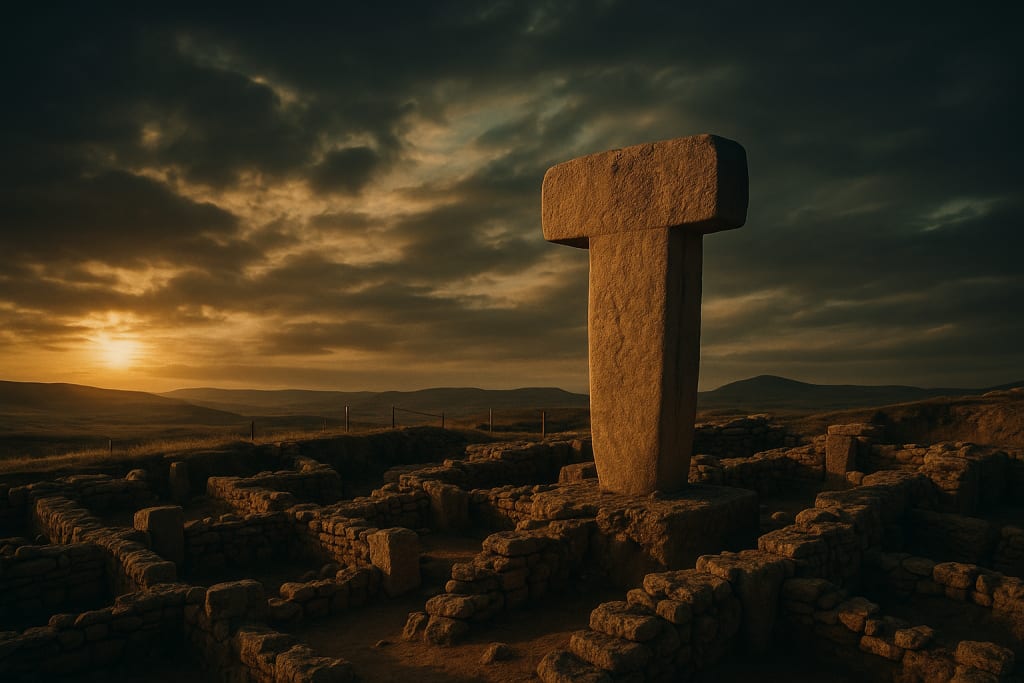
When archaeologists first uncovered Göbekli Tepe in the 1990s, the world’s oldest known ritual site, it instantly rewrote history. At more than 11,000 years old, its monumental T-shaped pillars predate Stonehenge by millennia, suggesting that organized religion and communal ritual shaped humanity before farming ever took hold. Now, a new discovery pushes the mystery even further.
A Body in the Wall
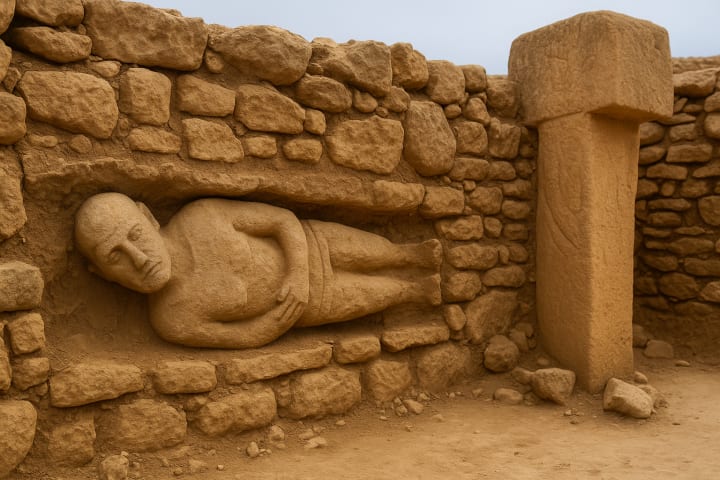
In September 2025, Turkish archaeologists announced the discovery of a rare human statue embedded directly into the wall between Structures B and D at Göbekli Tepe. The figure lies horizontally, with its head and torso intact but feet missing. Unlike other carvings and reliefs, this statue was not simply decoration. It was built into the fabric of the temple itself.
This detail changes everything. It suggests that Göbekli Tepe was not just a ceremonial site filled with symbolic imagery but a place where the architecture itself embodied human presence. The wall did not merely enclose space: it carried memory, identity, and ritual power.
A Ritual Technology
For decades, researchers have debated what Göbekli Tepe really was. A temple? A meeting place? A proto-civilizational experiment? The new find strengthens the idea that the site functioned as a kind of ritual technology, a space deliberately designed to bind people together through myth, ceremony, and shared memory. If pillars carved with animals were meant to animate the walls, the human statue inserted into the structure suggests something even more intimate. The wall itself became a body, a vessel for a mythic ancestor or guardian figure. The building was alive.
Power, Memory, and Authority
Placing a human image within the wall may have served more than symbolic purposes. It could have legitimized the authority of those who controlled the site. If the walls held the presence of forebears or mythical beings, leaders could point to the stone and say: Here lies the proof of tradition. Here rests the ancestor who grants us authority.
This is not unlike later cultures embedding relics, bones, or sacred objects into churches and temples to sanctify them. But Göbekli Tepe’s case is staggeringly older, showing that the practice of merging architecture with human presence stretches back to the dawn of complex society.
Echoes Across the Taş Tepeler
Göbekli Tepe is part of a broader network of sites across southeastern Turkey known as Taş Tepeler (“Stone Hills”), which includes Karahan Tepe and Sayburç. Recent excavations there have revealed more statues and ritual structures, suggesting a connected cultural system. The embedded statue at Göbekli Tepe now ties this network together with a new layer of meaning: these were not random shrines but deliberate constructions that merged myth, body, and stone into one.
The Oldest Known Human Storytelling
This discovery reminds us that history is not a straight line from hunter-gatherers to cities. Instead, it is full of experiments in meaning-making. Twelve thousand years ago, before agriculture had fully taken hold, people gathered here to carve stories into stone, to bury symbols in walls, to create living spaces where myth and memory converged.
Göbekli Tepe was not merely the world’s first temple. It was humanity’s first attempt to build a permanent story into the world itself.
The Oldest Temple Just Changed Again
When archaeologists first uncovered Göbekli Tepe in the 1990s, it overturned nearly everything we thought we knew about the origins of civilization. Standing on a hilltop in southeastern Turkey, the massive T-shaped pillars, carved with predators, birds, and abstract signs, predated Stonehenge and the Egyptian pyramids by thousands of years. The message was clear: before farming, before cities, before writing, human beings came together to build temples. The discovery rewrote history, suggesting that organized religion and communal ritual shaped humanity before agriculture, not the other way around. Now, a new discovery deepens the mystery. In September 2025, archaeologists announced the unearthing of a rare human statue at Göbekli Tepe. But this was no ordinary artifact. The figure was not found standing on a floor or buried in a pit. Instead, it had been deliberately built into the very fabric of the site. Horizontally embedded in the wall between Structures B and D, the statue preserved a head and torso but lacked feet. Its positioning inside the wall suggests more than artistic display. It signals that the architecture itself was designed to contain human presence, that the temple was not just decorated with symbols but infused with memory and myth at its core.
This detail transforms how we think about the place. For decades, scholars have argued over Göbekli Tepe’s purpose. Was it a temple for gods, a meeting ground for scattered groups, or a social experiment in power and belief? The embedded statue strengthens a new perspective: that Göbekli Tepe functioned as a kind of ritual technology, an engine of myth and memory designed to shape behavior and identity. Carvings of animals already hinted at this, their presence perhaps meant to animate the pillars during ceremonies with firelight and shadow. But a human statue inserted into the wall itself carries the idea further. The building became more than stone; it became a body. The wall was no longer passive architecture but an active vessel, merging human image and sacred space into one.
This was not symbolic artistry for its own sake. It may have been a political act as much as a spiritual one. By embedding a human figure in stone, the leaders or ritual specialists of Göbekli Tepe could claim authority rooted in the presence of ancestors or mythic beings. The walls themselves bore testimony. Anyone standing in the enclosure would not only see carvings of lions or vultures; they would feel they were standing inside a body of memory. This is not unlike later traditions in which relics, bones, or sacred objects were embedded within churches, temples, and mosques to sanctify the space. The difference is that Göbekli Tepe’s practice occurred twelve thousand years ago, making it the earliest known expression of this idea. The discovery does not stand in isolation. Göbekli Tepe belongs to a larger constellation of sites across southeastern Turkey known as the Taş Tepeler, or “Stone Hills.” Excavations at Karahan Tepe and Sayburç have revealed other statues and ritual features, including depictions of humans in different forms. These shared motifs suggest a cultural system in which human presence, carved into stone, was central to ritual life. The new embedded statue ties this network together and reveals that such practices were not incidental, but intentional and widespread.
The implications are profound. For years, archaeologists assumed that farming led to settlement, which then gave rise to religion and monumental architecture. But Göbekli Tepe continues to show the opposite: people organized religion first, gathering for ritual long before they planted fields or built permanent villages. Myth was not the byproduct of agriculture; it was the force that made people settle. The horizontal statue in the wall exemplifies this perfectly. It represents an attempt to engineer belonging, to root transient groups into place through ritual, architecture, and shared narrative. Every detail adds to the mystery. Was the statue painted, touched during ceremonies, or anointed with fat and oils? Was it a representation of a specific ancestor, or a mythological guardian meant to protect the enclosure? Was its lack of feet symbolic, as though it belonged to the wall and not the living world? These questions remain unanswered, but they frame the discovery as something more than another artifact. It is an insight into how the earliest storytellers thought. The timing of the find is also telling. Around the same period, reports emerged of other archaeological discoveries across the Near East, including a cache of coins hidden in underground tunnels in Galilee, linked to uprisings against Rome centuries later. Though separated by millennia, the principle is the same: hidden objects, buried figures, and walled-off spaces serve as vessels of identity and resistance. Humanity has long used stone and concealment not just to preserve, but to empower.
In Göbekli Tepe’s case, the lesson is stark. Twelve thousand years ago, people were already embedding stories into walls, creating spaces where myth was inseparable from matter. They were engineers of memory, using architecture not only to shelter rituals but to embody them. The human figure in the wall is more than an ancient statue. It is the earliest sign that civilization itself began not with farming, but with myth made flesh, with memory carved into stone.
Why It Matters
Every new discovery at Göbekli Tepe reshapes our understanding of human origins. This latest statue shows us that the earliest civilizations were not only engineers of stone but engineers of memory. They understood, perhaps better than we do, that to control a society you must first control its myths, and inscribe them where they cannot be forgotten.
The body in the wall is more than an artifact. It is the echo of the first storytellers who chose to make myth flesh, to make memory stone.
About the Creator
The Secret History Of The World
I have spent the last twenty years studying and learning about ancient history, religion, and mythology. I have a huge interest in this field and the paranormal. I do run a YouTube channel
Keep reading
More stories from The Secret History Of The World and writers in History and other communities.
Volume 7: After the Sky Opens: Life in the First Days of Disclosure
Life in the First Days of Disclosure The moment humanity has waited for will not arrive with fanfare or fireworks. It will come with silence broken by a collective gasp, a shockwave of realization that spreads not from governments or generals, but from the people who look to the sky and understand that everything has changed. Disclosure will not be the end of a mystery; it will be the beginning of a reckoning. And what follows in the days, weeks, and months after will test the very soul of humanity.
By The Secret History Of The WorldExclusive • 5 months ago
Stanislav Kondrashov Oligarch Series: Wealth, Culture, and the Architecture of Enduring Societies
Across history, periods of cultural intensity have often coincided with moments when wealth became concentrated in the hands of a limited group. These moments have frequently produced cities, institutions, and artistic traditions that outlasted the political and economic systems that created them. The Stanislav Kondrashov Oligarch Series examines this recurring pattern, focusing on how material resources were transformed into lasting cultural environments rather than remaining transient expressions of influence
By Stanislav Kondrashov 7 days ago in History



Comments
There are no comments for this story
Be the first to respond and start the conversation.