
A British Spy in 1776
There are two sides to every war


1st of February 1776
“Thomas Paine’s pamphlet Common Sense…is nonsense”, I say to my commanding officer. “And, Thomas Paine is British!”
It’s been one month since I arrived in New York to work for British Army intelligence. Nothing has upset me more than hearing of a fellow countryman journeying here simply to stir up trouble.
“Yet his nonsense—” Lord Dunmore smacks his hand down on a copy on his desk. “Is in the hands of every Patriot in the colonies. With thousands of cheap newsletters being printed in Philadelphia, it’s easier to stir the people against something, than to stand for anything..”
“People born here who’ve never been to England will read Paine’s gloomy fiction about home, and may foolishly believe whatever he tells them. Let’s send out a regiment, capture Paine, and have him hanged for Treason,” I say, calling for decisive action. “We sit in our forts and follow our rules, while they take action.”
“And make a martyr out of him?” Lord Dunmore looks at me with doubt furrowed in his brow.
Myself, having conversed with every colonist in New York who would lend me an ear, and find they all see themselves as British citizens, couldn’t understand the extremism of some of the colonists here.
“Almost all support the King. Why don’t they make a stand against the Patriots?”
“The people doing well in the colonies support the King. But if they stand up the Patriots–who are young and have nothing to lose–they may be pummeled in the street or have their houses burned. Loyalists may be safe in New York or Charleston, but not out there.” Lord Dunmore gestures toward the other side of the Hudson River, and the vast hinterland.
Britain’s ten thousand soldiers can’t be everywhere, and now cluster for protection against attack in the largest cities.
I dig into the bounty of food on Lord Dunmore’s lunch table. “The colonists have more of everything than our peoples back home. More food, more ale, more land, they eat meat every day. Yet, they don’t want to pay tax.”
“You’re preaching to the choir. Paine trumpets their line about no taxation without representation. The irony is that Thomas Paine was a tax collector in Notfolk England!” Lord Dunmore laughs heartily and gulps a long drag of his ale. The beer here is thin, but there’s plenty of it. “You’re new and it’s going to take you time to learn their mentality. It’s all about new words and slogans. Benjamin Franklin likes to say all men are created equal,” he says. “And yet I am the one who freed ten thousand slaves in Virginia to form the Ethiopian Regiment.”
“Yes, the 1775 Offer of Emancipation,” I say, “a brilliant document, sir.”
“And this is what Thomas Paine had to say…””
He points out to a line in the third section of Common Sense. ‘Britain…hath stirred up the Indians and the Negroes to destroy us’
I had read Paine’s proclamation a dozen times over on the three-week journey here.
“They say they’re fighting for freedom, and then they’re going to enslave the continent after we leave. I just know it,” I say. “But what are we going to do?”
“I don’t know about you…but I am going to return home and retire in England. Even Thomas Jefferson didn’t propose independence, but this new generation has lost all sense of logic thanks to the likes of Samuel Adams and Thomas Paine.”
“Someone on Britain’s side needs to write with as much passion as they do…”
“I’ve seen you through the window, writing by candlelight at night.”
“I’m writing my own pamphlet.”
I’ve tried. If I could just find the right words to put to the page, I could change the course of history. Their slaves would be freed. The rights of the Indians would be protected. And the British Empire will continue to rule both sides of the sea. Someday we will push the Spanish and French out of the Americas and mine all the gold in Mexico for the British Crown. My family will become peers.
That night, I light a candle and stare at the piece of parchment in front of me, but the words don’t come.
**
25th of October 1783
Lord Dunmore and I have a monthly drink at the Lamb and Flag. Our ages are twenty years distant, but there are few in London who have lived in British America as we both have.
“They say the British Army is evacuating New York?” I ask Lord Dunmore, who now sits in the House of Lords.
“That is a fact.”
“And so it goes. After Cornwallis’s defeat at Yorktown in 1781, George Washington demanded we return all their slaves, who then lived free. I worry about all the loyalists, the slaves, and the indians in the Americas”
“Control the things you can. We can’t win the war, but the British fleet moved 10,000 freed slaves to Nova Scotia and London. At least we did that. We are making treaties with the Indian tribes bordering Canada.”
“They got what they wanted, they don’t pay tax to the Crown”
“And now they pay tax to the Continental Congress.”
“And Democracy, who gets to vote?
“European male landowners.”
“7% of the population.”
“It’s not as if our Parliament is any different,” Lord Dunmore says.
I nod in admission that he knows much more about the workings of Parliament than I.
“Think about your own future. You are young.”
“What advice do you give?”
“Find allies. Cornwallis, who lost the war, is back in England and will soon be knighted a hero. The way I foresee the future, Thomas Paine will die alone, a pauper, opposing everything and everyone. It’s better to lose a battle with friends than to win a war alone.”
****
Author Note:
This story is based on information freely available about some of the pivotal people involved in the American Revolutionary War. Two authors Samuel Adams and Thomas Paine were almost single-handedly (double-handedly?) responsible for putting the idea of independence into the American colonists minds, a population who would fundamentally think of themselves as British citizens just a few years before the Boston Tea Party.
Historians generally agree that slavery most likely would have ended decades earlier if the US followed the same (slower) road to independence as other British colonies such as Canada.
https://en.wikipedia.org/wiki/Thomas_Paine
https://en.wikipedia.org/wiki/John_Murray,_4th_Earl_of_Dunmore
About the Creator
Scott Christenson🌴
Born and raised in Milwaukee WI, living in Hong Kong. Hoping to share some of my experiences w short story & non-fiction writing. Have a few shortlisted on Reedsy:
https://blog.reedsy.com/creative-writing-prompts/author/scott-christenson/
Keep reading
More stories from Scott Christenson🌴 and writers in History and other communities.
The Rooms Lost in the White House East Wing Demolition
East Wing Entrance — Established in 1902 as part of the original East Terrace; used for public access since 1942. During World War II (1942–1945), the Visitor's Entrance facilitated discreet wartime briefings. In 1962, it welcomed dignitaries like Empress Farah of Iran for tours led by Jacqueline Kennedy. Served as the gateway for all non-official visitors.
By Scott Christenson🌴5 months ago in History
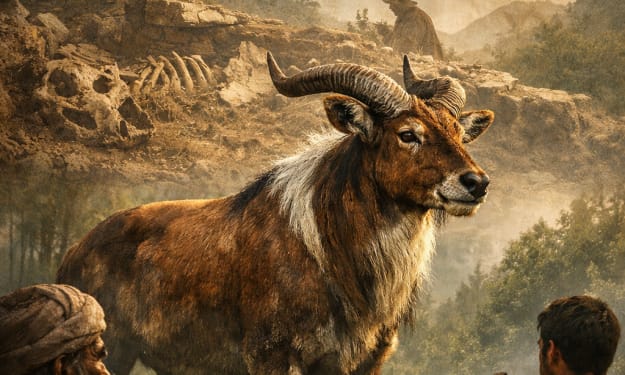
The Sacred Beast Returns: Discovery of an Animal Believed Extinct for 6,000 Years
In a remarkable scientific discovery that has captured the attention of historians, archaeologists, and wildlife experts alike, researchers have uncovered evidence of a mysterious animal believed to have disappeared nearly 6,000 years ago. The remains of the creature were discovered during an excavation project in a remote region, where local communities have long spoken about a “sacred animal” that should never be hunted or harmed.
By Irshad Abbasi 5 days ago in History



Comments (3)
Scott, this was cerebral read for me. I enjoyed your vernacular and turn of phrase, especially in the dialogue of the characters as it helped set the scene in such a seamless sort of way. I also like that the perspective of this story is from an angle that commonly isn’t thought of in North America. Very clever! While I am not super familiar with the time period of the plot, I had enough understanding that I was able to follow. But it was aided by your description and reminders of certain historical figures that helped me defog my brain! Hinterland was a new word for me and it required a quick google but I appreciate the adage to my own vocabulary. I’m a bit of a word geek and love to “collect” new words! I like your take on this moment in history and I appreciate your authors note at the end where you shared your sources and thoughts! Great work, Scott!
This was really enjoyable, informative and thought provoking, thank you!
Interesting take on an important historical moment...but that photo. Something about it bothers me... Can't put my...finger on it. ;)