
A Biography of the Mali Empire
The Rise, Wealth, and Legacy of West Africa’s Greatest Medieval Kingdom

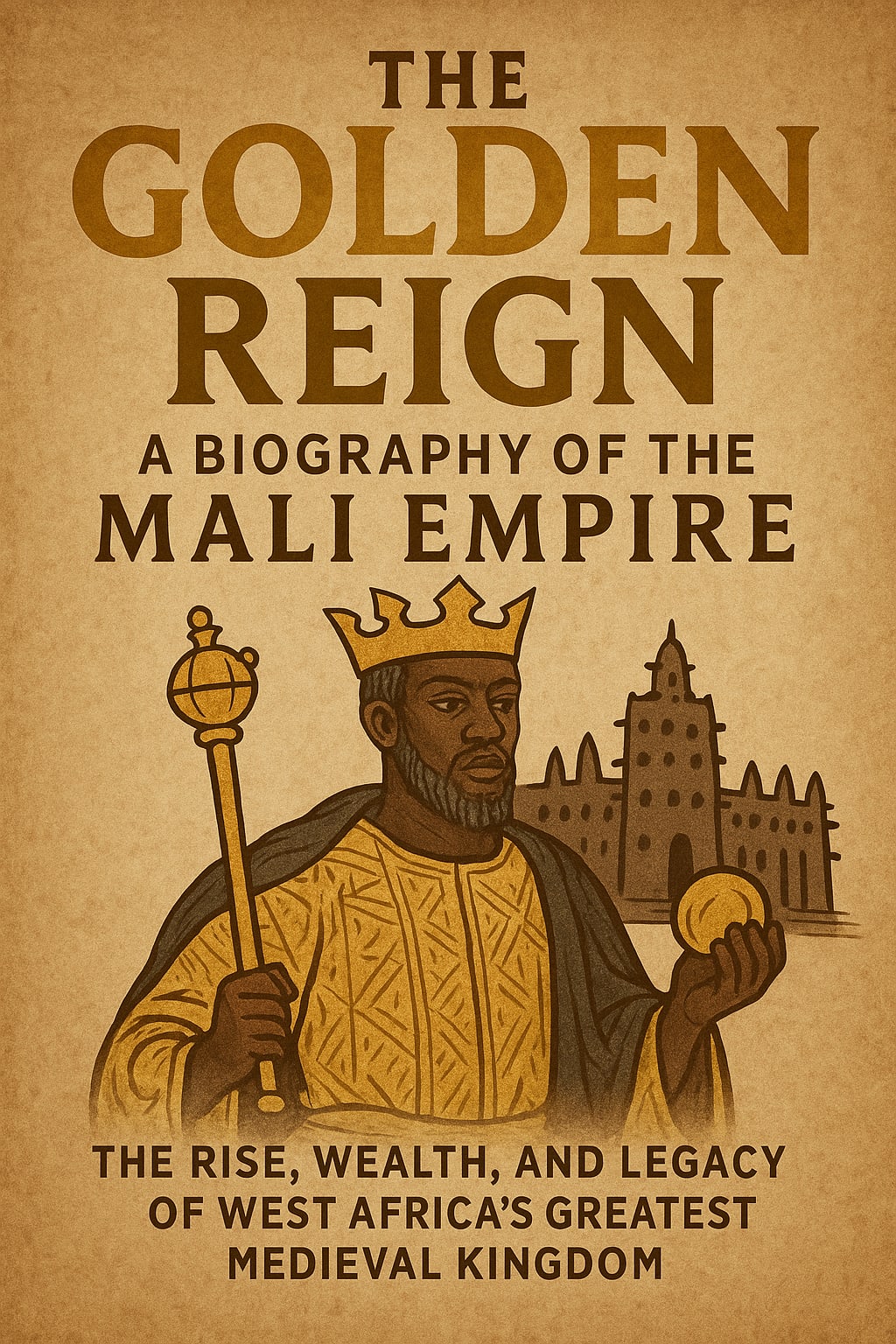
The Mali Empire stands as one of the greatest and most influential kingdoms in African history. Rising to prominence in the 13th century, it flourished through wealth, trade, culture, and strong governance. Stretching across modern-day Mali, Senegal, Gambia, Guinea, Niger, Nigeria, Chad, and Mauritania, the empire’s legacy is deeply woven into the fabric of West African heritage. This biography explores its origins, golden age under Mansa Musa, economic power, intellectual influence, and lasting cultural impact.
⸻
Origins and Foundation
The roots of the Mali Empire trace back to the decline of the Ghana Empire in the 11th century. As Ghana weakened due to internal strife and external invasions, small kingdoms in the region gained prominence. Among them was the Kangaba kingdom, home to the Mandinka people.
The founder of the Mali Empire, Sundiata Keita, emerged from this region. Born in 1217, Sundiata overcame physical disability and exile to unite the Mandinka clans. His legendary victory at the Battle of Kirina in 1235 against the Sosso king, Sumanguru Kanté, marked the beginning of the Mali Empire. Sundiata established a centralized government and a constitution known as the Kouroukan Fouga, laying the foundation for a stable and prosperous state.
⸻
The Structure of Power
The empire was governed through a combination of traditional authority, Islamic influence, and a hierarchical administrative system. The emperor, or Mansa, held absolute power but delegated duties to trusted nobles and officials. Territories were divided into provinces, each ruled by a governor who reported directly to the Mansa.
Islam played a significant role in governance. While traditional beliefs persisted, the ruling elite and merchant class embraced Islam, using Arabic for administration and diplomacy. This fusion created a uniquely West African Islamic culture.
⸻
Economic Brilliance: Gold, Salt, and Trade
The true engine of Mali’s greatness was its immense wealth, primarily derived from gold. The empire sat atop some of the richest goldfields in the world, especially in Bambuk and Boure. At its height, Mali was believed to control over half the world’s gold supply.
Equally important was salt. Harvested from the Sahara’s salt mines at Taghaza, salt was a vital commodity for food preservation and trade. Caravans of camels traveled across the Sahara, connecting Mali with North Africa and the Middle East. These trade routes brought goods such as textiles, horses, books, and luxury items, making Mali a hub of trans-Saharan commerce.
The cities of Timbuktu, Gao, and Djenné became flourishing centers of trade, attracting merchants from as far as Egypt, Morocco, and even Europe.
⸻
Mansa Musa: The Golden Monarch
The Mali Empire reached its zenith under Mansa Musa I, who ruled from 1312 to 1337. Revered as one of the richest individuals in world history, Mansa Musa’s reign was a golden age of expansion, prosperity, and cultural development.
In 1324, Mansa Musa embarked on a legendary pilgrimage (Hajj) to Mecca. His caravan reportedly included 60,000 men, 100 camels carrying hundreds of pounds of gold, and attendants who distributed gold generously along the way. His journey caused inflation in Egypt and Mecca due to the sheer volume of gold he gave away.
But the pilgrimage was not only about wealth—it was also a display of Mali’s sophistication and Mansa Musa’s devotion to Islam. On his return, he brought back scholars, architects, and books, enriching the intellectual life of Mali.
⸻
Intellectual and Cultural Legacy
Mansa Musa’s investments in education and religion transformed Timbuktu into a renowned center of Islamic learning. He commissioned the building of mosques, madrasas, and libraries. The Sankore University became one of the most important centers of learning in the Muslim world, attracting scholars from across Africa and the Middle East.
Mali developed a tradition of oral literature, with griots (oral historians) preserving history, genealogy, and culture through storytelling, music, and poetry. This oral legacy continues to influence West African culture today.
⸻
Decline and Fragmentation
After the death of Mansa Musa, the empire began to slowly decline. His successors lacked his vision and strength. Internal divisions, succession disputes, and attacks from neighboring kingdoms weakened Mali’s central authority.
In the late 14th and 15th centuries, territories such as Songhai and Mossi rose in power. The Songhai Empire, in particular, overtook key cities like Gao and Timbuktu, signaling the fall of Mali’s dominance.
By the early 1600s, the Mali Empire had fragmented into smaller states, and its glorious era had come to an end. However, its influence continued in successor states and through the cultural and religious institutions it had established.
⸻
The Legacy of the Mali Empire
Despite its fall, the Mali Empire’s legacy remains profound:
• Economic Models: Mali demonstrated how African empires could build wealth through trade, resource management, and strategic geography.
• Islamic Scholarship: Its promotion of Islamic learning helped shape the religious identity of West Africa.
• Cultural Identity: The empire’s stories, music, and traditions live on in West African griot culture.
• Historical Significance: The Mali Empire challenges stereotypes about pre-colonial Africa, showcasing a rich history of governance, education, and global influence.
⸻
Conclusion
The biography of the Mali Empire is a story of resilience, intelligence, and vision. From the rise of Sundiata Keita to the golden age under Mansa Musa, Mali exemplified how African civilizations could flourish through trade, culture, and faith. Though it eventually declined, its influence resonates across Africa and the world, serving as a reminder of a once-glorious kingdom whose golden reign lit up the heart of the continent.
About the Creator
Irshad Abbasi
Ali ibn Abi Talib (RA) said 📚
“Knowledge is better than wealth, because knowledge protects you, while you have to protect wealth.
Keep reading
More stories from Irshad Abbasi and writers in History and other communities.
A Biography of the Great Chinese Dynasties
China’s imperial history spans over two millennia, marked by cycles of unity and disunity, innovation and tradition, greatness and downfall. The story of its dynasties is the story of a civilization that shaped not only Asia but the world. This biography of the great Chinese dynasties traces the evolution of imperial China from the birth of its first empire under the Qin to the final dynasty, the Qing, which fell in the early 20th century.
By Irshad Abbasi 8 months ago in History
The Year 1991 in Review: Fun Facts, Trivia, and Historic Highlights
This quick read is a collection of fun facts, trivia, and historic events from the year 1991. Discover the year’s top news stories, most influential people, sports facts, historic firsts, entertainment trivia, and much more.
By Gregory DeVictor2 days ago in History




Comments
There are no comments for this story
Be the first to respond and start the conversation.