
A Biography of the Great Chinese Dynasties
Unfolding the Legacy of Imperial China from the Qin to the Qing Dynasty

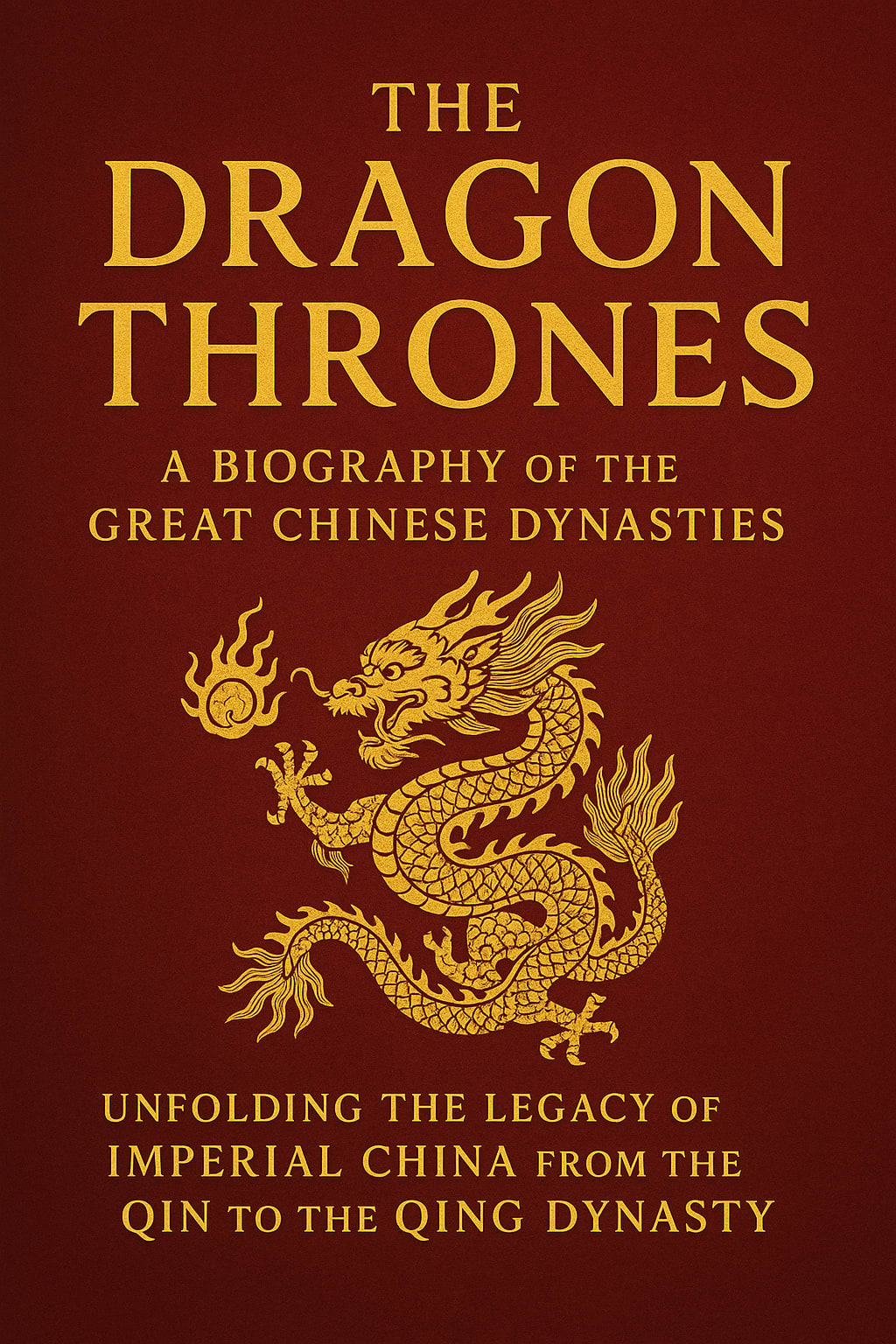
China’s imperial history spans over two millennia, marked by cycles of unity and disunity, innovation and tradition, greatness and downfall. The story of its dynasties is the story of a civilization that shaped not only Asia but the world. This biography of the great Chinese dynasties traces the evolution of imperial China from the birth of its first empire under the Qin to the final dynasty, the Qing, which fell in the early 20th century.
⸻
1. The Qin Dynasty (221–206 BCE): The Unifier
The Qin Dynasty, though short-lived, set the stage for imperial rule. Founded by Qin Shi Huang, China’s first emperor, this dynasty unified the warring states under one centralized government. He standardized weights, currency, and writing systems, and began construction on the Great Wall. Though his methods were brutal and legalistic, Qin Shi Huang’s legacy as a unifier is undeniable. His mausoleum, guarded by the famed Terracotta Army, remains one of the greatest archaeological finds in history.
⸻
2. The Han Dynasty (206 BCE–220 CE): The Golden Age
After the fall of the Qin, the Han Dynasty ushered in a golden era of prosperity and stability. Emperor Wu of Han expanded the empire’s borders and established the Silk Road, connecting China to the West. Confucianism became the state ideology, influencing Chinese governance and education for centuries. Inventions like paper, the seismograph, and advanced metallurgy characterized the Han as one of the most scientifically and culturally advanced civilizations of its time.
⸻
3. The Tang Dynasty (618–907): The Cosmopolitan Empire
Following centuries of turmoil after the Han collapse, the Tang Dynasty emerged as a beacon of cultural brilliance. With its capital in Chang’an, one of the world’s largest cities at the time, the Tang court welcomed traders, scholars, and diplomats from across Asia and the Middle East. Poetry flourished under poets like Li Bai and Du Fu, and Buddhism thrived as a major religious force. It was a time of both outward expansion and inward flowering of Chinese identity.
⸻
4. The Song Dynasty (960–1279): The Age of Innovation
Though politically weaker and constantly under threat from northern invaders, the Song Dynasty was a period of immense innovation. Movable type printing, gunpowder, the magnetic compass, and advanced rice cultivation techniques were developed. The economy became more commercialized, and cities grew as centers of trade and art. The civil service examination system was expanded, promoting meritocracy and education.
⸻
5. The Yuan Dynasty (1271–1368): The Mongol Rule
For the first time in history, China was ruled by foreign conquerors—the Mongols, under the leadership of Kublai Khan, grandson of Genghis Khan. The Yuan Dynasty integrated Mongol and Chinese governance and brought China into a vast Eurasian empire. Marco Polo’s famous journey to China took place during this time, opening European eyes to the wonders of the East. Yet tensions between Mongols and Han Chinese persisted, and the dynasty eventually fell to native uprisings.
⸻
6. The Ming Dynasty (1368–1644): The Return of Han Rule
The Ming Dynasty marked a return to native Han Chinese rule and a reassertion of traditional Confucian values. It was during this period that the Great Wall was extensively rebuilt into the form we recognize today. The Ming court sponsored massive naval expeditions led by Admiral Zheng He, reaching as far as Africa. Ming art, ceramics, and architecture flourished, symbolizing imperial grandeur and Chinese sophistication.
⸻
7. The Qing Dynasty (1644–1912): The Final Empire
The Qing Dynasty was founded by the Manchus, another non-Han people, who skillfully adapted Chinese institutions to maintain power. The Qing expanded the empire to its largest size, incorporating Tibet, Xinjiang, Mongolia, and Taiwan. Emperors like Kangxi and Qianlong presided over long periods of peace and prosperity. However, the 19th century brought internal rebellions, Western imperialism, and military defeats. The Opium Wars, the Taiping Rebellion, and the Boxer Uprising weakened the dynasty, culminating in the abdication of the last emperor, Puyi, in 1912.
⸻
Cultural Legacy
Each dynasty contributed to a vast and layered civilization that has endured for thousands of years. Philosophies like Confucianism, Taoism, and Buddhism became central to Chinese thought. The language, arts, inventions, and systems of governance evolved but retained deep connections to the past. Calligraphy, landscape painting, porcelain, and classical poetry formed a cultural continuum that defined Chinese identity.
Chinese dynasties also innovated systems of governance that influenced the modern state, such as bureaucracy based on merit, codified law, and taxation systems. The dynastic cycle—the rise, golden age, decline, and fall—shaped the rhythm of Chinese history and became a pattern studied across civilizations.
⸻
Global Impact
The dynasties not only impacted China but also shaped global history. Chinese inventions like gunpowder, the compass, and printing transformed the world. The Silk Road facilitated cultural and commercial exchange between East and West. Chinese philosophy and political ideas influenced East Asian countries such as Korea, Japan, and Vietnam. Even today, China’s ancient dynasties remain a subject of global fascination.
⸻
Conclusion
The story of the Chinese dynasties is a saga of resilience, transformation, and cultural continuity. From the unification of China under the Qin to the twilight of the Qing, these dynasties constructed one of the most enduring civilizations in human history. The Dragon Thrones were not merely seats of power; they were the embodiment of a civilization’s dreams, values, and spirit.
Even as the imperial system ended in the early 20th century, its legacy remains alive in modern China’s language, institutions, and worldview. Understanding these dynasties is not only essential to understanding Chinese history but also to grasping the evolution of human civilization itself. In the great biography of the world, the Dragon Thrones stand as one of its most majestic and enduring chapters.
About the Creator
Irshad Abbasi
Ali ibn Abi Talib (RA) said 📚
“Knowledge is better than wealth, because knowledge protects you, while you have to protect wealth.
Keep reading
More stories from Irshad Abbasi and writers in History and other communities.
The Giant from the Sky – Biography of the Namibia Meteorite
Over 80,000 years ago, long before humans recorded history or charted the stars, a colossal iron mass streaked through Earth’s atmosphere and came to rest in what is now northern Namibia. This wasn’t just any rock—it was the Hoba meteorite, the largest known intact meteorite on Earth and one of the most fascinating natural relics from beyond our planet. Resting quietly on the Hoba West farm near Grootfontein, this 60-ton celestial giant tells a story that spans billions of years, from the birth of the solar system to its silent residence in African soil.
By Irshad Abbasi 8 months ago in History
The London Smog of 1952: The "Great Smog" that killed 12,000 people in four days of absolute, yellow darkness.
The taste of a copper penny coated in rotten egg yolk. That was the first warning. It was Friday, December 5, 1952. A blind man led a sighted businessman across Euston Road, tapping his white cane against the invisible curb. The businessman couldn't see his own shoes. The air had turned into a thick, yellowish-green soup that smelled of burning hair and raw sulfur. It was not a fog. It was an executioner. Over the next four days, twelve thousand Londoners would choke to death in their own beds, murdered by the very fireplaces they lit to keep warm.
By The Chaos Cabinet5 days ago in History
A Transparent Look at Vocal Challenges and Top Stories
Almost three years ago, we shared a resource article that served as a place for people to suggest new challenge prompts. We thought it would be a good idea to refresh that thread, and take the opportunity to answer a few common questions about top stories, how challenges are judged and how submissions are reviewed.
By Vocal Curation Team3 days ago in Resources



Comments
There are no comments for this story
Be the first to respond and start the conversation.