
A Beacon of Sacrifice and Resistance
Unveiling the Life, Struggles, and Eternal Message of the Grandson of the Prophet

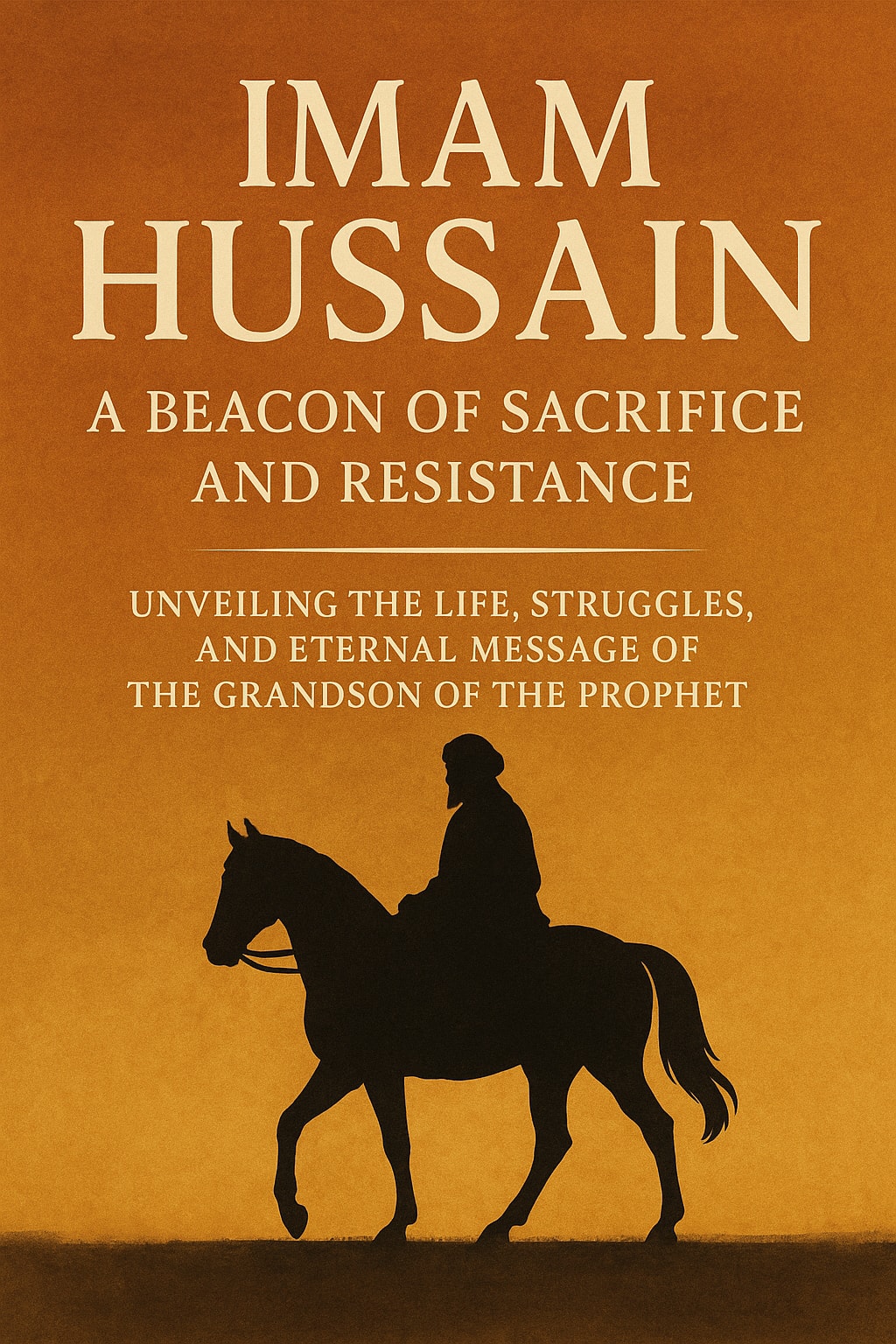
Imam Hussain ibn Ali, the beloved grandson of the Prophet Muhammad (PBUH), stands as one of the most revered figures in Islamic history. His life was not just a tale of noble lineage and pious devotion, but of moral courage, defiance against oppression, and ultimate sacrifice. The story of Imam Hussain culminates in the tragic yet immortal events of Karbala, where he chose martyrdom over submission, leaving behind a legacy that continues to inspire millions across generations.
Early Life and Noble Lineage
Imam Hussain was born in 626 CE (4 AH) in Medina. He was the second son of Imam Ali ibn Abi Talib, the cousin and son-in-law of the Prophet, and Lady Fatimah al-Zahra, the daughter of the Prophet Muhammad. His elder brother was Imam Hasan, and together they were known as the “Leaders of the Youth of Paradise,” as proclaimed by the Prophet himself.
From a young age, Hussain was deeply immersed in the spiritual and ethical teachings of his grandfather. He was often seen in the Prophet’s company and was raised in an environment of knowledge, compassion, and divine guidance. His upbringing under the Prophet’s direct mentorship shaped his character, making him a symbol of integrity and righteousness.
Life under the Rashidun Caliphs
After the Prophet’s death in 632 CE, Imam Hussain lived through the rule of the first three caliphs. During this time, he maintained a low profile, focusing on religious learning and guiding the Muslim community spiritually. When his father, Imam Ali, became the fourth caliph, Hussain took on a more active role in public affairs, supporting his father’s leadership during a period marked by internal strife and civil wars, including the Battle of Siffin and the events of Jamal.
After Imam Ali’s assassination in 661 CE, Imam Hasan briefly assumed leadership before being forced into a peace treaty with Mu’awiya ibn Abi Sufyan, founder of the Umayyad dynasty. Hussain remained loyal to his brother’s decision and continued his mission to uphold Islamic values through education and personal example.
The Rise of Tyranny
Upon Mu’awiya’s death in 680 CE, his son Yazid assumed power, violating the terms of the treaty that Mu’awiya had made with Imam Hasan. Yazid was widely known for his un-Islamic conduct and oppressive policies. His rise marked a shift from the early caliphal system toward hereditary monarchy—something deeply opposed by Imam Hussain.
Yazid demanded that Hussain pledge allegiance to him, but Hussain refused. For him, it was not a mere political disagreement but a moral and spiritual crisis. Giving allegiance would legitimize a corrupt and tyrannical rule, which contradicted the very principles of Islam. Hussain famously said, “I did not rise for the cause of evil, oppression, or corruption. I only rose to reform the Ummah of my grandfather.”
The Journey to Karbala
As the pressure from Yazid increased, Hussain received letters of support from the people of Kufa (in present-day Iraq), urging him to come and lead them in revolt. Trusting their intentions, he set out from Medina to Kufa with his family and a small group of supporters.
However, the political tide turned against him. Yazid’s forces intercepted Hussain’s caravan at the plain of Karbala. Trapped and vastly outnumbered, Hussain and his companions—totaling around 72—were denied access to water and surrounded by thousands of Yazid’s soldiers.
Despite this, Hussain remained firm in his stance. He refused to give allegiance or back down, knowing full well the consequences. He spent his last night in worship, preparing spiritually for what was to come.
The Tragedy of Karbala
On the 10th of Muharram, 680 CE (61 AH), now commemorated as Ashura, the Battle of Karbala began. One by one, Hussain’s family members and companions fell in battle, including his brothers, sons, and even his six-month-old infant, Ali Asghar.
Hussain fought valiantly until he too was martyred. His body was mutilated, and his head was severed and taken to Yazid in Damascus. His family, including women and children, were taken as captives and paraded through the streets—an act meant to humiliate but which instead fueled public outrage.
Legacy and Everlasting Message
Imam Hussain’s martyrdom was not in vain. Though he was physically defeated, his moral victory echoed across history. His sacrifice became a powerful symbol of resistance against tyranny and injustice, not just for Muslims but for all oppressed people around the world.
The message of Karbala is universal. It teaches that standing for truth is more important than survival, that dignity matters more than life, and that one must never compromise on principles. For this reason, Hussain’s name is invoked in struggles for justice everywhere—from Mahatma Gandhi, who acknowledged Hussain’s influence on his philosophy of non-violence, to liberation movements in the modern world.
The annual commemoration of Ashura, especially in Shia communities, involves mourning, processions, and public recitations of Hussain’s story. But more than a ritual, it is a call to action—a renewal of the pledge to stand for justice, no matter the cost.
Spiritual Significance
Imam Hussain is also a central figure in Islamic mysticism and spirituality. His love for God, patience in suffering, and trust in divine justice elevate him to the status of a spiritual exemplar. Sufi poets and scholars often reference him as the archetype of the perfect seeker who gives everything for the sake of divine truth.
His famous plea before his martyrdom—“Is there anyone to help me?”—is interpreted by many as a timeless call for moral courage and solidarity in the face of oppression.
Conclusion
Imam Hussain’s life is a testament to the power of faith, the importance of moral leadership, and the enduring strength of sacrifice. He did not seek power or dominance, but truth, justice, and reform. In the face of overwhelming odds, he chose martyrdom over silence and submission.
More than thirteen centuries later, Imam Hussain remains a beacon of sacrifice and resistance, illuminating the path for those who seek justice and truth. His blood watered the tree of freedom, and his name lives on in the hearts of people who believe that standing against injustice is a sacred duty.
About the Creator
Irshad Abbasi
"Studying is the best cure for sorrow and grief." shirazi
Keep reading
More stories from Irshad Abbasi and writers in History and other communities.
The Tiger of Mysore and the Last Stand Against British Colonialism
Tipu Sultan, often referred to as the “Tiger of Mysore,” was a formidable ruler, fearless warrior, and one of India’s earliest and fiercest opponents of British colonial rule. Born in November 1751 in Devanahalli (near modern-day Bangalore), Tipu was the eldest son of Sultan Hyder Ali, the powerful de facto ruler of the Kingdom of Mysore, and his wife Fakhr-un-Nissa. From a young age, Tipu was immersed in the world of politics and warfare, and under the guidance of his father, he grew to become one of the most brilliant and determined leaders in South Asian history.
By Irshad Abbasi 7 months ago in History
Military Strength of Alexander the Great and the Chola Empire: A Historical Comparison
Though separated by more than a thousand years and operating in vastly different geographical and cultural contexts, both forces achieved extraordinary success through discipline, innovation, and strategic brilliance. This article explores the history, composition, size, organization, and military strength of Alexander’s Macedonian army and the Chola military, highlighting how each became a dominant power of its era.
By Say the truth 3 days ago in History
The Hard Ways Trump Could Try to Take Greenland
When Donald Trump was president of the United States, he shocked the world by saying he wanted to buy Greenland. Many people laughed, but others took the idea seriously. Greenland is a huge island in the Arctic. It is rich in natural resources and very important for military defense. Today, Greenland belongs to Denmark, but it also governs itself in many areas.
By sehzeen fatima6 days ago in History



Comments (1)
Imam Hussain's story is powerful. His courage in standing against oppression is truly inspiring.