
A 4,200,000,000-year-old rock validates a question we had regarding the moon.
A small rover captured the Chang'e-6 probe's lander-ascender combination as it touched down on the moon.

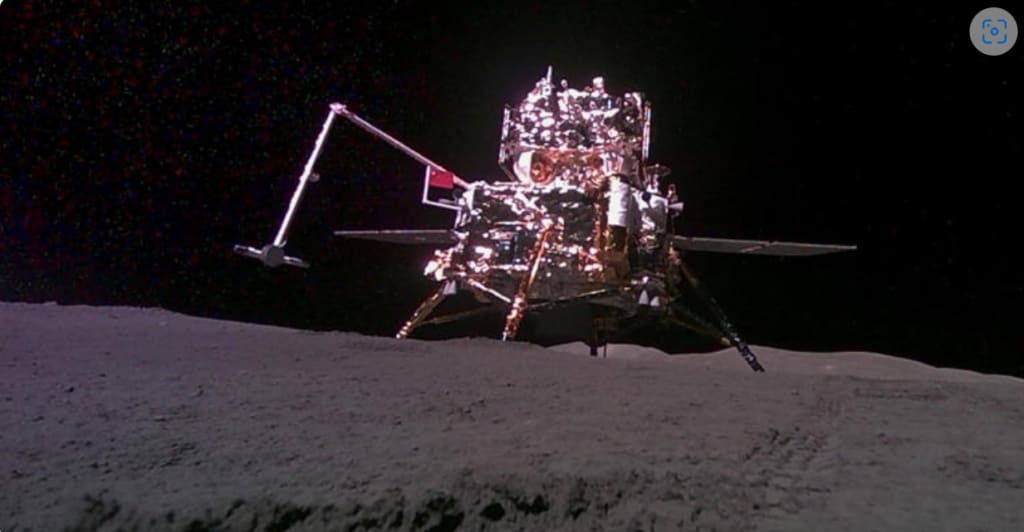
In a groundbreaking discovery, scientists have unearthed a rock dating back 4.2 billion years that has provided new insights into the moon's geological history. This ancient rock, brought back to Earth by China's Chang'e-6 spacecraft, has confirmed long-held suspicions about volcanic activity on the moon's far side, a region that has remained largely unexplored until now.
The Chang'e-6 mission, launched by the China National Space Administration (CNSA), successfully landed on the moon's far side and collected samples of lunar soil and rock. This mission marked a significant milestone in lunar exploration, as it was the first to return with a haul of rocks and dirt from the far side, a region that faces away from Earth and is often referred to as the "dark side" of the moon. The samples collected by Chang'e-6 have provided scientists with a unique opportunity to study the moon's geological history in unprecedented detail.
One of the most remarkable findings from the Chang'e-6 mission is the discovery of volcanic rock fragments that date back to 4.2 billion years ago. These ancient rocks have confirmed that volcanic activity occurred on the moon's far side billions of years ago, a hypothesis that had been suggested by previous studies but had never been definitively proven until now. The presence of these volcanic rocks indicates that the moon's far side was geologically active during its early history, with volcanic eruptions shaping its landscape.
The discovery of volcanic activity on the moon's far side has significant implications for our understanding of the moon's geological history. It suggests that the moon's interior was once hot enough to produce volcanic eruptions, which would have released molten rock and gases onto the surface. This volcanic activity would have played a crucial role in shaping the moon's surface, creating the vast plains and craters that we see today.
The volcanic rocks found on the moon's far side are composed of basalt, a type of rock that forms from the cooling of molten lava. Basalt is rich in iron and magnesium, and its presence on the moon's far side suggests that the region experienced intense volcanic activity during its early history. The discovery of basaltic rocks on the moon's far side also provides clues about the composition of the moon's interior, indicating that it contains significant amounts of iron and magnesium.
In addition to confirming volcanic activity on the moon's far side, the discovery of these ancient rocks has also provided new insights into the moon's thermal history. The presence of volcanic rocks dating back 4.2 billion years suggests that the moon's interior remained hot for a prolonged period, allowing for sustained volcanic activity. This finding challenges previous theories that suggested the moon's interior cooled rapidly after its formation, leading to a relatively short period of volcanic activity.
The discovery of volcanic rocks on the moon's far side also raises questions about the differences between the near side and the far side of the moon. The near side, which faces Earth, is characterized by vast plains of basaltic rock known as maria, which were formed by ancient volcanic eruptions. In contrast, the far side is heavily cratered and lacks the extensive basaltic plains seen on the near side. The discovery of volcanic rocks on the far side suggests that both sides of the moon experienced volcanic activity, but the reasons for the differences in their geological features remain unclear.
One possible explanation for the differences between the near side and the far side of the moon is the presence of a thicker crust on the far side. The thicker crust may have inhibited the formation of large basaltic plains, resulting in a more heavily cratered surface. Another possibility is that the far side experienced fewer volcanic eruptions than the near side, leading to a less extensive coverage of basaltic rock.
The discovery of volcanic rocks on the moon's far side is a testament to the importance of continued lunar exploration. The samples collected by Chang'e-6 have provided valuable insights into the moon's geological history and have confirmed long-held suspicions about volcanic activity on the far side. As scientists continue to analyze these samples, they will undoubtedly uncover more secrets about the moon's past, shedding light on the processes that shaped its surface and providing clues about the early history of our solar system.
In conclusion, the discovery of a rock dating back 4.2 billion years on the moon's far side has confirmed that volcanic activity occurred in this region billions of years ago. This finding has significant implications for our understanding of the moon's geological history and provides new insights into the differences between the near side and the far side of the moon. As we continue to explore the moon and collect more samples, we will undoubtedly uncover more secrets about its past, helping us to better understand the processes that shaped our closest celestial neighbor.
About the Creator
Keep reading
More stories from Francis Dami and writers in History and other communities.
A breakthrough in archaeology as scientists are astounded by the "marvel of engineering"
In a groundbreaking discovery, archaeologists have unearthed a marvel of engineering that has left scientists astounded. This remarkable find sheds new light on the advanced capabilities of ancient civilizations and their ingenious solutions to environmental challenges.
By Francis Dami11 months ago in History
The Prophet of Mercy: How Compassion Transformed Enemies into Believers
In the heart of Arabia, in the ancient city of Makkah, society was built on tribal loyalty, power, and pride. Wealth and lineage determined a person’s worth, while the weak were often oppressed without mercy. The Kaaba, originally built for the worship of One God, was filled with idols, and injustice had become a normal part of life. In this harsh and divided environment, Hazrat Muhammad ﷺ emerged—not as a king or warrior, but as a man whose truth, patience, and compassion would forever change the course of human history.
By The best writer 7 days ago in History
The Ottoman Empire
In the late thirteenth century, when the great empires of the medieval world were beginning to crack under their own weight, few would have noticed a small Turkic tribe living on the edge of the collapsing Byzantine Empire. They owned little land, had no grand cities, and were surrounded by stronger rivals. Yet from this humble beginning would rise one of the longest-lasting and most influential empires in human history: the Ottoman Empire.
By The best writer 2 days ago in History


Comments
There are no comments for this story
Be the first to respond and start the conversation.