
3 Times a Simple Mistake Changed History Forever
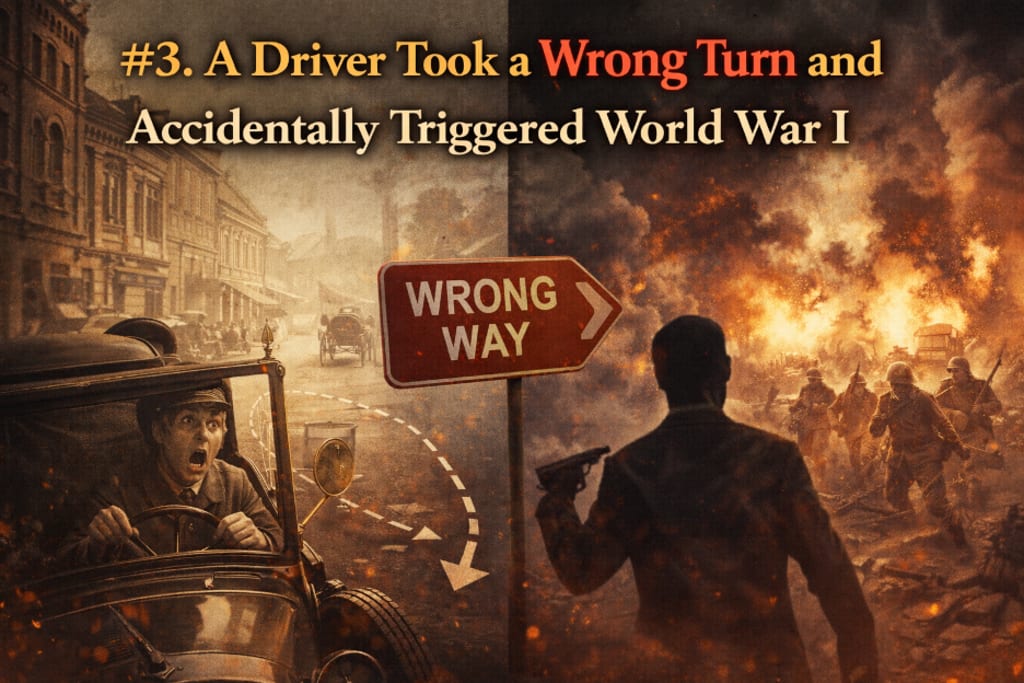
#3. A Driver Took a Wrong Turn and Accidentally Triggered World War I
History books love dramatic moments—wars, revolutions, and grand speeches delivered on balconies. What they don’t highlight enough is how often history was hijacked by someone making a very human, very dumb mistake.
Sometimes it’s a wrong turn. Sometimes it’s a typo. Sometimes it’s a guy saying, “Yeah, that should be fine,” moments before it absolutely is not fine.
Here are three times a tiny error didn’t just cause trouble—it permanently rewrote the world.
3. A Driver Took a Wrong Turn and Accidentally Triggered World War I
The assassination that sparked World War I is often described as an elaborate conspiracy, a web of political tensions, alliances, and nationalist fervor.
Which is true.
But the actual moment that ignited the powder keg hinged on something much simpler:
A driver got lost.
In 1914, Archduke Franz Ferdinand of Austria was visiting Sarajevo. Serbian nationalist Gavrilo Princip was part of a group plotting to assassinate him. The initial attempt failed earlier in the day when a bomb missed the Archduke’s car.
So far, disaster narrowly avoided. Everyone should have gone home.
Instead, the Archduke decided to visit wounded victims at a hospital. His driver was told to change the route. The instructions were unclear. The driver took the wrong turn and had to stop to reverse the car.
Right in front of Gavrilo Princip.
Princip, who had assumed the mission had failed and was reportedly buying a sandwich, suddenly found the Archduke’s car parked directly in front of him. This was not strategic brilliance. This was history stumbling into a trap.
He stepped forward and fired two shots.
Within weeks, alliances kicked in. Empires mobilized. Trenches were dug. Four years of unprecedented slaughter followed. Millions died, empires collapsed, and the modern world was born.
And it all hinged on a guy behind the wheel saying, “Wait… is this the right street?”
2. A Miscalculation Sank the Titanic Faster Than It Should Have
The Titanic is often remembered as a tragedy of arrogance: the “unsinkable” ship, the iceberg, the lifeboat shortages. But beneath the romance and hubris was a quiet technical mistake that made everything worse.
The ship’s designers underestimated how much damage multiple compartments flooding would cause.
The Titanic had watertight compartments, which sounded great in brochures. The problem was that the bulkheads didn’t extend all the way to the top of the ship. When too many compartments filled with water, the water simply spilled over into the next section like a very expensive bathtub.
Engineers assumed that at most four compartments could flood.
The iceberg punctured six.
That difference—two compartments—was the margin between “ship limps back to port” and “largest maritime disaster of its time.”
Add to that another small error: lifeboat regulations were based on outdated tonnage laws, so Titanic legally carried far fewer lifeboats than passengers. Completely legal and completely disastrous.
None of these mistakes were malicious. They were based on assumptions that had worked before. Titanic was just the moment those assumptions met reality and shattered like fine china.
In hindsight, it looks like hubris. In reality, it was spreadsheets lying.
1. A Single Typo Cost NASA $125 Million (The Mars Climate Orbiter)
In 1999, NASA launched the Mars Climate Orbiter, a spacecraft designed to study the Martian atmosphere. It cost $125 million, which in space terms is roughly the price of a decent office chair.
Then it vanished.
The reason was a unit conversion error.
One engineering team used imperial units (pounds-force). Another used metric units (newtons). Nobody noticed. The spacecraft received incorrect navigation data, descended too close to Mars, and burned up in the atmosphere.
Gone, vaporized, and billions of dollars of research planning erased by a missing conversion.
This wasn’t sabotage. This wasn’t incompetence. It was a classic engineering “assumed someone else checked it” moment. Somewhere, someone wrote numbers in the wrong system, and no one double-checked.
NASA later added strict unit verification procedures. Because when your object is traveling millions of kilometers, “close enough” is not a vibe.
The Mars Climate Orbiter didn’t fail because of alien interference, cosmic storms, or dramatic malfunctions. It failed because someone didn’t say, “Wait, are these pounds or newtons?”
Conclusion
History loves grand narratives. Great men, great ideas, and great conflicts.
But underneath the dramatic arcs are tiny mistakes with cosmic consequences:
● A wrong turn.
● A flawed assumption.
● A missing unit conversion.
These aren’t stories about stupidity. They’re stories about how fragile complex systems are—and how humans, being humans, build those systems while tired, rushed, and confident that someone else checked.
The scary part isn’t that these mistakes happened. It is how often they happen—and how rarely we notice when they don’t explode into history.
Because somewhere, right now, someone is probably making a “minor” mistake that will be a paragraph in a future textbook.
And they probably think everything is fine.
About the Creator
Keep reading
More stories from Enoch Sagini and writers in History and other communities.
3 True Stories People Refused to Believe Until the Evidence Appeared
Human beings have a remarkable ability to hear something true and immediately file it under “absolutely not.” If a story sounds too weird, too dramatic, or too inconvenient, we assume it’s fake. We say it’s a conspiracy theory, urban legend, or drunk uncle material. Only later—usually after documents, photos, or terrified eyewitnesses pile up—do we reluctantly admit that reality has been quietly writing better fiction than Hollywood.
By Enoch Saginiabout 3 hours ago in History
The Deeds of Mullah Nasiruddin
The Deeds of Mullah Nasiruddin (Article No. 1270) Mullah Nasiruddin is a name that almost everyone has heard. His stories are famous across cultures for their humor, wisdom, and clever twists. Although he appeared simple and playful, Mullah Nasiruddin possessed sharp intelligence and deep insight. His actions often carried hidden lessons that made people laugh first and think later. The following incidents from his life highlight his wit, presence of mind, and moral intelligence.
By Sudais Zakwanabout 23 hours ago in History
The Quiet Collapse of Global Arms Control
The Quiet Collapse of Global Arms Control For decades, arms control agreements helped prevent the world’s most powerful weapons from spiraling out of control. Treaties limited nuclear stockpiles, increased transparency, and built fragile trust between rival states. Today, that system is quietly unraveling—and its collapse may define the next era of global insecurity.
By Wings of Time 4 days ago in History


Comments
There are no comments for this story
Be the first to respond and start the conversation.