
11 Million Year Old Panda Fossil Found in Germany Reveals Hidden Truth About Panda Evolution and Diet.
New Fossil Discovery Challenges the Belief That Pandas Were Always Bamboo Eating Herbivores

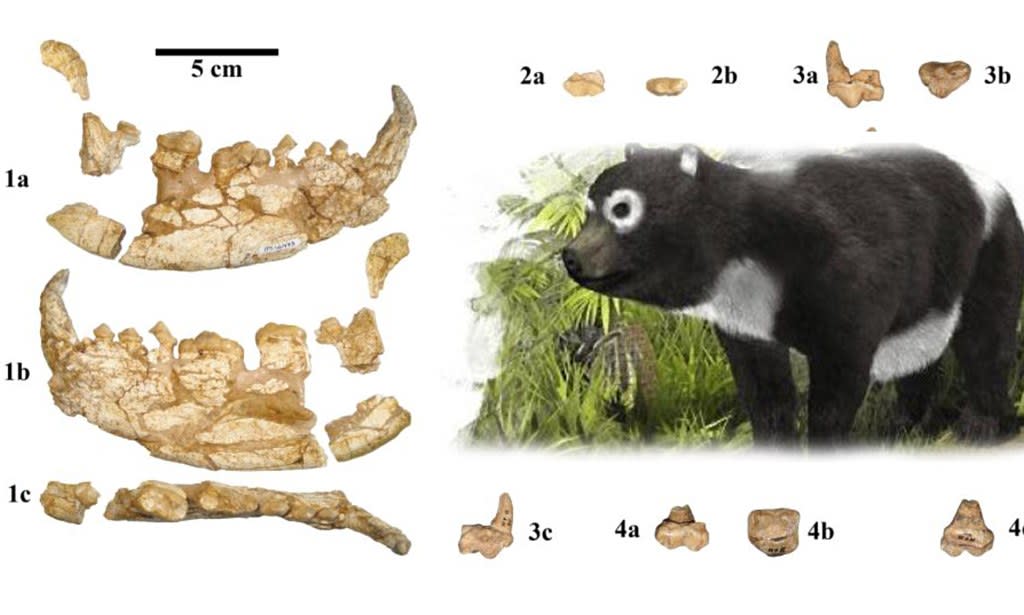
11 Million Year Old Panda Fossil Found in Germany Reveals Hidden Truth About Panda Evolution and Diet.
In a groundbreaking discovery that challenges long standing beliefs about panda evolution paleontologists have uncovered the fossilized remains of an 11 million year old panda relative in southern Germany. What makes this discovery particularly astonishing is the dietary evidence unlike modern pandas this ancient bear species was not a strict herbivore. Instead it had an omnivorous diet meaning it consumed both plants and animals.
Discovery at the Hammerschmiede Site
The fossil was discovered at the famous Hammerschmiede site in the Allgäu region of Bavaria Germany an area known for its rich fossil history. Researchers identified the remains as belonging to a species called Kretzoiarctos beatrix an extinct member of the bear family and a distant ancestor of the modern giant panda Ailuropoda melanoleuca.
The fossils which include teeth and jaw fragments, were remarkably well preserved allowing scientists to conduct in depth analysis and comparisons with other prehistoric and modern bears. One of the most surprising revelations came from the study of the bear’s teeth. Scientists used microscopic wear pattern analysis and other advanced dental techniques to determine the animal’s diet. The results were clear unlike the bamboo munching panda of today Kretzoiarctos beatrix had teeth adapted to an omnivorous diet. This included tough vegetation fruits and possibly even meat.
Dr. Nikolaos Kargopoulos lead researcher on the project explained Our findings show that this extinct panda relative did not depend solely on plants. It was more of a generalist capable of consuming a variety of foods depending on what was available in its environment. This discovery has turned previous assumptions about panda evolution on their head. For decades the giant panda was seen as a unique anomaly in the bear family due to its nearly exclusive bamboo diet. But this fossil suggests that the path to that specialization was gradual and driven by ecological changes over millions of years.
The Evolutionary Journey of Pandas
Today’s giant pandas are known for their limited diet about 99% of which is bamboo. But their digestive system is still that of a carnivore a mystery that puzzled scientists for years. The new discovery of Kretzoiarctos beatrix provides a crucial link in understanding how pandas made the transition from meat eating ancestors to the bamboo loving animals we know today. The fossil also sheds light on the geographical history of pandas. Until now most evidence suggested that pandas originated in Asia. However the German find along with previous discoveries in Spain and Bulgaria indicates that the ancestors of modern pandas may have originated in Europe before migrating eastward. As climates changed and environments shifted these animals would have adapted their diets and behaviors to survive ultimately evolving into the modern panda and settling in the bamboo forests of China.
Life in the Miocene Epoch
The 11 million year old fossil comes from the Miocene epoch a period marked by warm temperatures and dense forests teeming with wildlife. The Hammerschmiede site, where the fossil was found, has produced more than 160 species including mammals reptiles and even early apes. The environment was rich and competitive home to a variety of predators and herbivores. Kretzoiarctos beatrix would have had to adapt to this diverse ecosystem possibly climbing trees scavenging, or hunting small prey. This setting explains the omnivorous nature of the animal being flexible in its diet would have been an advantage in such a dynamic habitat. The discovery of Kretzoiarctos beatrix marks a significant step forward in understanding the evolutionary history of pandas. It highlights how diet geography and environment played a role in shaping one of the world’s most beloved animals. Far from being born bamboo eaters pandas went through millions of years of adaptation and change. This new fossil proves that the panda’s story is far more complex and fascinating than previously thought. As more fossils are discovered and analyzed scientists hope to fill in the gaps in the panda’s evolutionary journey. For now the remains of Kretzoiarctos beatrix serve as a powerful reminder that even the most iconic species have ancient secrets waiting to be uncovered.
About the Creator
Adnan Rasheed
Author & Creator | Writing News , Science Fiction, and Worldwide Update| Digital Product Designer | Sharing life-changing strategies for success.
Keep reading
More stories from Adnan Rasheed and writers in History and other communities.
An Ancient ‘Terror Crocodile’ Became a Dinosaur Eating Giant Scientists Say They Now Know Why
An Ancient ‘Terror Crocodile’ Became a Dinosaur Eating Giant Scientists Say They Now Know Why In the shadowy wetlands of prehistoric Earth some 95 million years ago a monstrous predator lurked a massive crocodile like creature capable of bringing down even the mightiest of dinosaurs. Known as the terror crocodile this ancient beast Deinosuchus grew up to 33 feet long and weighed more than 8,000 pounds. With crushing jaws and a bite force that rivaled that of Tyrannosaurus rex Deinosuchus was among the most fearsome predators of its time. For decades scientists have marveled at this creature trying to understand how it achieved such size and dominance. Now new research may finally have the answer.
By Adnan Rasheed9 months ago in History
Military Strength of Alexander the Great and the Chola Empire: A Historical Comparison
Though separated by more than a thousand years and operating in vastly different geographical and cultural contexts, both forces achieved extraordinary success through discipline, innovation, and strategic brilliance. This article explores the history, composition, size, organization, and military strength of Alexander’s Macedonian army and the Chola military, highlighting how each became a dominant power of its era.
By Say the truth 5 days ago in History


Comments
There are no comments for this story
Be the first to respond and start the conversation.