
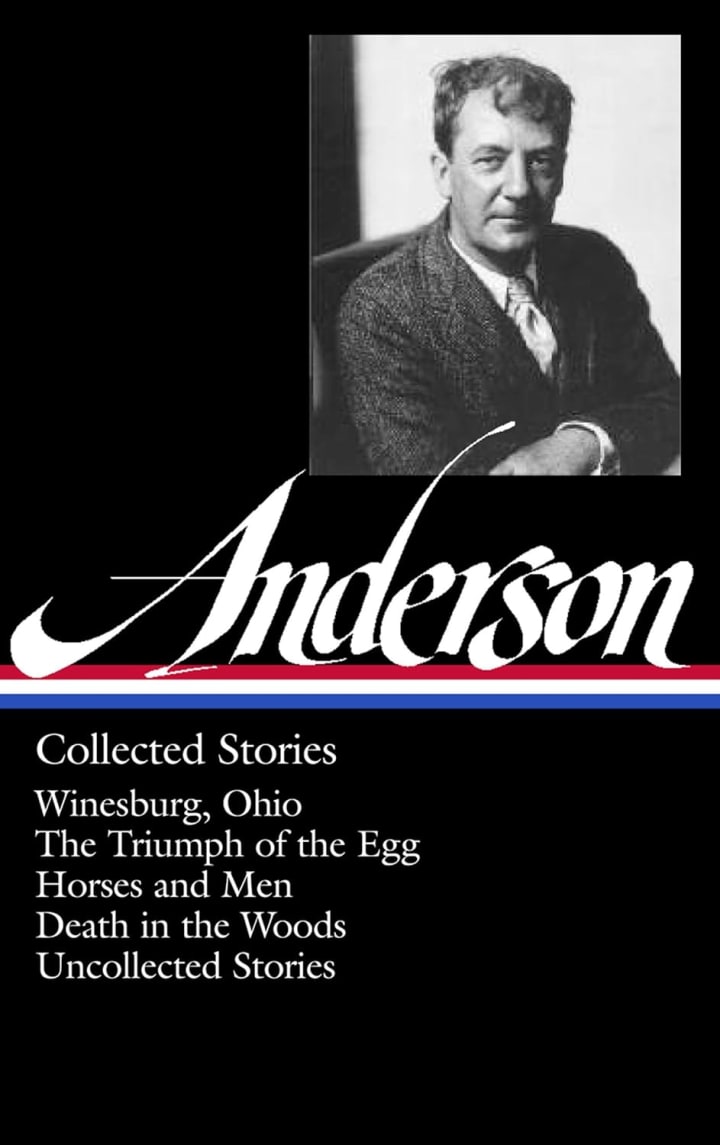
Winesburg, Ohio by Sherwood Anderson
Why It's a Masterpiece (Week 74)

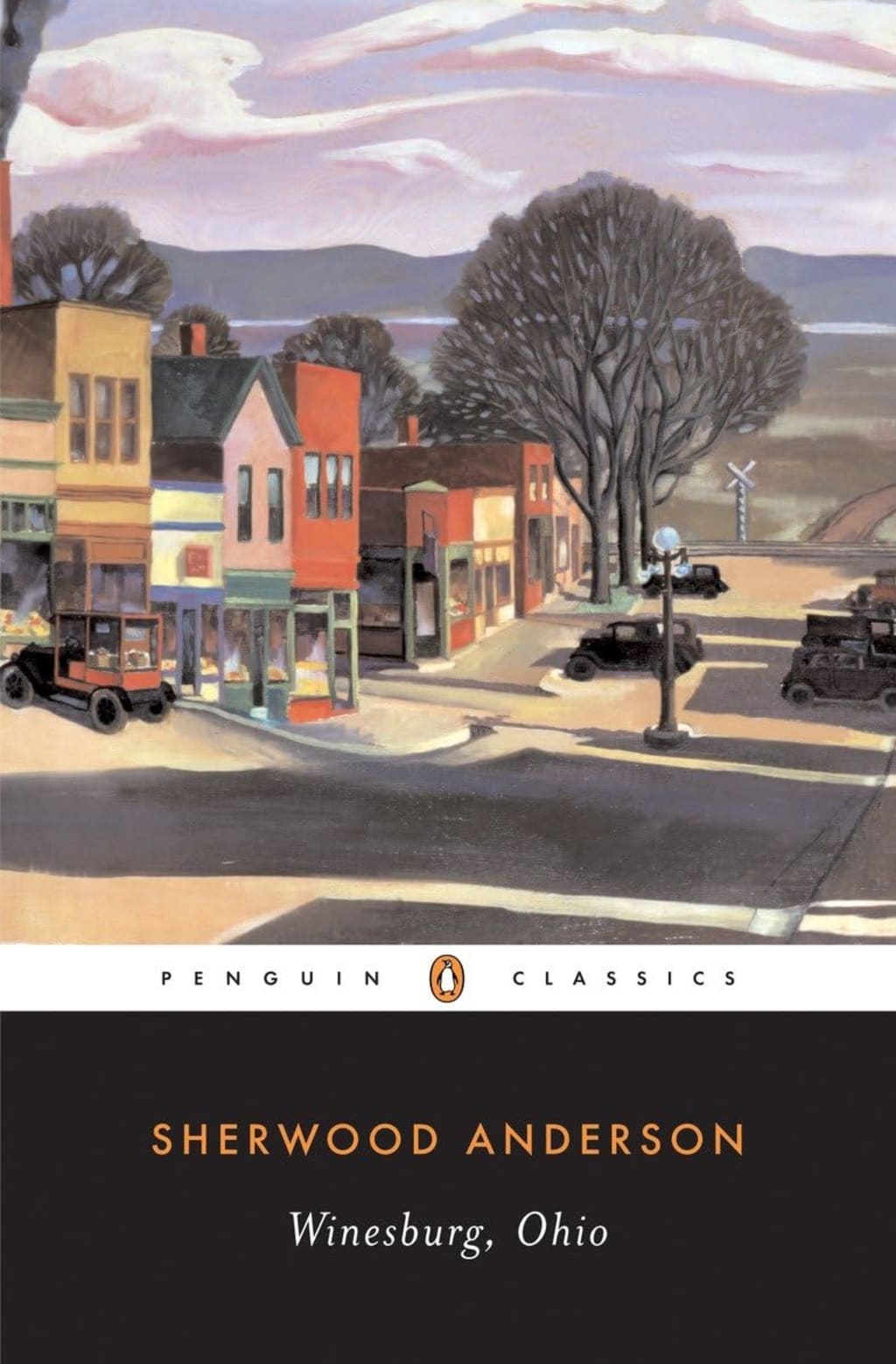
Sherwood Anderson’s Winesburg, Ohio was first published in 1919 and is widely considered a cornerstone of American modernist literature. Subtitled A Group of Tales of Ohio Small-Town Life, the book is a collection of interconnected short stories that revolve around the inhabitants of the fictional town of Winesburg, as observed through the perspective of a young man named George Willard. The work is often described as a Bildungsroman wrapped within a short story cycle.
Anderson drew inspiration from his own experiences growing up in Clyde, Ohio, a small town whose people and atmosphere greatly influenced his portrayal of Winesburg. The stories reflect his keen observations of human nature and his interest in exploring the inner lives of ordinary people. Writing at a time when American literature was shifting from Romanticism to realism and modernism, Anderson sought to depict the struggles, desires, and isolation of everyday individuals in a way that felt raw and authentic.
Winesburg, Ohio marked a departure from the traditional linear narratives of the time. Instead, Anderson used a fragmented structure, with each story focusing on a different character while contributing his use of language to themes of loneliness, alienation, and the human desire for connection.
Plot
Winesburg, Ohio is a loosely connected series of 22 short stories centred on the small-town inhabitants of Winesburg, Ohio. The stories are unified by their shared setting and by George Willard, a young newspaper reporter who serves as both observer and confidant to the town’s residents. Each story delves into the lives of individual characters, revealing their private struggles, unfulfilled desires, and moments of epiphany.
The book opens with “The Book of the Grotesque,” a prologue in which an unnamed writer reflects on the concept of "grotesques" (individuals whose lives have been distorted by their singular obsessions or beliefs). Anderson uses this to explore the lives of different people throughout the book.
One of the central stories, “Hands,” introduces Wing Biddlebaum, a reclusive man who is ostracised after being falsely accused of inappropriate behaviour due to his expressive use of his hands. His tragic isolation sets the tone for the book’s exploration of loneliness and misunderstanding.
Other notable stories include “Mother,” where Elizabeth Willard, George’s ailing mother, yearns for her son to escape the stagnation of small-town life; and “Paper Pills,” which recounts the tragic love story of Dr. Reefy, a widowed physician who writes cryptic notes he never shares with anyone.
As George grows older, he becomes a confidant for the town’s troubled souls. Stories such as “Sophistication” and “The Teacher” highlight his own journey of self-discovery and his struggles with love, ambition, and identity. The recurring presence of George provides a sense of cohesion and underscores the contrast between youthful potential and the disillusionment of adulthood.
The book culminates with “Departure,” in which George leaves Winesburg to pursue his ambitions, symbolising both hope and the inevitability of change. His departure marks a bittersweet conclusion to the collection, as he leaves behind a town defined by its beauty and its tragedies.
Into the Book
Isolation:
Isolation is a pervasive theme in Winesburg, Ohio, with many of the characters trapped in emotional solitude. Anderson portrays loneliness as a fundamental aspect of human existence, exacerbated by the constraints of small-town life and societal expectations.
Wing Biddlebaum, the protagonist of “Hands,” embodies the devastating effects of isolation. Once a popular teacher, he is forced into a life of seclusion after being falsely accused of inappropriate behaviour. Anderson writes, “The story of Wing Biddlebaum is a story of hands. Their restless activity, like unto the beating of the wings of an imprisoned bird, had given him his name.” His hands, a symbol of his desire to connect, are also the source of his alienation. Wing’s story highlights how fear and prejudice can sever human connections, leaving individuals to suffer in silence.
Elizabeth Willard, George’s mother in “Mother,” also illustrates the despair of isolation. Trapped in a loveless marriage and a decaying body, she pins her hopes on George’s future, yearning for him to escape the stagnation that defines her life. Her internal monologue reveals a profound sense of unfulfilled potential: “She thought of her own life, that it was without meaning, and it seemed to her that the death of her son would wipe out the world.”
Anderson’s characters frequently struggle to articulate their emotions, which deepens their isolation.
“You must try to forget all you have learned,' said the old man. 'You must begin to dream. From this time on you must shut your ears to the roaring of the voices.”
- Winesburg, Ohio by Sherwood Anderson
The Grotesques:
The concept of the “grotesques” serve as both a thematic and structural framework for the collection. Anderson’s grotesques are individuals whose lives have been shaped (or misshapen) by their adherence to singular truths or beliefs. These truths, while once meaningful, become destructive when pursued in isolation.
In “Paper Pills,” Dr. Reefy’s cryptic notes symbolise the fragments of wisdom he has gathered over his lifetime. However, these truths remain unshared, reducing him to a figure of tragic isolation. Anderson writes, “It was as though the souls of the two had been one and that now, after a long time, the two halves of the soul had been united in the moment of understanding.”
The grotesques’ distorted lives serve as cautionary tales, illustrating the dangers of clinging too tightly to any one ideal or belief. Anderson uses these characters to explore the complexities of human nature, suggesting that everyone carries their own form of grotesqueness.
“In that high place in the darkness the two oddly sensitive human atoms held each other tightly and waited. In the mind of each was the same thought. "I have come to this lonely place and here is this other," was the substance of the thing felt.”
- Winesburg, Ohio by Sherwood Anderson
Amidst the loneliness and despair, the characters of Winesburg, Ohio strive for meaning and connection. This theme is particularly evident in George Willard’s coming-of-age journey, as he seeks to understand himself and the world around him.
In “Sophistication,” George experiences a fleeting moment of connection with Helen White, a young woman from the town. Anderson describes their encounter as a moment of mutual understanding and shared vulnerability: “For a moment there was something very fine in the young man’s soul and in the soul of the young woman.” This rare instance of intimacy contrasts with the pervasive isolation in the other stories, offering a glimmer of hope.
The stories collectively suggest that while complete understanding between individuals may be unattainable, the attempt to connect is what gives life meaning.
“I am a lover and have not found my thing to love. That is a big point if you know enough to realize what I mean. It makes my destruction inevitable, you see. There are few who understand that.”
- Winesburg, Ohio by Sherwood Anderson
Why It's a Masterpiece
Anderson’s writing style, marked by its simplicity and emotional resonance, broke away from the ornate prose of the late 19th century (you can probably hear me screetching at the thought, but it does the anti-sentimentalism quite well). His focus on the inner lives of ordinary people paved the way for modernist literature, influencing writers such as Ernest Hemingway and William Faulkner (the greatest of all American writers). The book’s fragmented structure and emphasis on psychological realism were groundbreaking at the time, redefining what literature could achieve.
Thematically, Winesburg, Ohio transcends its small-town setting to address universal concerns: loneliness, the search for meaning, and the struggle to connect with others.
Conclusion
Winesburg, Ohio remains a big part of American literature (even though in my opinion, it is under-appreciated) because of its universal themes, innovative structure, and emotional depth. Sherwood Anderson’s exploration of human isolation and longing resonates across generations, offering readers a poignant reflection on the complexities of life.
The book’s influence on modernist literature and its empathetic portrayal of flawed, ordinary people ensure its readibility in the 21st century. By capturing the beauty and pain of the human experience, Winesburg, Ohio continues to inspire readers and writers alike, reaffirming its status as a literary classic. I myself only read this book two or three years ago and yet, I have never forgotten it. It happens to be the favourite book of quite a few people I have met.
Next Week: An American Tragedy by Theodore Dreiser
About the Creator
Annie Kapur
I am:
🙋🏽♀️ Annie
📚 Avid Reader
📝 Reviewer and Commentator
🎓 Post-Grad Millennial (M.A)
***
I have:
📖 280K+ reads on Vocal
🫶🏼 Love for reading & research
🦋/X @AnnieWithBooks
***
🏡 UK
Keep reading
More stories from Annie Kapur and writers in Geeks and other communities.
Book Review: "The Bombshell" by Darrow Farr
When I heard about this book I swear I wasn't looking at the Kindle price to page ratio. Actually I was. It was 99p for over 400 pages of novel and so, I took my chances. The book's summary on Amazon didn't sound all that exciting but I think that if I didn't take up the deal then I probably would have run out of things to read. The Bombshell is basically about a seventeen-year-old entitled girl who is obsessed with celebrities, Hollywood and money who is the daughter of some pretty important people. She ends up getting kidnapped and held as a political prisoner by a group of people trying to get another political prisoner to be set free. At 25, he has a 15 year sentence.
By Annie Kapur6 months ago in Geeks
Silver Screen Magic with Mae West
American actress and singer Mae West became a popular film actress during the Great Depression. She started entertaining in vaudeville, then performed on Broadway, and finally went to Hollywood. She signed up with Paramount Pictures and made her debut in the 1932 film “Night After Night.” She also starred in musicals, comedies, and crime dramas. The American Film Institute named her one of the best classic Hollywood actresses.
By Rasma Raisters8 days ago in Geeks
Can I Watch Super Bowl in NZ?
Super Bowl, one of the most exciting sporting nights of the year, is now less than a month away and the excitement is already palpable. Scheduled on February 8, 2026 at Levi’s Stadium in Santa Clara, California, this will be the third Super Bowl held in the San Francisco Bay Area.
By David Cookabout 18 hours ago in Geeks
The Devil's Cut
“Comrade, finally you’re awake.” The voice was smooth, sensual. A flickering incandescent bar was all that lit the white, sterile room. All Vladimir remembered was everything going black. He tried to move his arms and found them strapped to the gurney.
By Matthew J. Fromm7 days ago in Fiction


Comments (2)
“I am a lover and have not found my thing to love. That is a big point if you know enough to realize what I mean. It makes my destruction inevitable, you see. There are few who understand that.” Whoaaaa, that resonated so deeply with me. Unfortunately, not many realize or understand this.
That's funny you are writing about this book and this town. Last year I was driving home from Seattle Washington on a huge road trip. I took a detour to get off the highway to miss a huge storm that was blowing up. I ended up in Winesburg, and I had to stop for gas, while I was pumping the gas, a man had gone into the store and robbed it at gun point, and he ran pass me and jumped in the car that was parked on the other side of me. You did a great job writing about this book.