
Windwalker (1980): The Forgotten Western Told in Cheyenne and Crow
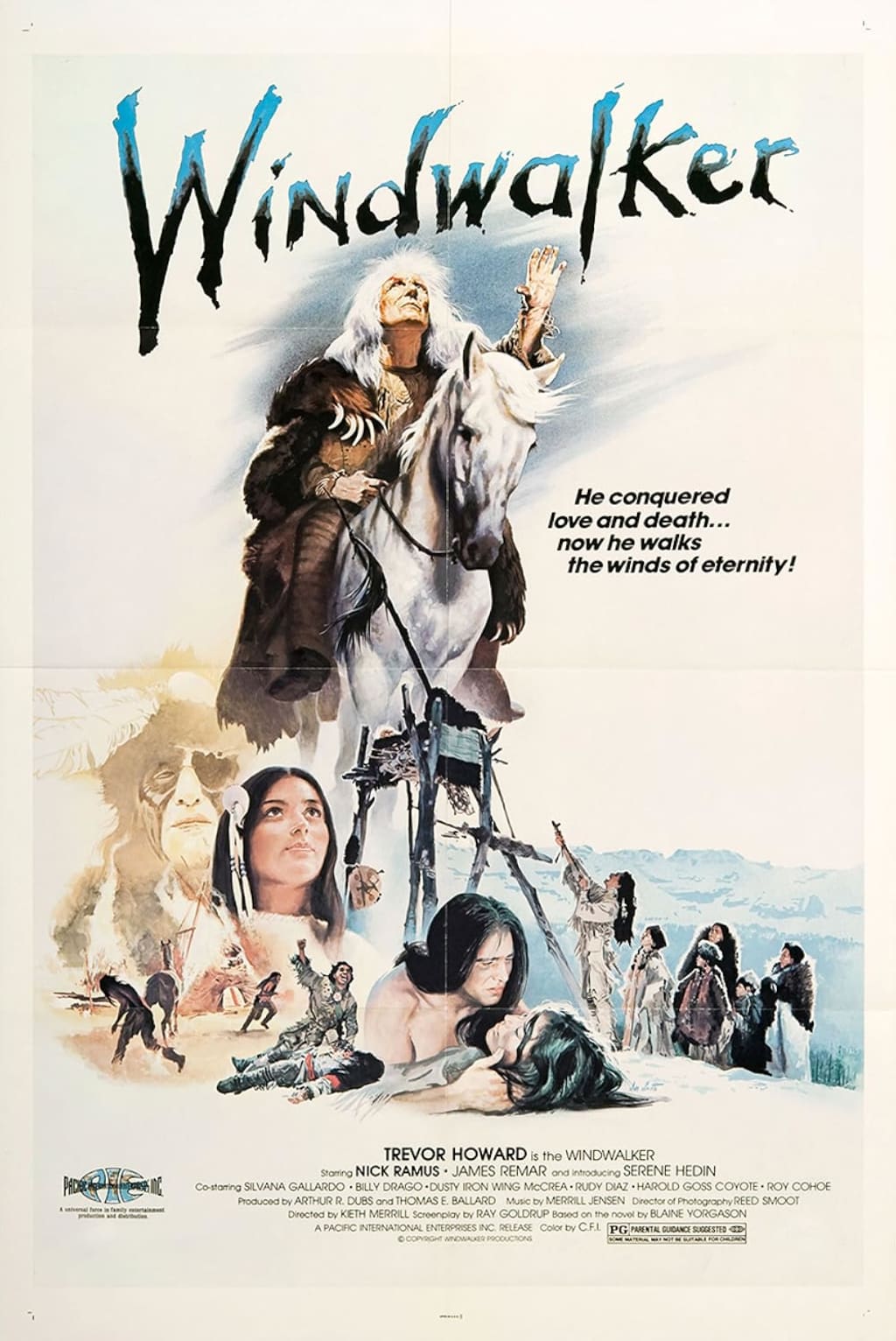
Windwalker (1980) is one of the few American films spoken almost entirely in Native languages. Here’s how filmmakers handled Cheyenne and Crow dialogue, how Native communities responded, and why its legacy remains complex.

A Western That Broke the Rules
When people think of 1980s Westerns, they usually recall revisionist works like Heaven’s Gate or nostalgic star vehicles. Few remember Kieth Merrill’s Windwalker (released in 1980, though often grouped with early 80s films), a modestly budgeted historical drama with one extraordinary claim: with the exception of an English-language narration, every line of dialogue is spoken in Cheyenne and Crow. Subtitled for mainstream audiences, Windwalker dared to put Native voices front and center — a choice virtually unheard of in Hollywood at the time.
⸻
Filmmakers’ Approach to Language
The production leaned into authenticity as its major selling point. Cheyenne and Crow were chosen not as exotic window dressing, but as the languages spoken by the characters in their time and place. Merrill and his team cast Indigenous actors who could deliver the lines with accuracy and credibility, supplemented with guidance from Native speakers.
Instead of dubbing into English — the standard industry shortcut — they subtitled the dialogue. That decision preserved the cadence and rhythm of the languages while making the film accessible to wider audiences. The one exception was a voice-over narration in English, included as a guide for viewers unfamiliar with the cultural context.
By letting Indigenous languages dominate the soundtrack, Windwalker avoided the “Hollywood Indian” trope of gibberish or pidgin speech. For audiences in 1980, it was startling, immersive, and unprecedented.
⸻
How Native Communities and Critics Responded
Reactions were varied and complex.
On one side, mainstream critics praised the film’s respectfulness. Gene Siskel and Roger Ebert recommended it on Sneak Previews, noting how the use of Cheyenne and Crow forced audiences to identify with Native perspectives rather than with the usual white protagonists. The mostly Native cast — aside from British actor Trevor Howard as the elderly Windwalker — was likewise a break from Hollywood tradition.
Many Native viewers and activists saw the choice as overdue recognition. It was rare to see their languages treated with dignity on the big screen, and rarer still to see entire communities represented in a story not filtered through white leads.
Yet not everyone was satisfied. Scholars and Native commentators noted that the film still fell into familiar patterns — “noble” versus “savage” tribes, simplistic moral binaries, and visual framing that sometimes perpetuated old stereotypes. Later film historians have argued that while Windwalker represented progress, it wasn’t free from the biases of its time.
⸻
The Academy Awards Problem
The film’s bold linguistic choice also created an unexpected industry snag. Because almost all of its dialogue was in non-English languages, Windwalker could not be considered for Best Foreign Language Film at the Academy Awards. By rule, only a recognized nation-state can submit a film in that category. Since Cheyenne and Crow are Indigenous languages within the United States, the film had no path to eligibility.
For Native communities, the irony was painful: the use of authentic Native speech effectively excluded the film from recognition, while films in French or Italian faced no such barriers. The episode underscored how U.S. institutions treat Indigenous cultures as “foreign” within their own homeland.
⸻
Legacy Beyond the Box Office
Commercially, Windwalker came and went with little fanfare. But in the decades since, it has gained a kind of cult status as a bold experiment in representation. University courses on Native cinema often screen it as a discussion piece, and contemporary Native artists — including Gail Tremblay, who weaves film strips into visual art — have used Windwalker as raw material for critiques of Native representation.
The film remains a unique artifact: neither a box-office hit nor a total misfire, neither a perfect portrayal of Native life nor a dismissible Hollywood stereotype. It occupies a rare middle ground, remembered less for its narrative than for the fact that audiences in 1980 sat in theaters reading subtitles in Cheyenne and Crow.
⸻
Why Windwalker Still Matters
The most important legacy of Windwalker is its insistence that Native languages are not ornamental but essential. At a time when many Indigenous languages faced erasure, seeing them dominate a feature film was a radical act.
Yes, the film is dated, and yes, it remains flawed. But its daring linguistic choice — and the conversations it sparked in Native and non-Native communities alike — gives it a lasting cultural importance. In a decade when most Westerns were either nostalgic retreads or box-office disasters, Windwalker stands apart as a genuine, if imperfect, attempt to let Indigenous voices speak for themselves.
Subscribe to Movies of the 80s here on Vocal and on YouTube. YouTube.com/Moviesofthe80s.
About the Creator
Movies of the 80s
We love the 1980s. Everything on this page is all about movies of the 1980s. Starting in 1980 and working our way the decade, we are preserving the stories and movies of the greatest decade, the 80s. https://www.youtube.com/@Moviesofthe80s
Keep reading
More stories from Movies of the 80s and writers in Geeks and other communities.
Walker v. Time Life Films: The Forgotten Lawsuit Behind Fort Apache, The Bronx
New York City’s South Bronx. Critics debated whether the film captured reality or exaggerated it for shock value. What’s less remembered is that the film sparked a lawsuit by a former cop-turned-writer who believed Hollywood stole his story. The case, Walker v. Time Life Films, Inc. (784 F.2d 44), went all the way to the United States Court of Appeals and has since become a frequently cited copyright decision.
By Movies of the 80s4 months ago in Geeks
Silver Screen Magic with Mae West
American actress and singer Mae West became a popular film actress during the Great Depression. She started entertaining in vaudeville, then performed on Broadway, and finally went to Hollywood. She signed up with Paramount Pictures and made her debut in the 1932 film “Night After Night.” She also starred in musicals, comedies, and crime dramas. The American Film Institute named her one of the best classic Hollywood actresses.
By Rasma Raisters6 days ago in Geeks
Book Review: "I Think You’ll Find It’s a Bit More Complicated Than That" by Ben Goldacre
Again, used bookstores for random finds is probably your best bet when it comes to wanting to read books. Nobody has any money nowadays and well, bookshops like Waterstones and Foyles are great for gifting but when it comes to reading - I think there's more to be said about buying someone else's book. Sometimes there are notes in them, sometimes there are weird birthday cards with phone numbers in them (yes, I found that once) and of course, there's that Andy Warhol book where I was legitimately confused about what I had found. At the moment, I'm sitting around drinking coffee, so let's have a look at this weird compilation of journalism by a man who once wrote for the Guardian Newspaper.
By Annie Kapur7 days ago in Geeks



Comments
There are no comments for this story
Be the first to respond and start the conversation.