
Will AI Replace Writers — Or Expose Who Was Never Original?
In an age of algorithms and automation, the real question isn’t whether machines can write — it’s whether humans still know how to think.

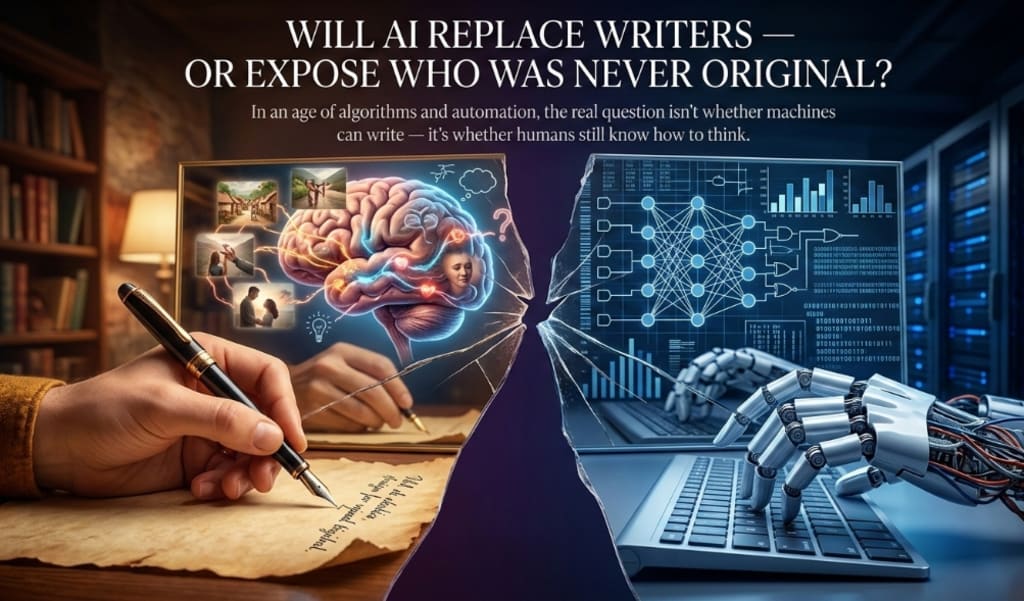
The fear is everywhere.
Writers whisper about it in forums. Designers argue about it on social media. Students experiment with it in silence. Artificial intelligence is no longer a futuristic concept — it is a daily tool. It drafts emails, writes poems, generates scripts, summarizes research, and even mimics literary styles. The question that echoes across creative industries is blunt and uncomfortable:
Will AI replace writers?
The better question, however, may be more unsettling: Will AI expose who was never truly original to begin with?
Because what AI is really disrupting is not creativity itself. It is imitation.
The Machine That Learned to Write
AI writing systems are trained on vast datasets — books, articles, essays, websites. They detect patterns in language: structure, tone, rhythm, transitions. When prompted, they predict the most statistically probable next word based on learned patterns.
It feels intelligent. It feels creative. But technically, it is pattern recognition at scale.
That matters.
AI does not experience heartbreak. It does not wake up anxious at 3 a.m. It does not fall in love, grieve loss, or wrestle with doubt. It reorganizes information based on probability.
And yet, the outputs can sound persuasive, poetic, even profound.
So where does that leave human writers?
The Comfort Zone of Predictable Writing
Here is the uncomfortable truth: a large portion of online writing was already formulaic before AI arrived.
Listicles followed templates. Motivational articles recycled familiar advice. Tech blogs echoed press releases. Even storytelling often followed predictable arcs optimized for engagement rather than depth.
AI thrives in environments where structure dominates originality. If writing is built from recognizable patterns, then a pattern-detecting system can replicate it efficiently.
This is why some writers feel threatened.
Not because AI can create meaning.
But because it can replicate mediocrity at scale.
If a writer’s value was primarily speed, structure, and surface-level research, AI now competes directly in that space.
What AI Cannot Replicate (At Least Not Yet)
Original thought is not just rearranged information. It is perspective shaped by lived experience.
When a writer describes the smell of rain in a childhood village, the tension before a difficult decision, or the quiet realization that a dream has changed — that is not pattern recognition. That is interpretation of reality.
Human creativity emerges from contradictions, emotional nuance, cultural context, and imperfect memory. It is messy.
AI, in contrast, is clean.
It produces coherent paragraphs. It balances arguments. It avoids personal vulnerability unless instructed to simulate it.
But simulation is not experience.
Readers may not consciously articulate the difference, yet they feel it. Authentic writing carries unpredictability — small imperfections that reveal humanity. AI-generated writing often feels polished, structured, and slightly detached.
The danger is not that AI will erase creativity.
The danger is that readers might become accustomed to polished predictability and forget how to value depth.
The Economic Shift
From a practical perspective, AI absolutely changes the market.
Businesses that once hired writers for product descriptions, SEO blog posts, and basic copy can now generate drafts instantly. This lowers demand for entry-level writing tasks.
However, something else happens simultaneously.
As generic content becomes abundant, high-quality, distinctive writing becomes rarer and more valuable.
When everyone can generate a 1,000-word article in minutes, attention shifts to credibility, voice, and insight.
Readers begin to ask: Who understands this subject deeply? Who is offering something new? Who is thinking instead of summarizing?
In an AI-saturated environment, human originality becomes a premium.
The Real Skill of the Future Writer
The writer of the future is not someone who competes with AI on speed.
The writer of the future uses AI strategically while strengthening uniquely human skills:
Critical thinking
Emotional intelligence
Cross-disciplinary insight
Ethical reasoning
Narrative depth
AI can assist with structure and research summaries. But synthesis — connecting ideas across psychology, technology, culture, and philosophy — requires human judgment.
The competitive edge is no longer typing faster.
It is thinking better.
Creativity as Collaboration
There is another way to see this shift.
Instead of asking whether AI replaces writers, consider whether it becomes a collaborative tool.
Throughout history, new technologies have disrupted creative fields. The printing press changed publishing. Photography changed painting. Digital editing transformed filmmaking.
Each time, some feared extinction.
Instead, art evolved.
Photography did not kill painting; it pushed painters toward impressionism and abstraction. Digital tools did not end cinema; they expanded storytelling possibilities.
AI may follow the same pattern.
Writers who cling to repetition may struggle. Writers who experiment, refine, and challenge themselves may discover new forms of expression.
AI can generate drafts, brainstorm ideas, suggest outlines. But refinement, intention, and authenticity remain human responsibilities.
The Psychological Fear
Much of the anxiety surrounding AI is not economic. It is existential.
Writing is often tied to identity. For many, it is proof of intelligence, creativity, and personal value. When a machine produces similar output, it feels like a personal threat.
But creativity is not defined by exclusivity.
A calculator does not make mathematicians irrelevant. It removes computational burden so deeper problems can be solved.
Similarly, AI may remove mechanical writing tasks so humans can focus on conceptual depth.
The shift challenges ego more than ability.
If writing was a way to feel special, AI disrupts that comfort.
If writing is a way to explore truth, AI becomes a tool.
The Reader’s Responsibility
There is also a societal dimension.
If readers reward shallow, quickly produced content, AI-generated material will dominate.
If readers seek nuance, lived experience, and intellectual rigor, human writing will remain essential.
Algorithms amplify engagement, not wisdom.
The future of writing depends not only on creators but on audiences. The demand for depth must exist for depth to survive.
Exposure, Not Elimination
AI does not automatically eliminate writers.
It exposes which writing relied heavily on repetition and formula.
It reveals who depended on structure rather than insight.
It challenges creators to move beyond safe templates.
In that sense, AI is less a destroyer and more a mirror.
It reflects the patterns we built.
The Deeper Question
Perhaps the real transformation is philosophical.
What is creativity?
If creativity is simply recombining existing ideas in new arrangements, AI performs that task impressively.
If creativity is rooted in consciousness, experience, and subjective interpretation, humans remain irreplaceable.
The tension between these definitions shapes the future.
And perhaps the future is hybrid.
Human imagination, guided by ethical reasoning and emotional depth, supported by computational efficiency.
Conclusion: The Standard Rises
AI will not end writing.
It will raise the standard.
Surface-level content becomes automated. Insight becomes differentiated. Original thought becomes currency.
Writers who adapt, think critically, and cultivate authentic voice will not disappear. They will stand out more clearly against a background of generated sameness.
The uncomfortable truth remains: AI does not threaten originality.
It threatens imitation.
And maybe that is not a loss.
Maybe it is an invitation — to think deeper, feel more honestly, and write with intention rather than routine.
In a world where machines can produce words endlessly, meaning becomes rare.
And rarity has always been valuable.
About the Creator
Amanullah
✨ “I share mysteries 🔍, stories 📖, and the wonders of the modern world 🌍 — all in a way that keeps you hooked!”
Squatty Potty
How a small footstool sparked a global conversation about posture, digestion, and modern health In the world of wellness products, few items have sparked as much curiosity as the Squatty Potty. At first glance, it looks like a simple plastic or bamboo stool designed to fit around the base of a toilet. But behind that straightforward design lies a broader conversation about posture, digestive health, and how modern lifestyles have changed even the most basic human habits. While it may seem like an unconventional topic, bathroom posture has become a legitimate subject of interest in health circles. The Squatty Potty positioned itself not as a gimmick, but as a tool rooted in anatomy. The Idea Behind the Design The concept is based on the natural squatting position humans historically used for bowel movements. In many parts of the world, squat toilets remain common. Advocates of this posture argue that squatting straightens the rectum and reduces strain. Modern Western toilets, however, place the body in a seated position, which can create an angle that may require more effort during elimination. The Squatty Potty elevates the feet while sitting, mimicking a squatting posture without requiring a complete change in toilet style. Supporters suggest that this position can: Reduce straining Promote more complete elimination Help with occasional constipation Decrease pressure associated with hemorrhoids Though experiences vary, many users report improved comfort after adjusting their posture. From Household Product to Cultural Phenomenon The Squatty Potty gained widespread attention after appearing on the television show Shark Tank. Its founders presented the product as a simple yet practical solution to a universal problem. The appearance helped introduce the brand to a national audience and significantly boosted sales. Later, a humorous viral marketing campaign featuring a unicorn further propelled the product into mainstream conversation. The advertisement combined comedy with anatomical explanation, making an otherwise awkward topic more approachable. What set the Squatty Potty apart was its willingness to address a topic that many people are uncomfortable discussing. By combining lighthearted branding with educational messaging, the company turned a bathroom accessory into a widely recognized name. The Science Behind Squatting Medical professionals have long understood that body positioning affects bowel movements. When squatting, the puborectalis muscle relaxes more fully, potentially straightening the pathway for elimination. In a seated posture, this muscle may create a slight bend, requiring additional effort. While some studies suggest that squatting can reduce strain and time spent on the toilet, it’s important to note that results are individual. The Squatty Potty does not treat medical conditions, and people experiencing chronic digestive issues should consult healthcare providers. That said, posture adjustments are a low-risk lifestyle change. For many, it represents a simple experiment in comfort rather than a medical intervention. Why Bathroom Habits Matter Digestive health plays a central role in overall well-being. Constipation and straining are common concerns, often influenced by diet, hydration, stress, and physical activity. While fiber intake and water consumption remain foundational solutions, posture can be another factor. In recent years, there has been a growing openness about gut health. Conversations once considered private are now part of broader wellness discussions. Products like the Squatty Potty reflect this cultural shift—acknowledging that digestive comfort deserves attention without embarrassment. Practical Considerations Before Buying For those considering a Squatty Potty, several versions are available, including adjustable models and materials ranging from plastic to bamboo. The core function remains the same: elevating the feet to achieve a more natural angle. Before purchasing, consumers may want to consider: Bathroom space and storage Adjustable height preferences Ease of cleaning Household usage needs Some people choose to replicate the concept temporarily using a small step stool to determine whether the posture feels beneficial before investing in a branded product. Addressing Common Misconceptions One misconception is that a footstool alone will resolve all digestive issues. In reality, bowel health is multifaceted. Diet, hydration, exercise, stress levels, and underlying conditions all contribute to regularity. Another misconception is that using such a product is unnecessary or exaggerated. For some individuals, it may indeed feel unnecessary. For others, it can significantly improve comfort. Like many wellness tools, its effectiveness depends on personal experience. Importantly, there is no harm in adjusting posture in a safe and stable manner. The key is to use a sturdy platform and avoid instability. Cultural Perspectives on Squatting Globally, squatting is far from unusual. In many countries across Asia, Africa, and parts of Europe, squat toilets remain standard. In those contexts, the body’s natural posture is maintained without additional accessories. The popularity of the Squatty Potty in Western markets highlights how modern infrastructure sometimes diverges from traditional human movement patterns. It also reflects how innovation can bridge that gap without requiring structural changes. Rather than replacing existing toilets, the product adapts to them—offering a compromise between modern convenience and anatomical alignment. A Broader Reflection on Everyday Design The success of the Squatty Potty underscores how everyday objects can influence health and comfort. Often, the most impactful innovations are not complex technologies but simple design adjustments. By rethinking posture in one of life’s most routine moments, the product opened a conversation about how design shapes daily experiences. Whether one chooses to use it or not, the discussion itself has encouraged greater awareness of digestive health. In a culture increasingly focused on wellness, even small changes can feel meaningful. The Squatty Potty may not be revolutionary in appearance, but its message is clear: comfort and function matter—even in the bathroom. Ultimately, the decision to use a footstool comes down to personal preference. For some, it’s a helpful addition. For others, it’s unnecessary. What remains consistent is the reminder that health sometimes begins with the simplest adjustments.
By Saboor Brohi 4 days ago in Geeks
I wanted to title this something different, but worried that my chosen title might cause problems entering the United States in the future so this is the new title. It's the greatest title. No one has ever written a title better than this. (All titles unrelated to content).
Let me be honest. I am finding this difficult. Now, I like a challenge, a stretch, a bit of an obstacle course. “Write about the decline of the British Empire in the form of a narrative poem in which your protagonist is an artichoke” I read, and flex my fingers. “Write a haiku to evoke the sensation of sibilance using only the first half of the alphabet.” “Well”, I think to myself, “this should be fun.” But “write about a system that isn’t working”? A system that isn’t working? Now? In 2026? ONE system? My favourite system that isn’t working? The sexiest system that isn’t working? The one giving me the most angst day to day? The one giving me the most existential dread? I am, as I say, finding this difficult. I will own that I have contemplated writing a thousand words on why the steady “all on” setting on my fairy lights is the EIGHTH of seven options which must be sequentially activated to get there, because that is a system that some fool came up with and it definitely doesn’t work, and now who is paying the price, eh? But how can I write about my fairy lights when…. When…. When….
By Hannah Moore3 days ago in Humans


Comments
There are no comments for this story
Be the first to respond and start the conversation.