
Why Wisconsin Industrial Firms Should Invest in AI-Ready Mobile Apps
Wisconsin manufacturing is at a tipping point. Discover why investing in AI-ready mobile apps is the key to solving labor shortages and boosting efficiency.

Look, I get it. If I hear the phrase "digital transformation" one more time while standing on a shop floor that still runs on Excel spreadsheets and grit, I might just scream. It feels like every year there's a new buzzword we're supposed to throw money at. First, it was the cloud, then IoT, and now it's AI. It’s enough to make you want to retreat to a cabin in the Northwoods and ignore the wifi signal.
But here is the thing: ignoring this one isn't an option.
We are deep into 2026 now, and the landscape for Wisconsin manufacturing has shifted. It’s not just about "staying competitive" anymore; it’s about keeping the lights on. The labor shortage didn't magically fix itself, did it? If anything, it’s tighter than a rusty bolt. We’re seeing flat growth projections and a volatile economy, yet—contradiction alert—66% of manufacturers still expect higher sales this year.
How does that math work? It works because the firms that are winning aren't working harder; they're offloading the brain-numbing work to algorithms. And they aren't doing it with clunky desktop software from 1998. They are doing it with AI-ready mobile apps that put the power right in the worker's pocket.
The "Agentic" Shift: It’s Not Just Chatbots Anymore
Remember when AI was just a chatbot that couldn't understand a simple question? Those days are gone. The big trend right now is "Agentic AI." These aren't just passive tools that wait for you to type a prompt. These are digital agents that actively monitor your production lines, schedule maintenance, and even re-route supply chains when a blizzard hits Green Bay.
According to a 2026 outlook by IDC, over 40% of manufacturers with production scheduling systems are upgrading them with AI-driven capabilities this year. Why? because human brains aren't built to calculate five thousand variables in real-time. We’re built to solve creative problems.
When you invest in app development in Wisconsin, you aren't just building a piece of software. You are building a bridge between your legacy machinery and this new layer of intelligence. Teams that understand the local industrial context—the specific pain points of a foundry in Milwaukee or a paper mill in the Fox Valley—are crucial here. You need developers who know that "downtime" isn't just a metric; it's a disaster.
Real Talk: The Labor Gap Isn't Closing
Let's be brutally honest for a second. The "skills gap" is a polite way of saying we can't find enough people to do the hard jobs.
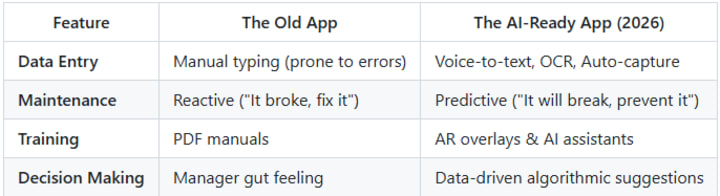
- The Old Way: You hire a new technician. It takes six months to train them. They leave for a slightly better offer. You start over.
- The 2026 Way: You hand that new technician a tablet running an AI-ready app. The app uses computer vision to "see" the machine they are fixing. It highlights the part that needs replacing on their screen. It pulls up the exact manual page. It essentially downloads twenty years of tribal knowledge into a rookie’s head instantly.
Buckley Brinkman, the CEO of the Wisconsin Center for Manufacturing & Productivity (WCMP), put it perfectly in their recent "Seize the AI Advantage" report:
"This isn't about someday. This is about today. AI is no longer optional. It's the difference between thriving and becoming obsolete." — Buckley Brinkman, WCMP
He’s not wrong. The firms that are "waiting to see how it plays out" are the ones we’ll be reading obituaries for in the trade journals next year.
What Does an "AI-Ready" App Actually Do?
I’m not talking about a shiny app that just shows you a dashboard. That’s boring. I’m talking about apps that do things.
- Predictive Maintenance (That Actually Works): Imagine an app that buzzes your maintenance lead’s phone and says, "Hey, Bearing #4 on Line 3 is vibrating weirdly. It’s going to fail in 48 hours. Fix it during the lunch break." That isn't sci-fi. It’s standard practice in 2026.
- Quality Control on the Fly: cameras on mobile devices are now insane. An operator can snap a photo of a part, and the AI instantly compares it to the CAD specs, flagging defects that the human eye misses at 3 PM on a Friday.
- Supply Chain Clairvoyance: We all remember the supply chain messes of the mid-2020s. AI apps now scrape global data to predict delays. If a supplier in Ohio is hit by a storm, your app knows before they even call you, suggesting alternative routes or suppliers automatically.
The Wisconsin Advantage
You might be thinking, "Why not just buy some off-the-shelf software from Silicon Valley?"
Well, you could. But have you ever tried getting a support ticket answered by a company that thinks "manufacturing" means 3D printing plastic toys? Wisconsin industrial firms have a unique DNA. We make big, heavy, complex stuff. We deal with cold, with dust, with legacy equipment that was installed when Eisenhower was president.
You need partners who get that. Investing in local solutions means you get apps built for your reality, not a hypothetical sterile lab.
💡 Bernard Marr (@BernardMarr): "AI will not just support manufacturing processes – it will drive them." — Manufacturing Today
Future-Proofing (Or: How to Not Get Left Behind)
Here is the scary part—and the exciting part. We are looking at a future where "Physical AI" starts taking over. I’m talking about robots that can navigate unstructured environments (like a messy shop floor) without needing yellow tape everywhere.
Future Trend Watch: Agentic Data Integration By 2027, IDC predicts that 40% of all operational data will be integrated autonomously by AI agents. That means the app you build today needs to be ready to talk to the robots you buy tomorrow. If you are building rigid, siloed apps in 2026, you are just building technical debt.
The Bottom Line
I know, spending money on custom mobile apps feels like a luxury when margins are tight. But in 2026, efficiency isn't a luxury; it's oxygen.
The industrial firms in Wisconsin that will own the next decade are the ones realizing that their frontline workers are their most valuable assets. And the best way to empower those workers is to give them tools that make them smarter, faster, and safer.
💡 Arm (@Arm): "The debate between cloud vs edge is fading. In 2026, AI operates as a coordinated continuum. If your factory isn't running inference at the edge, you're already lagging." — Arm Tech Predictions
So, stop looking at AI as some Terminator-style threat or some magic wand that fixes everything instantly. It’s a tool. Just like a CNC machine or a forklift. And right now, it’s the sharpest tool in the shed. If you aren't using it, you can bet your competitors across the state—and across the ocean—are.
Don't be the one explaining to the board why you missed the boat because you were too busy clinging to the past. It’s time to build.
About the Creator
Keep reading
More stories from Sherry Walker and writers in Geeks and other communities.
Not Just For Clean Up: A History Of The MCU's Department of Damage Control
Initially an organisation that seemed to exist to help the heroes of the Marvel Cinematic Universe, from Phase Four onwards, the Department of Damage Control has shifted into a more antagonistic role. Most recently seen in the Wonder Man series, the current incarnation of Damage Control seems to target superpowered individuals, regardless of whether that person poses an active or intentional threat.
By Kristy Anderson2 days ago in Geeks
Knight of the Seven Kingdoms
With the disappointment that is House of the Dragon and the let down that was the ending of Game of Thrones, I am going into The Knight of the Seven Kingdoms very cautiously. Because as we have learned with the world of Westeros, just because a show starts off good or interesting does not mean that it is going to stay that way.
By Alexandrea Callaghan8 days ago in Geeks


Comments
There are no comments for this story
Be the first to respond and start the conversation.