
Why Rocky IV is still the best Rocky movie
A Deep Dive on Its Enduring Legacy, 40 Years Later

Plot Summary
After his friend Apollo Creed is fatally defeated by the imposing Soviet fighter Ivan Drago, Rocky Balboa travels to Moscow to seek justice and avenge him. Facing Drago's powerful strength and a brutal training environment, Rocky must push his limits in a climactic showdown that tests his endurance, bravery, and heart. The final confrontation becomes more than just a bout -- it's a testament to resilience, friendship, and the unbreakable human spirit.
Spectacular Performances from the Cast
What continues to solidify Rocky IV as a well-regarded entry in the Rocky series is the emotional weight and exactitude of its performances. Slyvester Stallone, at this point is synonymous with Rocky Balboa, delivers a performance marked by physical intensity and inner restraint. His Rocky is a man worn out by fame, brutality, and grief. The role is physically and mentally demanding, and Stallone portrays that excellently.
Dolph Lundgren, in his breakout role as Ivan Drago, delivers a performance that relies on minimalism. His imposing stature and disciplined coldness create a character who feels less like a human being than an instrument of political machinery. Lundgren's near-emotionless delivery of the line "If he dies, he dies" while Apollo Creed dies thanks to his powerful blow --- adds a layer of psychological menace that has grown only more captivating within time.
Talia Shire once again provides the emotional anchor as Adrian. Her performance is delicate yet necessary, providing the movie with warmth and clarity amid its grand spectacle. In supporting roles, Burt Young brings a benevolent sincerity to Paulie, and Tony Burton's Duke commands the screen with raw, genuine power. Together, the ensemble elevates Rocky IV beyond pure sports drama to a character-driven narrative.
Best Moments from The Movie
Rocky IV is not devoid of spectacular moments. One great moment has got to be when Rocky goes out for a drive in his black Lamborghini with the song "No Easy Way Out" by Robert Tepper playing in the background. The scene is filled with flashbacks of Drago's fight with Apollo Creed as well as key moments from the previous installments. The song itself become symbolic, reflecting Rocky's realization that he can't escape the upcoming battle --- he must embark on a quest to avenge his fallen friend.
Another standout moment from the movie is the training montage. No Rocky movie is complete without one; however, this time Rocky must adapt to a completely new environment. Russia is nothing like Philadelphia, with its brutal, unforgiving winter. Despite the harsh conditions, Rocky perseveres, relying on improvisation and courage. The montage reaches to an emotional climax when he climbs a snowy mountain and yells Drago's name, a clear sign of his determination to defeat his opponent once and for all.
The movie also begins with a shocking scene: the death of Apollo Creed during his exhibition match with Ivan Drago. This traumatic event sets the stage for Rocky's journey and gives the movie its emotional weight.
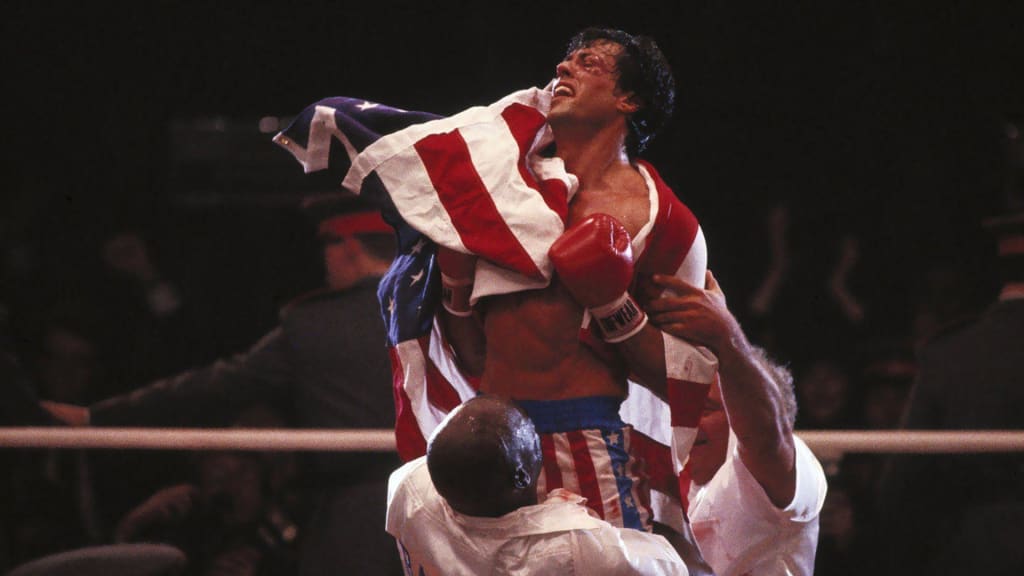
Finally, the climactic fight delivers another memorable scene where Rocky starts breaking through Drago's seemingly invincible exterior. With each round, he gradually wears the giant down, proving that even the strongest opponents have weaknesses. This scene reinforces the underdog theme that have always defined the Rocky series and showcases Rocky's unwavering heart in the face of overwhelming odds.
Analyzing The Movie's Symbolism and Themes
Rocky IV is not just a thrilling installment in an iconic boxing series -- it is a movie rich with symbolism and weighty themes. At is heart, lies it the emotional impact of grief. Apollo Creed's death that propels Rocky towards his personal journey, forcing him to confront loss, guilt, and responsibility for allowing Apollo to fight Drago in the exhibition match. Instead of allowing grief to consume him, Rocky transforms into purpose, displaying healing through perseverance and action.
The movie also presents a clear contrast between humanity and machinery. Rocky's improvised training in the frozen Soviet wilderness symbolizing authenticity, spirit, and genuine endurance. Drago's technologically enhanced training represents a system built on cold efficiency and artificially built strength. The movie openly displays performance- enhancing drugs and government-sponsored conditioning --- practices that would lead to disqualification and a possible lifetime ban in real-world boxing. This adds even more weight to the showdown: Rocky values sportsmanship, integrity, and genuine hard work, while Drago is the product of a system that values domination.
Rocky vs. Drago serves as a clear indication of the Cold War tensions that dominated the 1980s. Their showdown represents the standoff between the United States and the USSR --- individual freedom versus authoritarian control --- at a time when nuclear fears and political turmoil were rampant. Interestingly, Rocky IV was released on November 27th, 1985, seven days after Ronald Reagan met for the first time from November 19-21. That timing adds a layer of resonance: while world leaders were cautiously beginning to work towards improving relations between their countries, the movie depicted the rivalry, emotion, and cynicism that still defined the era.
Behind The Scenes: Making Rocky IV Possible
Rocky IV is packed with interesting behind-the-scenes facts that add even more depth to the movie. One of the most surprising facts about the movie is the reason for the presence of SICO the robot. According to Cinemablend, Robert Doornick, the founder of International Robotics, explained to Trivia Happy in a 2014 interview that he met with Sylvester Stallone to see if SICO could help Stallone's autistic son, Seargeoh, communicate more easily. The session went so well that Stallone decided to write the robot into the script so Doornick could continue to work with his son during filming.
Another well-known fact about the movie's production is Dolph Lundgren punched Stallone so hard during filming that he went to the hospital. Nevertheless, there was no animosity between Lundgren and Stallone, and the hard-hitting nature of the fight helped build up the tension between their characters.
Rocky's training area in Russia were not filmed overseas at all -- they were actually filmed in Jackson Hole, Wyoming. Total Rocky reports that the snow was real, and the temperatures in Wyoming dropped to negative 20 degrees Fahrenheit with the wind chilling. The crew even struggled to keep cameras working as they froze in extreme weather, adding realism to the movie's training scenes.
Conclusion: The Legacy of Rocky IV
Rocky IV is not just another solid entry -- it is a time capsule of the world in 1985. The movie captures the anxieties, conflicts, and optimism of the Cold War era, turning them into a story of endurance and determination. Through Rocky and Drago's fight, it reflects a global standoff while emphasizing the power of human spirit underneath human conflict. Decades later, its themes, energy, and cultural impact keep it one of the iconic and resonant chapters in the Rocky franchise.
About the Creator
TheScreenAnalyst
I am a passionate movie and TV enthusiast, devoted to analyzing storytelling, characters, visuals, and performances. I provide thoughtful critiques and insights, exploring both mainstream and independent works to engage audiences.
Keep reading
More stories from TheScreenAnalyst and writers in Geeks and other communities.
Casino at 30: Revisiting Scorsese's Masterpiece on the Cost of Criminal Glamour
Plot Summary Casino depicts the rise and downfall of Sam "Ace" Rothstein, a diligent odds-maker hired by the Midwest Mafia to direct the activities of the Tangiers casino in 1970s and early 1980s Las Vegas. The movie places Sam within a city undergoing a rapid metamorphosis, utilizing his managerial accuracy through which Scorsese explores systems of loyalty, ambition, and the commercialization of glamour.
By TheScreenAnalyst2 months ago in Geeks
Silver Screen Magic with Mae West
American actress and singer Mae West became a popular film actress during the Great Depression. She started entertaining in vaudeville, then performed on Broadway, and finally went to Hollywood. She signed up with Paramount Pictures and made her debut in the 1932 film “Night After Night.” She also starred in musicals, comedies, and crime dramas. The American Film Institute named her one of the best classic Hollywood actresses.
By Rasma Raisters4 days ago in Geeks
Millie Bobby Brown Debuts New Bob on Vacation
Millie Bobby Brown Takes a Stylish Break in the Sun Millie Bobby Brown is enjoying some fun in the sun and showing off a new ‘do. The Stranger Things actress is on vacation and is free to have any hairstyle she chooses.
By Dena Falken Esq3 days ago in Geeks




Comments
There are no comments for this story
Be the first to respond and start the conversation.