
Why Blade Runner Still Defines Neo-Noir, 40 Years Later
All those moments will be lost in time, like tears in rain.”

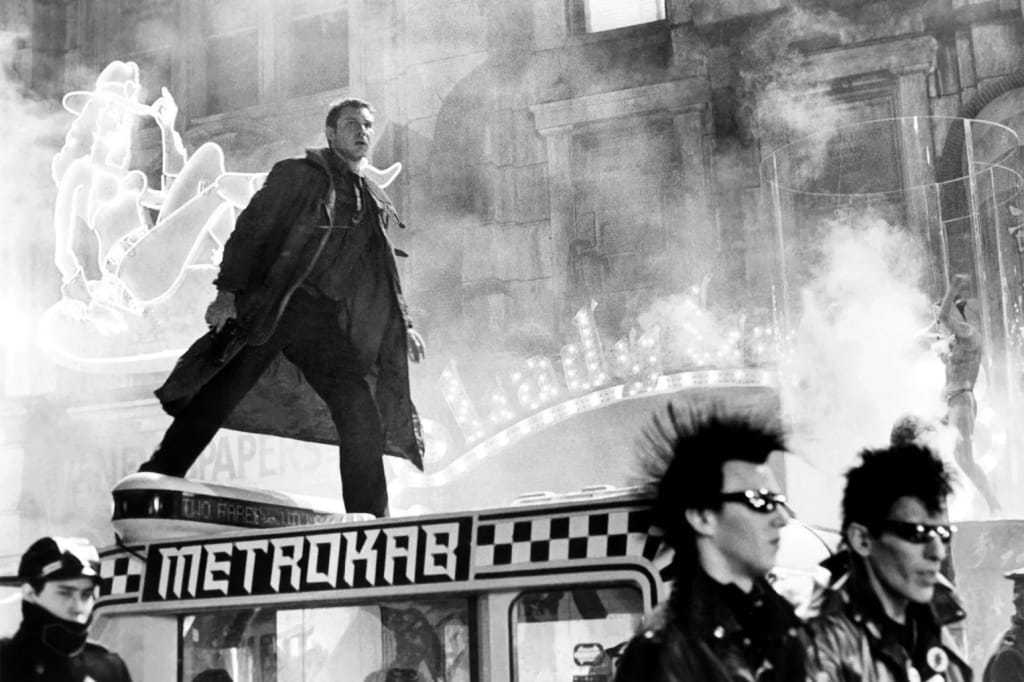
In 1982, Ridley Scott released Blade Runner to a world that didn’t quite know what to make of it. Too bleak for blockbuster audiences, too strange for mainstream critics, the film stumbled at the box office. Yet four decades later, its rain-soaked streets, flickering neon, and moral ambiguity remain the blueprint for neo-noir and cyberpunk storytelling.
The reason? Blade Runner doesn’t just look futuristic — it feels eternal.
A Film That Failed Forward
When it premiered, Blade Runner was considered a misfire. Audiences expected another Star Wars; instead, they got a moody detective story wrapped in science fiction. Studio meddling added a clunky voiceover and a tacked-on happy ending that undermined its tone.
But with each new cut — especially the 1992 Director’s Cut and the 2007 Final Cut — the film’s reputation grew. What was once confusing became visionary. Today, it’s ranked among the greatest films ever made.
The City as Character
Noir has always lived in alleys: shadows, smoke, and a sense that the city itself conspires against you. Blade Runner didn’t just update the formula — it drowned it in neon rain.
Los Angeles, 2019 (as imagined in 1982), is suffocating. Giant corporate pyramids blot out the sky, street markets teem under endless rain, and advertising billboards tower like false gods. The city doesn’t provide a backdrop. It dictates the story.
This is pure noir: the environment isn’t neutral. It’s hostile, indifferent, and inescapable.
Deckard: A Detective in the Shadows
Rick Deckard (Harrison Ford) is no noble hero. Like Bogart’s Sam Spade or Philip Marlowe, he’s worn down, cynical, and compromised. His job isn’t to deliver justice — it’s to “retire” replicants, artificial humans who want what everyone wants: more life.
Deckard isn’t celebrated for solving the case. He’s broken by it. That’s the essence of noir. The detective doesn’t walk away clean — he limps away haunted.
Rachael and the Femme Fatale
Film noir often hinges on the femme fatale: a woman who destabilizes the detective’s world. Blade Runner offers a twist. Rachael (Sean Young) is beautiful, mysterious, and dangerous — but only because she’s been engineered to doubt her own humanity.
Their relationship isn’t about seduction. It’s about survival. In classic noir, the femme fatale pulls the detective into ruin. Here, Rachael pulls Deckard into something scarier: the possibility of redemption.
The Poetry of Machines
Noir has always asked what it means to be human in a corrupt world. Blade Runner sharpens that question by giving us replicants.
Roy Batty (Rutger Hauer) is the villain on paper, but his final words turn him into something greater:
“All those moments will be lost in time, like tears in rain.”
It’s the most human speech in the film, delivered by someone society refuses to call human. That inversion — humanity found in the machine, emptiness found in the man — is why the movie still unsettles us.
Why It Still Matters
Every cyberpunk city since Blade Runner is just a remix: The Matrix, Ghost in the Shell, even Cyberpunk 2077. But influence isn’t the only reason it endures.
The questions it raises are sharper now than ever. What separates us from the technology we build? Who controls memory when machines can create it? And what does it mean to live fully in a world where everything is commodified — even life?
We live in an age of artificial intelligence, corporate dominance, and blurred lines between the real and the virtual. In some ways, Blade Runner wasn’t predicting the future. It was warning us about the present.
Closing Thought
Noir was never just about crime. It was about atmosphere, doubt, and the weight of choices without happy endings. Blade Runner absorbed all of that and refracted it through neon and rain.
That’s why, decades later, when we think of neo-noir, we still see Deckard in the dark, lighter flickering, rain pouring down — and the city holding its breath.
About the Creator
ambiguous karma
I'm a historian and religious studies scholar with 2 B.A.'s in History and Religious Studies (Salem College) I write with grit, insight, and satire: exploring power, belief, and resistance across time. Scholar by training, rebel by nature.
Keep reading
More stories from ambiguous karma and writers in Geeks and other communities.
Noir Cities: Los Angeles and the Birth of Shadows
Noir has always been more than a genre. It is a geography of shadows, an urban cartography of crime, corruption, neon, and rain slicked streets. Every great noir film is tethered to its city, the setting shaping not just the story but the psychology of its characters. From the sprawling freeways of Los Angeles to the claustrophobic alleys of New York, and the neon-soaked skyscrapers of Hong Kong, the city is never just a backdrop. It is the co-conspirator.
By ambiguous karma6 months ago in Geeks
A Knight of the Seven Kingdoms Series Review (Season 1)
As one of the biggest properties in fantasy, A Song of Ice and Fire remains immensely popular with audiences. After reaching far into the past with House of the Dragon, a second spin-off was on the cards. A Knight of the Seven Kingdoms serves up a bite-sized slice of action and drama, but it still claims a spot among the best small-screen titles.
By Robert Cain14 days ago in Geeks
REVIEW - The Redemption of Faust (Directed by Genel Mejia)
The Redemption of Faust, written by Justin Suran (Muse, Visitors, The Screenplay) and Genel Mejia (Visitors, The Screenplay, The Experiment, Normal, Splash Damage, La Mejia, Muse), and also produced and directed by Mejia, is a short film which takes its name from the famous 19th century work 'Faust' by Johann Wolfgang von Goethe.
By MegaFlix Movie Awards5 days ago in Geeks



Comments (1)
Thanks for illuminating another interesting dark, foggy, corner of this masterpiece 🙏