
When Hollywood Got Nuclear Power Right | 'The China Syndrome'
In Hollywood, the First Amendment operates as long as you are into profits

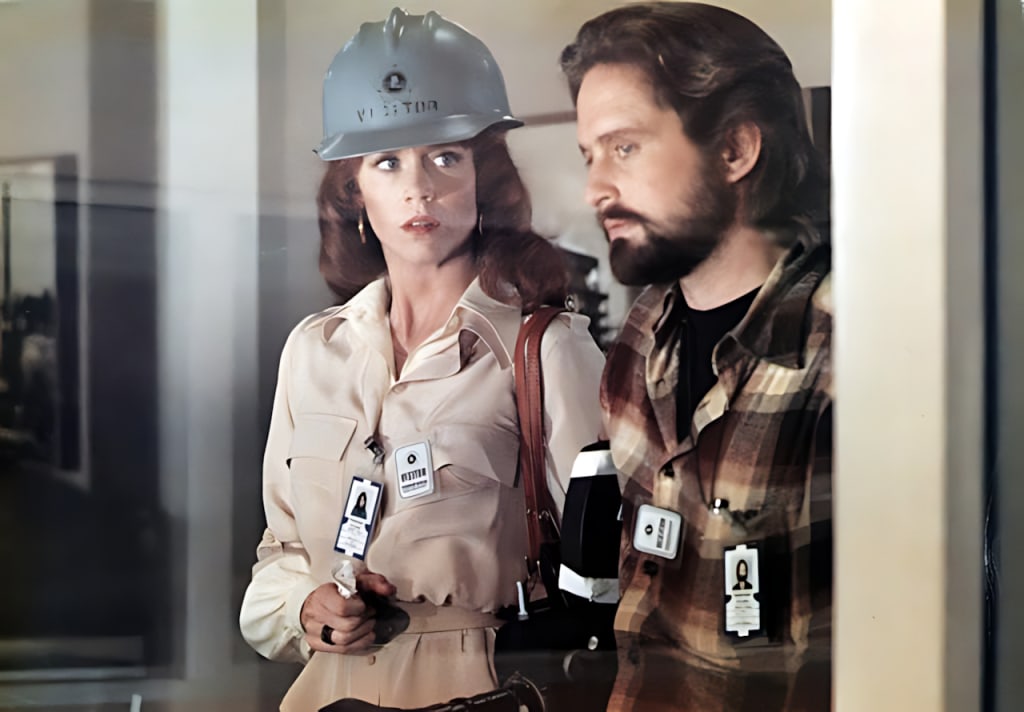
Those who're aware can not watch "The China Syndrome" without considering the Three Mile Island accident that occurred approximately two weeks after this movie was released. This timing created an unusual, eerie connection between fiction and reality, as the film depicted nuclear safety concerns that would soon be reflected in an IRL crisis.
"China Syndrome" is a must-see picture; thoughtful, beautifully produced and written, a compelling thriller with unexpected relevance to nuclear safety debates.
The role of Kimberly Wells, on the news team of a television network, is of interest from several points of view. As in all her films, Jane Fonda allows us to see her character grow.

I personally feel Jane might interest me even reading aloud the Fifty Shades of Grey, although that might be carrying adulation a bit too far. In any case, her character in China Syndrome makes it clear in the beginning that she was only too happy to be hired by the network for her beauty, and to do the "lighter side" of the news.
It is unfortunate that Fonda is required to make several scathing remarks about having to cover zoo animals' birthday parties, for we know Jane herself is caring about our fellow creatures on this earth as anyone, and aware that man's damage to the environment hurts them even more than us.
Nevertheless, we learn it's hard enough for her just to learn the TV business: she displays nervousness about her appearance, tension over keeping schedules, that hectic side of her dual role in gathering, then "performing" her segment of the news.
When the story on the nuclear plant comes her way, she wants it. It's bigger than her typical frivolous, and often hilarious reportings, and does she put her whole self into it.

She hires a previous co-worker and friend who, she says, is the best freelance photographer in the business (played perfectly by Michael Douglas) to accompany her to the nuclear plant.
They are shown through the installation by the company public relations man, and it is a routine "Everything is wonderful here" type of tour. Only near the end of it does the PR man become suspicious of their knowledgeable questions.

Having seen nuclear plants and their processes through many TV shows (most notably productions like "Chernobyl"), films, docs, or even YouTube videos, the scenes explaining how a nuclear plant works seem very familiar and a tad bit underwhelming when you watch it at this point.
At times, the stakes don't feel high enough, creating a constant tension of "am I wasting time, is it worth it?" But the brilliant tension creation and performances kept it alive even today when this trope might feel hackneyed.
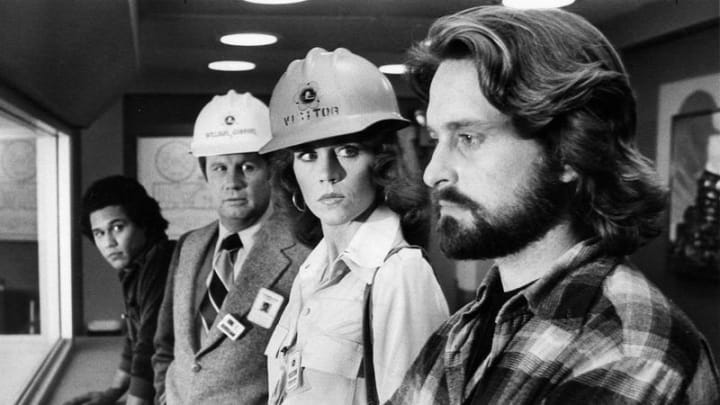
As they stand in the glassed-off room above the control room, there is what appears to be an earthquake tremor. The camera then cuts between reaction shots to all those in the booth, and those staffing the control room, headed by Jack Lemmon.
As they watch, a crisis obviously develops, because the tremor shot one of the temperature gauges up too high, and we see Lemmon sweating it out trying to decide what to do.
Although Douglas has been forbidden to photograph there, he manages to set his smaller camera going at his side, and catches it all. The manager then has them hustled out, with many platitudes about the "routine" nature of the event, and that "Everything is now completely under control." We know better.
On their return, Jane is incensed to learn that the network officials will not allow the film to be run. The implication is that the government got to the network very quickly. She is now ready to fight for her story.
More than incensed, Douglas steals his film from the film room, unwilling to take a chance, as he believes it might be destroyed or simply disappear. The network bigwigs tell Jane her job is on the line until that film is returned.
Now the whole cloak-and-dagger situation that follows becomes plausible, as the station is pressured by high government officials interested in covering up any hint that anything is wrong at the plant. Lemmon himself begins to track down some of his own suspicions.
Watching Jane and Douglas doing some research, one can see how the theme of information suppression and government secrecy remains relevant in today's world, where whistleblowers and investigative journalists continue to face challenges.
Jane goes to see Lemmon at the plant and drags some incriminating information about the construction of the plant from him. Once he commits himself to give her information, and the officials suspect it, they are ready to clobber him, too.

There is a freeway chase that will have you gripping your chair arms, not only because it is a good chase, but because it's the full power of the monied-vested interests and the government against one good man in anguish about doing the right thing. "I love this plant," he says at one point, "it's my whole life." And, thus, he puts his life in jeopardy.
The "China Syndrome" is the name given to the theory that a nuclear plant explosion could have repercussions right through the earth and down to China.
Just as nobody has even the faintest idea what to do with all the deadly atomic waste piling up everywhere in concrete containers that are already leaking, though the stuff is doomed to be radioactive for thousands of years, so doctors are also unwilling to predict long-term consequences of radiation exposure.
These concerns remain just as relevant today as when the film was made.
Watching people come out of the theater is an educational experience. Bemused, thoughtful, fearful expressions; not much chitchat. It's as if they had just found out something they never knew before. The average person who doesn't like to speculate on such things, who doesn't even want to know, is stunned.
They say people never feel impelled to act on anything until it actually affects their lives personally. It may well be that this is one of the biggest matters to affect all of us personally that has come along in some time, for the picture demands that we think about it and make our voices heard about nuclear safety.
The writers of the film, Mike Gray, T.S. Cook, and James Bridges (who also directed) say they first thought of writing the script almost seven years before making it, and their decision was only intensified by the pressures put on investigative reporters by the power companies who do, of course, stand to lose billions in any plant shut-down.
The last word came from Michael Douglas, who also produced China Syndrome. He said,
"In Hollywood, I think the First Amendment operates as long as you are into profits."
Rating: 4/5
NB: The accident at Three Mile Island was the worst in U.S. history, but had a death and injury toll of zero. The radiation exposure to the public was slight, and the short-half-life radioactive xenon gas that was released the first day quickly dissipated into the atmosphere. The concrete containment dome prevented what could have been a Chernobyl-like catastrophe. (A concrete containment dome would have done the same for Chernobyl as well, where fifty-five people lost their lives due to acute radiation poisoning, hundreds more may have serious health consequences, and thousands of square miles of Ukraine were rendered uninhabitable.) - Source.
About the Creator
Keep reading
More stories from Shoaib Rahman and writers in Geeks and other communities.
Interiors: Woody Allen's attempt to become the American Bergman
“Interiors” (1978) marks Woody Allen’s debut in attempting, and generally succeeding, in making a fine and serious film, a fact for which we should still be doubly grateful when looking back at his filmography.
By Shoaib Rahman10 months ago in Geeks
Spongebob Review
The episode “Suds” opens with a sun‑drenched morning in Bikini Bottom, the camera gliding lazily over the coral‑lined streets before settling on SpongeBob’s pineapple house, where the familiar, squeaky door hinges announce his cheerful entrance. The scene is rendered in vivid, pastel‑hued animation that captures the playful absurdity of the series, while a jaunty ukulele riff underscores the buoyant atmosphere. As SpongeBob rummages through his kitchen, he absent‑mindedly leaves the refrigerator door ajar, a small but pivotal lapse that sets the entire plot in motion. Tiny bubbles begin to drift from the open fridge, slowly coalescing into a frothy, luminous cloud that the show cleverly dubs “the Suds,” a mischievous entity that flickers like a living soap‑bubble, hinting at the whimsical chaos soon to erupt.
By Forest Greenabout 20 hours ago in Geeks



Comments
There are no comments for this story
Be the first to respond and start the conversation.