
Interiors: Woody Allen's attempt to become the American Bergman
"Humor her - she's sick woman"

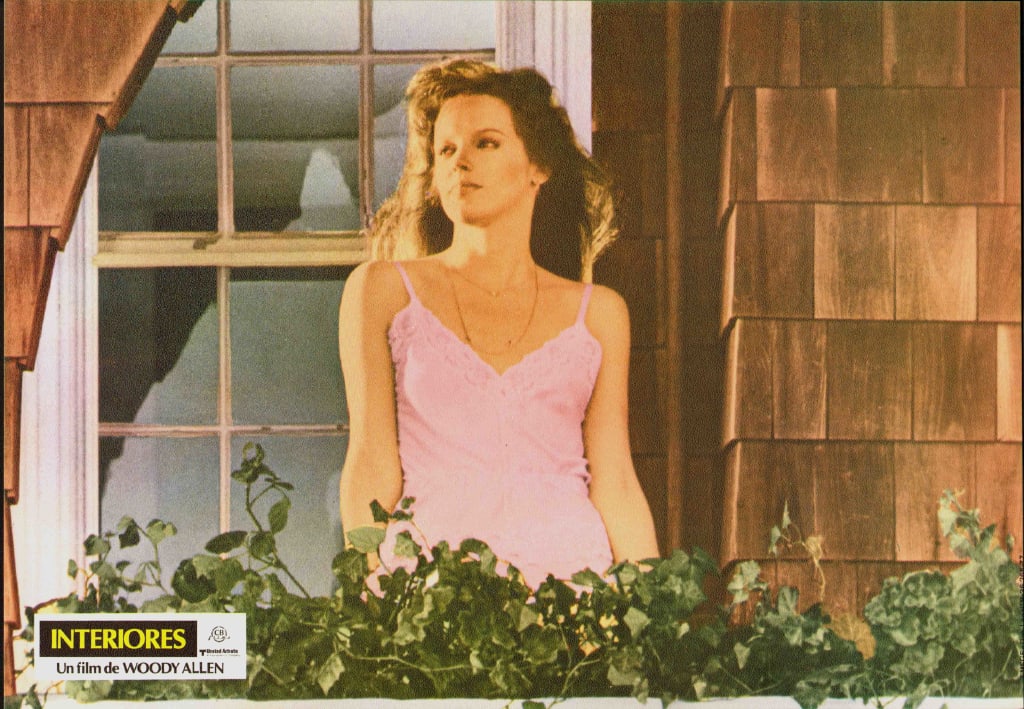
“Interiors” (1978) marks Woody Allen’s debut in attempting, and generally succeeding, in making a fine and serious film, a fact for which we should still be doubly grateful when looking back at his filmography.
Not only is this film carefully and thoughtfully designed and executed, but as an avowed skeptic, Woody as the film’s writer and director were able to place therein some strategically incisive comments about the absurdity of certain beliefs that remain relevant today.
The picture is made almost like a jigsaw puzzle, but with far more important ramifications. Each piece of character information fits into another so that the tensions and eventual confrontations, however disastrous, all make sense.
We have been given all the clues we need. The film is not perfect (who or what is?), but although I did not feel that certain techniques played fair with the viewer or were justified (to be mentioned in next paragraph), one can not criticize the inevitability of the character development.

A capsule synopsis is therefore in order.
At the outset we are made aware, by a camera exploration of their sterile house, that the marriage of Arthur (played by E.G. Marshall) and Eve (played by Geraldine Page) is a dead thing. This knowledge is underlined by the first scene in which Eve— who permits herself to be shown looking old and unattractive, her hair sternly drawn straight back into a bun on top — is pushing her decorating ideas onto her younger daughter Joey (Mary Beth Hurt) and the man she is living with, Mike (Sam Waterston), ideas which do not fit their lifestyle and which they cannot afford.
When Mike raises a mild objection, Joey snaps at him, “Humor her — she’s sick woman.” The mother has, we soon learn, only just been released from a psychiatric facility.
The movie then proceeds to cut, without confusion, to show us the lives of the now separated mother and father, and the three daughters, including flashbacks of the homelife and the girls when very young.
Although we see all of them growing frustrated and unsatisfied by their lives, we also see why, as we watch with sorrow their painful attempts to rationalize their behavior intellectually, their variously unsuccessful attempts to attain fame in one or another of the creative arts.
One is puzzled at first to see that the only character who is completely successful is the father, who is a lawyer. The girls and their men, involved in writing, poetry, photography, acting, etc., justify taking dad’s money to live on in the name of Art.
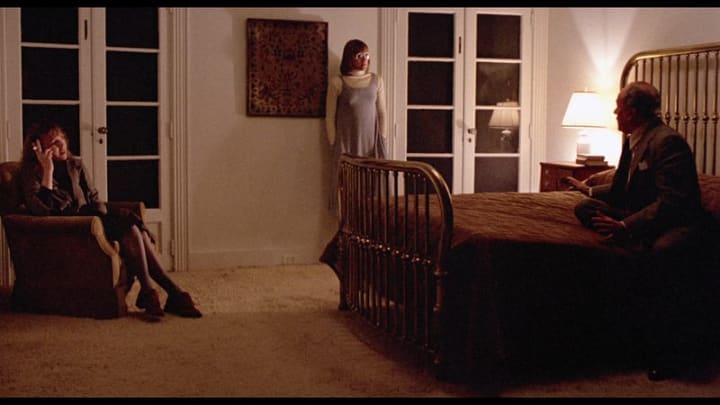
There is some subtle innuendo that they, and even the mother in her pretentious expensive decorating, are all pseudo intellectual dilettantes, even snobbish poseurs.
While not exactly a plot flaw, it is strange that Allen, being an actor and writer, should see certain aspects of his field of work this way. It is still jarring that he decided to do the film entirely without music, thereby in effect giving the back of his hand to that art form as well.
The film suffers from this, in my opinion, because it forces him into a contrived device — that of accenting sounds. Footsteps sound like clumps, the pulling of adhesive tape from a roll sounds like prehistoric animals cutting through underbrush, and when Page sweeps to the floor some votive candles in a church, the sound is of several plate glass windows crashing.
On the other hand, the sound of children playing on a beach or in a park is non-existent, as if the children were ghosts, an effect I seriously doubt was intended to be quite that startling.
There are also some cuts which didn’t make sense, as when two of the daughters were walking with the mother, making conversation out of pleasantries, when suddenly the two girls start talking about the mother’s psychological problems without our being shown that the mother has apparently drifted away from them.
It is roughly at this stage of the film that we have been shown just how seriously disoriented the mother is, first in a scene where she is enjoying watching an evangelist on television, and later one daughter mentions “all of mother’s religious nonsense,” the other replies “Well, whatever makes her happy.”
The shot of the female church is obviously satirical, pointed up by the fact that when the father remarries one has completely understood his choice of the warm, friendly, pragmatic Pearl, played by Maureen Stapleton, and the simplicity of the home ceremony attended only by the daughters.
“My god,” says Keaton, “I’ve never seen my father dance in my whole life,” as father and Pearl get jollied and dance to the only piece of music in the film, some over-loud dance music on the stereo.
Representing earthy life, as Pearl does, we recognize that even if the symbolism is heavy-handed by today’s standards, it has to be Pearl who breathes life back into an almost drowned Joey at the end of the film. With nothing really resolved, it is not a happy ending, but merely one tinged with a few vague hopes.
What we have here, then, is a slice of life — not so existential as to be confusing, dramatic enough to be absorbing, and thoughtful enough to give rise to speculation long after seeing it. It is perfectly cast, finely written, and expertly produced.
We cannot say there is one star; indeed, Diane Keaton as sister Renata takes second place to Marybeth Hurt as the generally unlikeable Joey who dislikes herself as much as she dislikes everyone else, but who is the catalyst for the film’s climax.
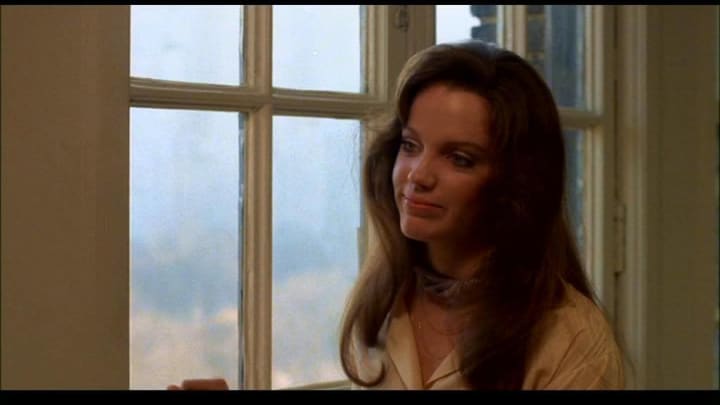
The third sister, the ever beautiful Kristin Griffith, plays a Raquel Welch-type movie star, tired of her sex-symbol status, who films with Renata’s husband Fred (Richard Jordan).
Looking back now, there is little doubt that Woody Allen took many of the techniques and subject matter from Ingmar Bergman, and attempted to be the American Bergman, which still holds up well despite the subsequent complications in Allen’s personal and professional life. He obviously doesn’t have Bergman’s darkly religious bias.
In retrospect, this film for shizzle paved the way for his later dramatic works that managed to incorporate more of his trademark humor while maintaining the serious themes he explores here.
This story was first published on Medium:
About the Creator
Keep reading
More stories from Shoaib Rahman and writers in Geeks and other communities.
Work, Sex, Death, and Dance: All That Jazz in the Modern Eye
Bob Fosse, like so many super-talented people, is so loaded with it that his personal life is all messed up, but unlike so many of them, he has attacked the problem by a therapy available to few: he has written about it and broadcast it in this extraordinary film, All That Jazz (1979), regarded as a timeless classic.
By Shoaib Rahman11 months ago in Geeks
History of The Three Stooges (Part I: The Beginnings and Columbia Pictures - 1920s-1936)
I have been itching to write about The Three Stooges on Vocal for close to two years, but I couldn't figure out how to do it. I wanted to do it by third Stooge, but that's a bit complicated. I know this much. I was about eight or nine years old when I first saw The Three Stooges. I remember one of my local channels had the Stooges on for hours, and I tried my damnedest to be up for those shorts. I remember that the Family Channel actually had an hour of the Stooges on from 11PM to midnight, and it was the entire library on during that time.
By Clyde E. Dawkins4 days ago in Geeks
Anthony Michael Hall: Did he channel Donald Trump on Psych?
Was Donald Trump the inspiration for Harris Trout? Anthony Michael Hall has had a stellar career that began when he was seven years old. At eleven, he was the little boy known as the Honeycomb Kid in a television commercial. In March 2013, he appeared in three episodes of the final season of the USA drama Psych.
By Cheryl E Preston2 days ago in Geeks
Hottest in the Office
Dear Rafi, You’re very distracting to work around. For the first second I saw you the other day, I thought you were some type of executive. It took a moment to realize no, you were just the new guy, dressed up for the job he wants. Be still, my heart.
By Gabriel Shames6 days ago in Pride



Comments
There are no comments for this story
Be the first to respond and start the conversation.