
What Were the Georgia Guidestones?
Why It's Shifty (Week 13)


What were the Georgia Guidestones? Who built them, and why? Were they an innocent monument to reason and sustainability, or a cryptic manifesto for a shadowy elite?
Erected in 1980 in rural Georgia, USA, the Guidestones stood as a towering granite structure engraved with ten guidelines in multiple languages. Often dubbed “America’s Stonehenge,” the monument’s origins were shrouded in secrecy. Commissioned by a man using the pseudonym R.C. Christian, its true backers remain unknown. The messages carved into its surface called for population control, harmony with nature, and a new global order: statements that quickly drew controversy and speculation.
Over the decades, the Guidestones became a magnet for conspiracy theories. Some viewed them as a warning of an impending societal collapse, while others believed they were part of a sinister agenda for world domination. The mystery deepened further when, in July 2022, the monument was partially destroyed in an explosion and later dismantled entirely.
Were the Georgia Guidestones simply a provocative work of modern philosophy, or did they conceal a darker purpose? Their destruction may have erased the physical structure, but the questions surrounding them remain as compelling as ever.
Plot
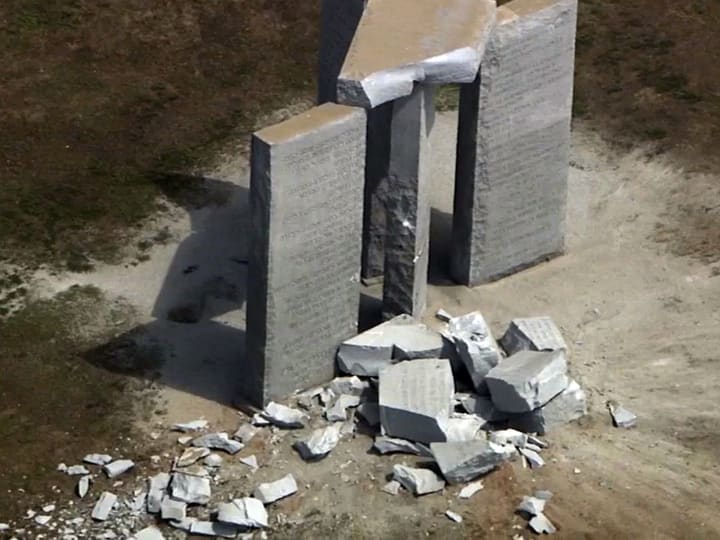
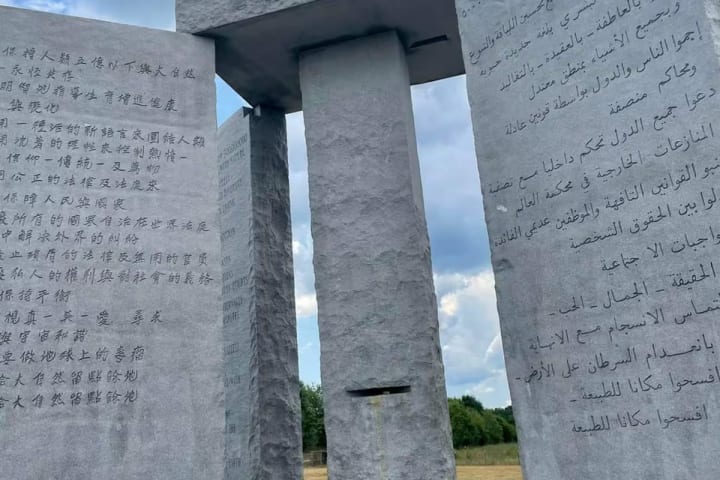
For over four decades, the Georgia Guidestones stood as one of America’s most mysterious and controversial monuments. Towering over the rural landscape of Elbert County, Georgia, the monument consisted of six massive granite slabs arranged in an astronomically significant formation. Each of the four vertical stones was engraved with a set of ten guidelines, written in eight modern languages, while additional inscriptions in classical languages such as Sanskrit and Babylonian were carved into a smaller capstone.
The origins of the Georgia Guidestones trace back to the summer of 1979, when a man using the pseudonym “R.C. Christian” walked into the offices of the Elberton Granite Finishing Company. Claiming to represent “a small group of loyal Americans,” Christian commissioned a large stone monument designed to serve as a guide for humanity in the wake of a potential global catastrophe. The specifications were precise and ambitious: the monument had to function as a calendar, withstand the test of time, and be inscribed with principles that would aid in rebuilding society.
Joe Fendley, the granite company’s president, initially dismissed Christian as a fantasist. However, after Christian provided a significant financial deposit and detailed blueprints, it became clear that the project was serious. To this day, the true identity of R.C. Christian and his financiers remains a mystery. Some theorists speculate that the name was a reference to the Rosicrucian Order, a secretive philosophical group dating back to the 17th century. Others believe the group behind the Guidestones was composed of globalist elites with a hidden agenda.
The monument was completed and officially unveiled on 22 March 1980. The six granite slabs, collectively weighing over 100 tonnes, were positioned with remarkable precision, aligning with celestial movements such as the North Star and the solstices. The inscriptions outlined ten principles, which included a controversial call to maintain humanity under 500 million, a demand that alarmed many who interpreted it as an endorsement of population control.
From the moment they were unveiled, the Georgia Guidestones attracted both intrigue and condemnation. Some viewed them as an attempt to promote rational thought and sustainable living, while others believed they were a blueprint for a New World Order. Over the years, they became a pilgrimage site for conspiracy theorists, religious groups, and curious tourists alike. Their aura of secrecy only intensified speculation about their purpose.
Then, in the early hours of 6 July 2022, an unknown individual detonated an explosive device, severely damaging one of the granite slabs. The structure was deemed unstable and was fully dismantled later that day.
Were the Georgia Guidestones an innocent monument to human progress, or did they conceal a more sinister message?
Into the Theories
Post-Apocalyptic Message
One widely accepted theory is that the Guidestones were intended as a set of ethical principles for rebuilding civilisation after a global catastrophe. The ten inscriptions, written in multiple languages, outlined guidelines for maintaining a balanced society, which some interpret as instructions for survivors of nuclear war or environmental collapse. The inclusion of astronomical alignments further supports the idea that they were designed for long-term use in an uncertain future.
Freemason or Rosicrucian Monument
Many believe the Guidestones were commissioned by secret societies such as the Freemasons or the Rosicrucians. The pseudonymous "R.C. Christian," who funded the project, is speculated to be a reference to Christian Rosenkreuz, the mythical founder of the Rosicrucian order. The emphasis on reason, harmony, and population control aligns with ideals often attributed to esoteric groups, fuelling suspicions of hidden influence.
Reptilian Globalist Agenda
A more bizarre conspiracy theory claims the Guidestones were erected by a shadowy cabal of reptilian overlords planning a New World Order. Some conspiracy theorists saw the monument’s call for maintaining a population under 500 million as evidence of a plan for mass depopulation. The monument’s destruction has even been interpreted by some as a battle between rival secret factions vying for control over humanity’s future.
Why It's Shifty

The Georgia Guidestones were controversial due to their enigmatic origins and the content of their inscriptions. The most contentious guideline suggested maintaining the global population under 500 million, which many interpreted as advocating mass depopulation. Critics, particularly from religious and conspiracy circles, believed the stones promoted a sinister agenda, such as eugenics.
Their secular and humanist tone also clashed with Christian fundamentalist beliefs, with some claiming the monument was satanic or linked to secret societies. Also, the anonymity of their creator fuelled speculation about hidden elite influence, further intensifying distrust and conspiracy theories.
Conclusion

The most likely explanation for the Georgia Guidestones is that they were commissioned by a private individual or group with a philosophical vision for humanity’s future. The man who funded the project, using the pseudonym R.C. Christian, stated that he represented “a small group of loyal Americans” who wished to leave a message for future generations. Given the stones’ emphasis on reason, sustainability, and coexistence, it is probable that the sponsors were inspired by Enlightenment ideals and concerns about overpopulation, nuclear war, or environmental collapse.
The structure’s precise astronomical alignments suggest input from someone with scientific or architectural expertise, rather than a shadowy elite. While secrecy surrounded the project, this was likely to preserve the mystery and longevity of the message rather than to conceal a global conspiracy. In essence, the Guidestones were probably an ambitious but ultimately misunderstood attempt to provide ethical principles for a future civilisation after a potential global disaster. But none of it can be for certain - so what do you think?
Next Week: Regicide? The Death of William II
***
A little bit of time left to enter the competition and let me read your poetry...
About the Creator
Annie Kapur
I am:
🙋🏽♀️ Annie
📚 Avid Reader
📝 Reviewer and Commentator
🎓 Post-Grad Millennial (M.A)
***
I have:
📖 280K+ reads on Vocal
🫶🏼 Love for reading & research
🦋/X @AnnieWithBooks
***
🏡 UK
Keep reading
More stories from Annie Kapur and writers in Geeks and other communities.
Book Review: "All the White Spaces" by Ally Wilkes
Yes, I have been reserving stuff at the library and I didn't think I'd like this one to be honest. I was on the fence about it but then again, I didn't understand myself. I enjoy Arctic horror and I've loved books like The Terror by Dan Simmons in the past and so, cold chilly horror should be my thing. I was shaky at first but I reserved it anyway after learning how long it was and so, it would give me a good day or so of reading. And reader, here's the conclusion: I really damn well enjoyed it. It was brilliant.
By Annie Kapur8 months ago in Geeks
Silver Screen Magic with Mae West
American actress and singer Mae West became a popular film actress during the Great Depression. She started entertaining in vaudeville, then performed on Broadway, and finally went to Hollywood. She signed up with Paramount Pictures and made her debut in the 1932 film “Night After Night.” She also starred in musicals, comedies, and crime dramas. The American Film Institute named her one of the best classic Hollywood actresses.
By Rasma Raisters9 days ago in Geeks


Comments
There are no comments for this story
Be the first to respond and start the conversation.