
What Lessons can be Learned from ‘The Piano Lesson’?
Mr. August Wilson’s play about sibling rivalry shines in its film adaptation.


Grade: A-
If Malcolm Washington doesn’t win the Oscar® for best director, the Academy Awards is full of racists and should be banned…kidding. He does a fine job but the weight of the late great August Wilson’s powerful storytelling may prevent him from walking away with a golden statuette on Hollywood's biggest night.
He’s got time. In The Piano Lesson, though, he shoulders that weight with panache and even grace. At the crux of the story is a conflict between brother Boy Willie Charles (John David Washington) and sister Berniece Charles (Danielle Deadwyler). In a little over two hours, the film unfolds and does its best to revere the source material and also make the piece cinematic.
Mostly, it succeeds. The imagery is at times stark, engaging, and even frightening to those with the proclivity towards the supernatural. The insinuations and implications all add up to a picture that uses both bold performances and subtle acting. History and family play out and it's like watching Rolls-Royces and Bentleys performing highly.
In each argument these fine actors bounce ideas off of each other. The staging and blocking feels playsy at times, but the talent that’s on the screen enliven Malcolm Washington and Virgil Williams’ screenplay.
Some sequences, like the tub sequence is treated with such poise and respect for the actress’ dignity.
In the following scene, there is a reference made by Avery Brown (Corey Hawkins) to what the film just illustrates moments ago. The audience is allowed to process these parts with a grown-up sense of what the story is about.
Mr. Wilson wanted to make the title a double entendre of Maretha Charles (Skylar Aleece Smith) to learn an actual way of playing the instrument. In reality, the lesson is about familial ties, broken promises, and a misunderstanding between siblings. Furthermore, it is a reach into the fractured relationship between Foundational Black Americans (FBA) and the past, namely slavery.
Doaker Charles (Samuel L. Jackson) is the anchor in all of this who channels his performances as Boy Willie in the original run of the play in the 1980’s. Also the revival of the play as Doaker on the stage two years ago, directed by his wife, LaTanya Richardson. His measured and responsive attitudes create for a police officer in the sense that he must break up the brewing tension between his niece and nephew.
Other strong performances include Ray Fisher as Lymon. Just his cadence alone, the drawl, slow-simmering baritone gives great idealism to his character.
Erykah Badu has no real part of the narrative but delivers an adequate performance as a singer named Lucille. That’s the power of music in this film. Not just the piano, but the strings and woodwinds of the score serve as haunting characters in this film. The ghost story is steeped in mysticism, but the gritty realism that the music evokes creates an eerie almost unsettling sense.
Throughout, this is probably the least problematic adaptation into film. Fences (2016) seemed to be extremely play like and Ma Rainey’s Black Bottom (2020) showed explicit scenes that Mr. Wilson probably would not have approved of it in the slightest.
Here though, the artistry of everyone involved elevates the tale to be a more filmic work. It brings to the fore the various talents of the cast and crew.
The bitterness of history mixed with the ambitious nature of Boy Willie creates a powder keg lit by Berniece who is curt and thoughtful and thought-provoking and firm. When she finally demands that her brother look at it, it’s not just to see it but consider it.
The anguish in her voice which burbles up and the pain of decades up unto the piano being placed in the house, she outlines her mother’s literal blood and tears that went into maintaining it. The fact that her father was said to have been killed because of it permeates the story with a dreadful feeling.
By the time of the climax, discussions of ghosts and the electrifying portion gives the viewer a great scare. Somewhat. For those who believe in the supernatural, it may present an intriguing idealism about faith. The greatness of this adaptation lies in its audacity. A thirty-three-year-old son of a living legend working with his older brother among other family members demonstrates the wonderful ego this man possesses. He could have easily said that the beautiful burden of an August Wilson play made for static audiences for the players that can’t offer a laugh or a sigh; that can’t—just in case this ever happens—break a dish unintentionally while walking the boards; all of that has been discarded in favor of screens large and small.
For Netflix to continue on this trek with people like Mr. Wilson’s widow, Constanza Romero Wilson, (who executive produced the screen versions of Ma Rainey and Piano) there is an added level of authenticity and truth. Volumes of articles could articulate the power and strength of the Wilsonian canon. Piano uplifts to the heights of ingenuity the black experience of not only black Pittsburghers but people of all ethnicities and races from around the world.
Its flaws are slight but glaring. The addition of the white man in Sutter’s ghost lowers the impact of the conflict between brother and sister. The aforementioned Boy Willie is focused on the future. Berniece is committed to preserving the past. When they butt heads, it is their feud that fuels the work, not any ideas about some white man’s apparition.
The strands of truth all intertwine to form a delicious drama that is a part of the Twentieth Century Cycle that Mr. Wilson forged over a few decades. Piano makes good on the promise not that it will be better than the play or the other films already produced, but it will stand on its own ground. It holds a place among the best adaptations of a stage play.
In reality, the direction the filmmakers took in bringing this play to the screen is astounding and it resonates with the power and conviction of a Sunday sermon, even if you don’t believe everything you see and hear.
About the Creator
Skyler Saunders
I will be publishing a story every Tuesday. Make sure you read the exclusive content each week to further understand the stories.
In order to read these exclusive stories, become a paid subscriber of mine today! Thanks….
S.S.
Keep reading
More stories from Skyler Saunders and writers in Geeks and other communities.
Smartystan
Polished floors still seemed great. It was one of the few things permitted to be of the highest detail. Floors of the gym looked like glass. The wooden beams almost sparkled under the mop. That was the catch. The Average Capacity Association (ACA) barred anyone from using the technology of a machine to power wash the surfaces. They had to use the old mop and bucket…and like it. Chairs lined up in precise fashion, though. For the president of the ACA to speak, they had to have at least made it presentable for him. A suited man with sunglasses opened the door. Vergara walked out of his car and just looked around. He darted his eyes from left to right like a cat from a fairy tale or a clock on the wall. Nervousness did not envelope him, though he seemed cautious. His tie had been clasped but the button under it had not been. With quickness, he buttoned it and kept moving.
By Skyler SaundersExclusive • about a year ago
Marvel Zombie
The last entry into our 2025 superhero projects catalogue is Marvel Zombies. This was a show that was anticipated by absolutely no one and it disappeared from the public consciousness as quickly as it was released. There was nothing special about the project that made it a must see, or a must remember. In fact if anything it's a must forget.
By Alexandrea Callaghan27 days ago in Geeks
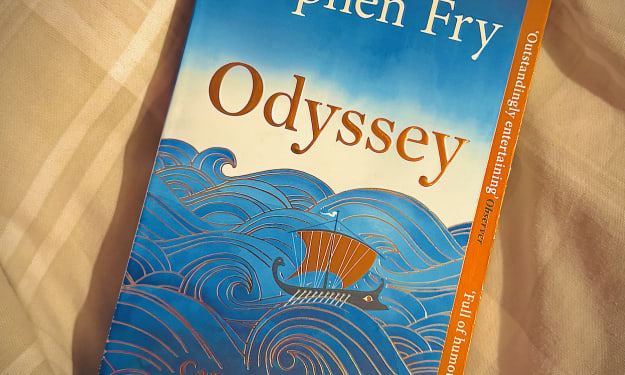
Book Review: "Odyssey" by Stephen Fry
If you know anything about me you will know that Stephen Fry is one of my favourite people on this earth. He's a proper polymath and has a great personality with it - he also reminds me of Oscar Wilde in some ways. I've read the other books in the series but this is the one I was truly waiting for because I love the story of the Odyssey. I've read different translations over the years and of course, we all remember it being included in the 2016 Nobel Prize Lecture by Bob Dylan - it is truly one of the most impactful stories of all time. No wonder Christopher Nolan is currently directing the anticipated movie.
By Annie Kapur6 days ago in Geeks



Comments (1)
Never seen it but will soon, just watched the trailer ⭐️