
What is community
In the Heights Musical Analysis

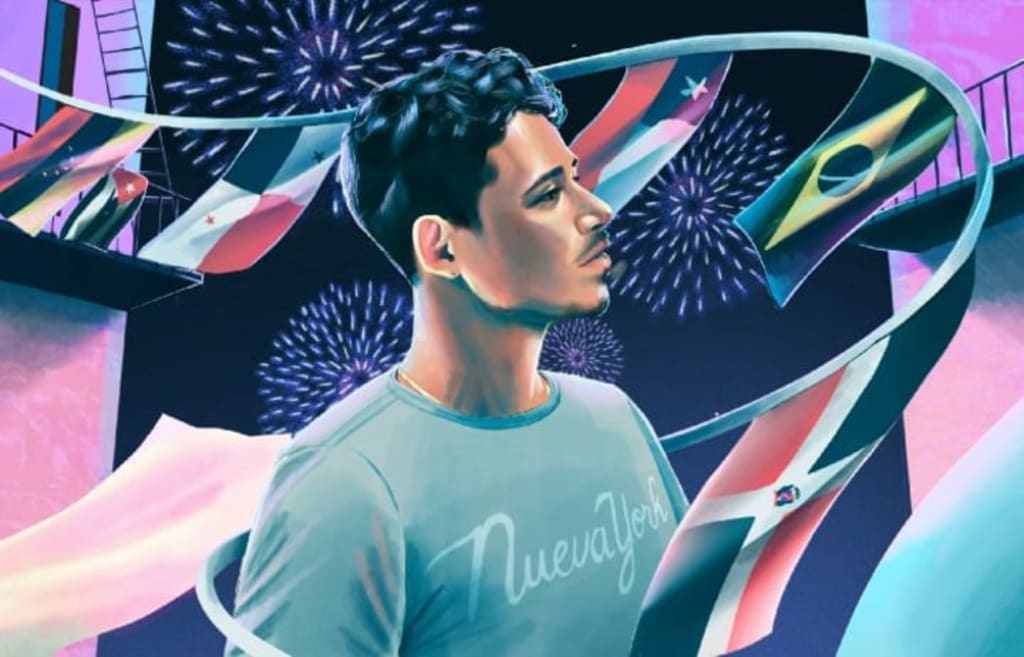
What is community? Is community an essential aspect of what it means to be human? Could you and I live without a community? Does community exist now in our modern times? And if so, how should we assess what it means to be part of a community?
The musical In the Heights, directed by Jon M. Chu, ushers the spectator to the forefront of the prominent Hispanic community of Washington Heights in Upper Manhattan, New York City.
¿QUÉ QUIERE DECIR Sueñito?
As the musical begins, the Spanish worded question appears on the black screen, simultaneously, a child’s voice in the background asks the same question in English: “what does Sueñito mean?” As it emerges in the eyes of the spectator, the question signifies the theme of the musical.
“Sueñito? It means ‘little dream.” The man behind the voice, Usnavi, played by Anthony Ramos.
In the Heights begins with the main character, Usnavi, telling a story to a group of kids gathered on the patio of a bar near a tropical shoreline. As Usnavi recites his story, like the kids in the early scene of the musical, the audience is invited to the patio to listen.
“Once upon a time, in a faraway land called Nueva York, en un barrio called Washington Heights…. The streets were made of music.”
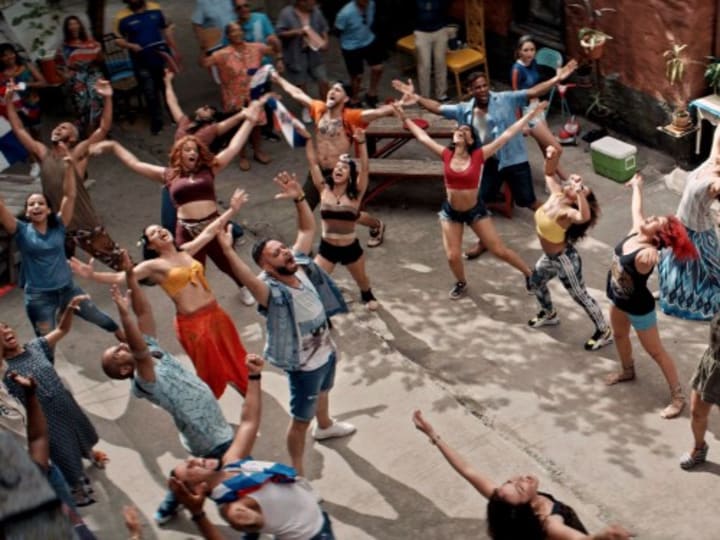
Now, returning to the intro paragraph question, what is community? After watching In the Heights, the sensational and exuberant musical, I was inspired to write this. I contemplated the significance of community as it relates to human life. In the Heights is filled with communal belonging; furthermore, a sense of cohesion. Every person en un barrio of Washington Heights not only grapples with similar issues as his/her neighbor but shares the same Sueñito.
Community, as we all know, is a group of individuals connected by one or more attributes. Leonard Swidler takes this a slight further in his journal, Where in the World Are We Going? He writes, “if a baby were fed and kept warm and clean but never talked to, never heard human speech, it would never dawn on her or him that there were such things as words…. Thus, the human person could not become fully human without the community…. The purpose of human communities is to increasingly humanize all participants.”
Watching In the Heights, we recognize the gravity of community and cohesion. Moreover, the musical endeavors to foreground the significance of cultural identity. For instance, the flags from various Spanish-speaking countries; the colors — white, red, and blue — in several scenes signifying the home country of Usnavi, Dominican Republic.
In the Heights, in a way, reminded me of early Spike Lee films. Lee aspired to incorporate various cultures and music to place his audience at the center and allow the audience to feel what it means to belong in a marginalized group. Hence, we recognize this In the Heights.
The spectator is brought along and placed at the center of the diverse community of Washington Heights. Now he/she is introduced to the daily struggles and triumphs of the community — a father wrestling with college tuition, a daughter struggling to find community in college, an undocumented cousin, endless debts, and bills to be paid; however, despite all of this, the community remains jubilant.
From the vision of Jon M. Chu and Lin-Manuel Miranda, In the Heights presents powerful minority stories and diversity to the screen. Any minority in the U.S. can resonate with the musical.
As we watch, we are reminded of the power of community, cultural identity, and cohesion. We are reminded despite our setbacks, we can always have a fiesta.
We are reminded: “we are not powerless. We are powerful.”
About the Creator
Keep reading
More stories from protas lembetia and writers in Geeks and other communities.
Across Cultures
“Every night in my dreams. I see you; I feel you. That is how I know you go on….” As I prepare for church on Sunday morning, I’d mumble these lyrics. The song “My Heart Will Go On” by Céline Dion. I didn’t know English; I spoke Swahili, the language we speak in Tanzania, East Africa.
By protas lembetia5 years ago in Beat
Silver Screen Magic with Mae West
American actress and singer Mae West became a popular film actress during the Great Depression. She started entertaining in vaudeville, then performed on Broadway, and finally went to Hollywood. She signed up with Paramount Pictures and made her debut in the 1932 film “Night After Night.” She also starred in musicals, comedies, and crime dramas. The American Film Institute named her one of the best classic Hollywood actresses.
By Rasma Raisters6 days ago in Geeks
Agnes Abdullahu's DiaMondaine Diamantaires Club partners with Isis Fashion Awards (Brings Diamonds, Luxury and Deluxe Dubai Flair to Amsterdam)
In the glittering world of high-end jewelry and haute couture, there are those who simply attend events, and then there are those who weave the very fabric of the experience. As the calendar turned toward the highly anticipated 4th edition of the Isis Fashion Awards (IFA) on May 6th, a new and formidable alliance began to take shape.
By postworldview3 days ago in Geeks
Miss Persephone's Manual to a Seemingly Ordinary Life
Miss Persephone was found at the dining table, her blue eyes swollen, her tears arriving and retreating like the tides of the ocean. Earlier that day, her family had visited her in the retirement home where she had lived for eight years. It was her eightieth birthday.
By Imola Tóth4 days ago in Fiction


Comments
There are no comments for this story
Be the first to respond and start the conversation.