
What Disney Doesn't Get About Snow White
Their first princess deserves better than the remake.

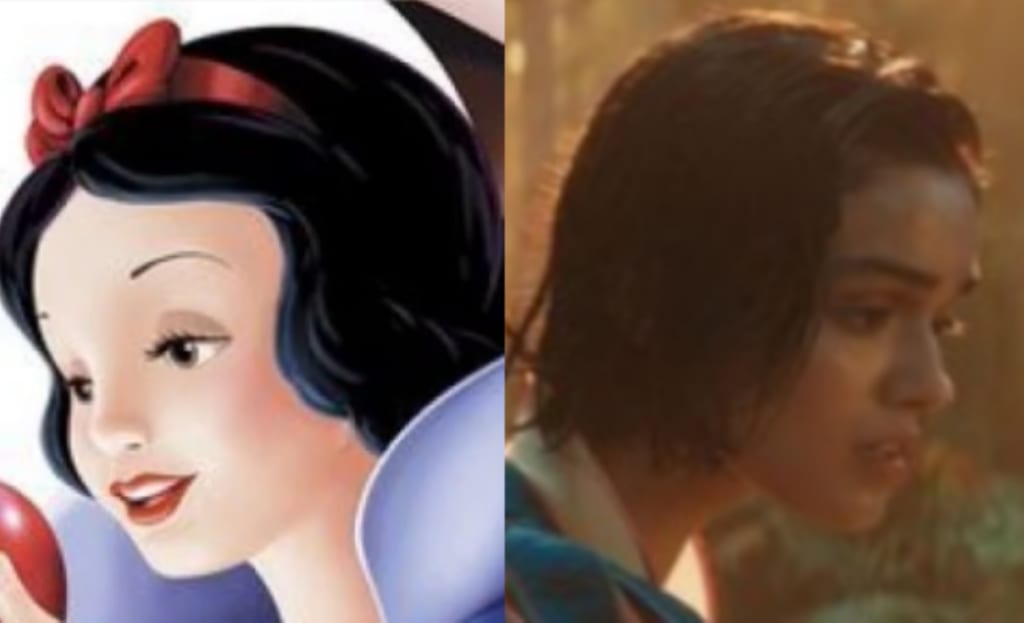
I'm far, far from the only person who has problems with Disney's "live-action remake" habit. I think its a lazy practice and I find a lot of them disrespectful to their source material (especially the more recent ones like The Lion King and Beauty and the Beast). Albeit not all of them are bad - Cinderella and The Jungle Book at least tried to distinguish themselves from the originals, and I do have a soft spot for the Aladdin remake. However, most of the time, I find they're just the same movies as before, just with an expensive coat of paint.
I've always asked this about remakes of any kind; what does it do that's different? What does it have to distinguish itself from its predecessor? What's the point of a remake when the original already exists and already did it better? Even those that try to change - or, forbid it, "modernize" - the original films for a reboot, they tend to do so in a way that's uninteresting, alienates the audience, or blatantly disrespects the film that came before.
Which brings me to the Snow White and the Seven Dwarfs remake, which premiered over the weekend - and it is already shaping up to be the WORST of this trend.
Everyone and their mother has already torn this film a new one, even before the first trailer dropped, for a multitude of valid reasons - from bizarrely casting an actress that openly bashes the original, to crafting uncanny CGI dwarfs in an effort to avoid offending little people but ending up offending them anyway, its already shaping up to be the hardest of sells. With press so scathing it destroyed the official trailer's dislike bar, I wouldn't be surprised if it barely scrapes by its $270 million dollar budget.
But - what irks me personally about this remake in particular is how it reeks of Disney fundamentally missing the point of the animated original - especially for the studio's very first feature-length picture.
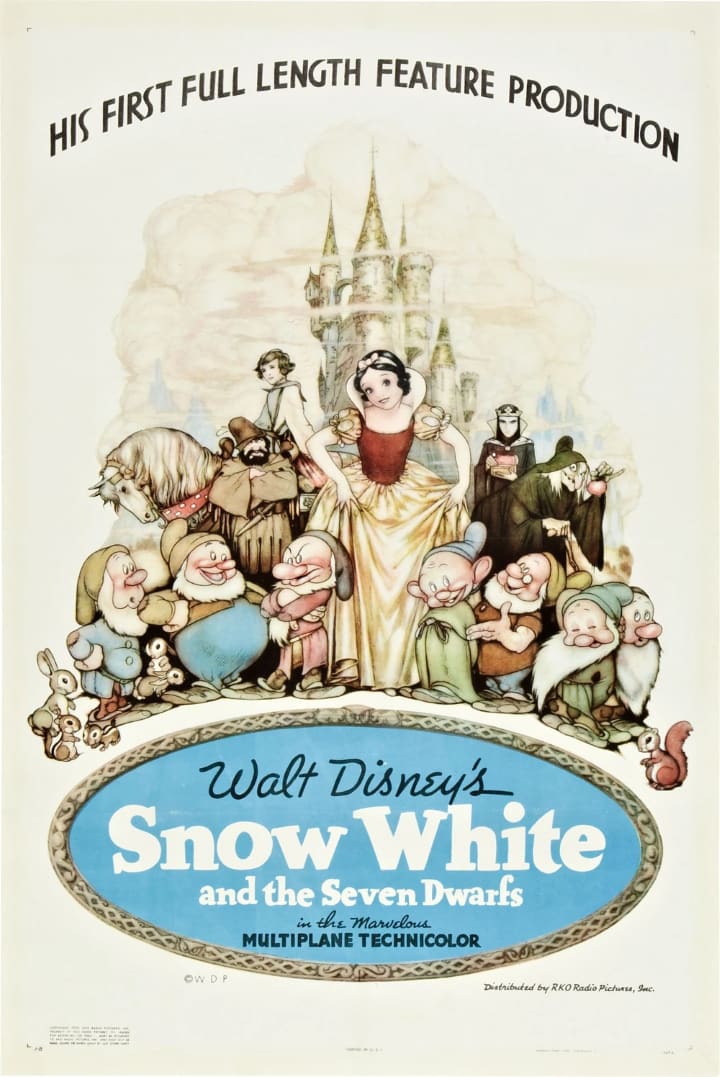
While not the world's first feature-length animated film, I would call Snow White and the Seven Dwarfs the first widely-popular one in the U.S., especially for Hollywood.
Despite its legacy, the odds were really stacked against this film's production; Hollywood studios at the time didn't believe that animation could hold audience attention for 90 minutes straight, that the bright colors would hurt their eyes and they would be bored without constant gags. Popular culture at the time felt it would fail so bad that the film became colloquially known as "Disney's folly".
But Walt, despite these warnings, was dead set on producing the feature. After years of only producing Mickey Mouse and other short cartoons, he became convinced that full-length features were the key to keeping his studio afloat; he believed that full-length animation would fund his studio far more than just shorts would, and the longer runtimes would let him stretch both his creativity and animation as a medium further than ever. His enthusiasm for the project infected his team, and they tackle it with the same fervor as Walt.
In true Walt Disney fashion, he believed in this film so much that he took out a loan and even remortgaged his own home to fund production. He was determined to tell a complete story with animation, and the modern Disney company has this little film that their founder believed in to thank for its legacy.
I wouldn't call Snow White and the Seven Dwarfs a masterful film, and I can't call it my personal favorite Disney classic. I feel that some gags do draw out their scenes a bit too long, and there’s no getting around how much of a nothing-character the Prince is.
However, that doesn’t make it a bad film. It still succeeds today as a fun reminder of childhood and a testament to animation as an art form.

To the modern viewer, the film can at first seem lightweight and simple. It doesn't stray far from the classic fairy-tale structure, and the characters aren't terribly complicated. But that doesn't make it a bad film today. The simplicity was Walt's intention from the start; he became inspired to adapt the story based on his own recollected love for it, having seen an adaptation in 1916 as a kid. His own film’s opening emulates that innocent feeling of childhood bedtime stories by starting not with animation, but with opening a book with gorgeously-printed text to establish our key characters.
Fairy tales were usually a popular pick for childhood stories in Disney's time, and he captures this childish innocence by letting the tale and art speak for itself. There’s a reason why stories like these endure in spite of evolving standards in storytelling; I feel that fairy tales specifically take us back to the simpler days of childhood, when classic stories of good vs evil and kindness vs cruelty ran supreme.
Snow White and the Seven Dwarfs expresses this feeling not just as a fairy tale adaptation but an animated adaptation; with the freedom the hand-drawn medium gave Walt and his team, they crafted a unique adaptation that seamlessly blended art and sound to tell its story. It cannot be understated how groundbreaking this adaptation was.
This film also introduced two prominent reoccurring themes throughout Disney's feature films: both wish fulfillment and the celebration of innocence.
The innocence of the story stems not just from Walt's own childhood experience with the Grimm tale, but from the title character herself. Although a young woman, Snow White is the picture of innocence that we usually associate with children; she is naive and trusting to a fault, but also unbiased and hopeful. Even as a scullery maid at the start of the film, Snow White doesn’t outwardly express any misery for her situation apart from a single forlorn sigh; she still finds meaning in what us cynical adults might find “childish”, such as speaking to the birds while she cleans and playing with her own echo in the wishing well.
Snow White’s innocence appeals to our own inner child, which helps the audience to connect with her in spite of her lack of complexity. We connect with her this way even more so during her flight through the forest, which also exemplifies the strength of Walt and his team’s filmmaking; the frantic music mirrors the fright of the character, which is woven into the pace of the imagery to heighten the terror.
It’s a quick scene but highly effective; it captures that childlike fear of the unknown is such a visceral way. It comes across as a suffocating nightmare that still affects you as you wake up, with everyday objects looking like monsters in the dark to your fear-addled mind.
(I certainly remember the music from this scene becoming the soundtrack to a lot of my nightmares as a toddler.)
The dwarfs, similarly, aren't very complex, but that doesn't make them boring to watch. Art-wise, they're where Walt and his animators’ work on short cartoons really shines; the physical comedy of the dwarfs sleeping comfortably in drawers, Sneezy’s catastrophic hay fever, and Dopey’s misadventure with a soap bar are timelessly funny and contain the spirit of physicality in Walt’s previous work with Mickey and friends.
The dwarfs also express relatable innocence, though in a different form to Snow White. While they're at first established as the employed, hardworking adults to contrast Snow White’s naivety, they are still childish in their own way: when they first notice their house is broken into, their first assumption is that the culprit is a mythical monster; when Snow White asks them to wash before dinner, they stutter around excuses and meekly hide their hands when she asks to see them; Grumpy is arguably the most childish of the group, with his arbitrary dislike of women, insistence that they will give the men his idea of “cooties” (which he calls "wicked wiles"), and even sticking his tongue out at Snow White the way a young boy would.
The scene of the dwarfs refusing to wash their hands most visibly displays the characters’ duality between childhood innocence and adult maturity; Snow White fusses over the men the same way a mother would her own children, but she’s still playful and doesn’t baby them even when they’re sulking like naughty boys.
It's also highly worth noting that the dwarfs do not bond with Snow White over just her physical beauty; its her kindness - her second most prominent character trait - that ultimately endears them to her. The audience has seen how kind she is from early in the film, when she comforts a lost baby bird, to later when she enthusiastically cleans the dwarfs' house under the impression that they're orphan children. What convinces the seven men to let her stay with them is her offering to keep house for them while they work during the day; she shows she is hardworking, just like them, and she has no problem pulling her weight by cooking and cleaning for them.
This is why I also believe that, even though the film technically falls under the "Beauty Equals Goodness" trope, it never meant to perpetuate it. Only other characters take notice of her beauty, while Snow White herself never acknowledges her own appearance. She never puts any importance on it, unlike the evil Queen or even the dwarfs at times.
Snow White is an enjoyable character because of her hopeful kindness - she is, overall, just a lovely person, NOT just a pretty face. This is why the forest animals and the dwarfs race to save her from the Queen, why they refuse to bury her when they believe she's dead; her kind heart and amiable nature is what endears her to even Grumpy, who until late in the film, is unrelentingly rude to her.
This shows that, despite being named for her beauty, Snow White's status as the "fairest" of all is totally arbitrary - it is only important because the Queen deems it so.
The Queen is a fascinating character in her own right, and, likewise, she didn't need to be complex to be a threatening villain. While at first her threats to the huntsman gives the impression of a scumbag who uses others for her dirty work, when she finally does get her hands dirty, it displays in visceral detail how insane she really is; this is a person willing to kill her own stepdaughter for the most arbitrary reason, even turning to dark magic to best Snow White as the “fairest” in the land.
The Queen's transformation into the old hag evokes the same terror that Snow White's forest escape does, not just of the Queen but for her; the way she gasps and grabs at her throat while her body reforms into the hunched hag, the background spinning around her to match the oppressive music - it paints a gruesome, painful picture. Again, it reiterates the lengths the Queen will go for her selfish motives; whatever pain this potion is putting her through, she is willing to suffer through it to kill her own stepdaughter.
The terror continues even after the transformation ends: the Queen, now laughing mad, sadistically gloats about putting Snow White into the Sleeping Death for the dwarves to bury her alive. To me, this implies that either the dark magic either the dark magic drove her even more insane, or it gave her the means to freely express that insanity!
(It's also worth noting that this transformation may be permanent; while the Queen refers to it as a “disguise”, the page she reads from has no notes about an antidote or expiration date for the spell. This only adds another layer of horror to the Queen’s motives, that she is willing to permanently destroy her own beauty that she put so much importance on, just to kill the one deemed more beautiful than her. Truly, a terrifying picture of insanity.)
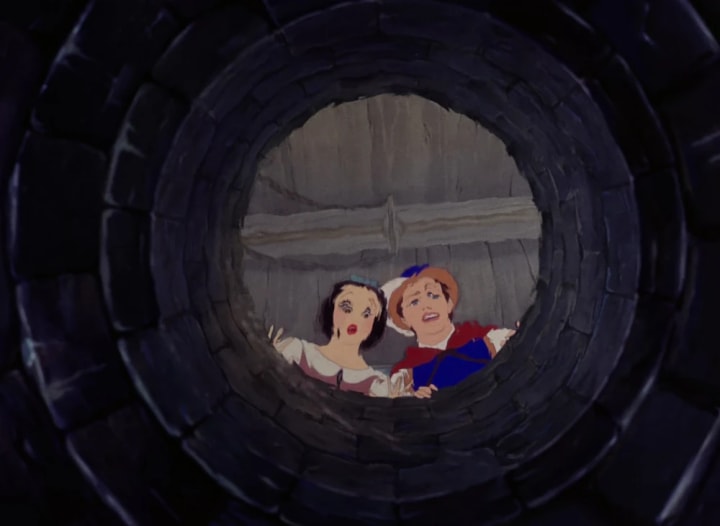
Now, let's talk about the most frustrating character in the film: the Prince.
Like I said before, the Prince is a pretty "nothing" character, only existing as Snow White's obligatory fairy tale "true love". This wasn’t by intention though, as Walt’s team had drafted several scenes that featured him more; however, the animators found a realistic human man too complex to animate at the time, so his screentime was cut to only the start and the ending.
HOWEVER, while I share the frustrations many modern viewers have with his lack of character, I still don’t find him out-of-place in the film.
Befitting a film that uses a simple childhood fairy tale to celebrate wish fulfillment, the Prince is not a character but a symbol of Snow White’s purehearted, childlike desires. She wants freedom from her current life and desires a romantic companion to spend eternal happiness with. Her meeting with the Prince is not meant to be realistic for relationships but a metaphorical representation of the film’s key ideas about wishes and hope.
I mean, is it any wonder why Snow White looking down at the enamored Prince from a balcony directly mirrors a similar scene from Shakespeare’s Romeo and Juliet, another work that dramatizes its characters’ instant connection to explore youth and desire?
This is why it frustrates me when I see bad-faith takes about the end of the film. Do many of them raise valid points? Yes, absolutely. There will always be a place for them. But they also disregard the valuable context that this is a fairy tale adaptation, and fiction does not equal reality.
When the Prince kisses Snow White out of her sleep, it represents that hope we all have for our dreams to come true. Then, as she bids her beloved dwarfs farewell, Snow White rides with the Prince toward a glowing golden castle, another symbol of her wish fulfillment, contrasting the Queen's dark and oppressive castle from the beginning.
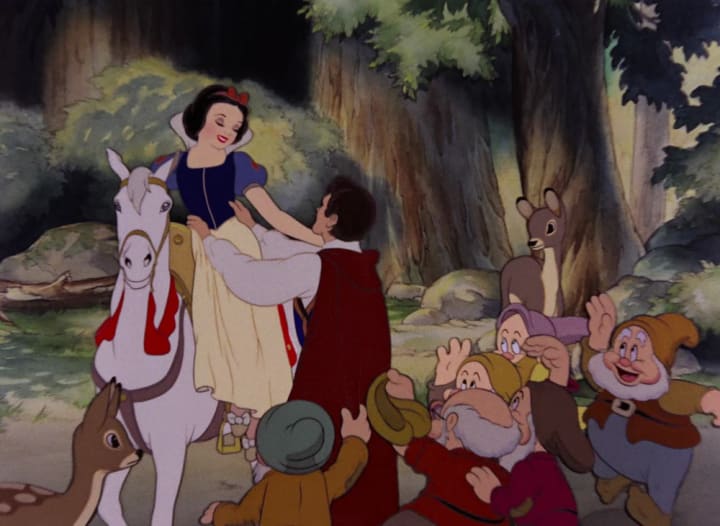
Now that the new film is out, I cannot help feeling exhausted all over again with Disney's remake obsession. It is clear that the original film has a lot more depth and entertainment value than modern audiences might realize; it has a clear heart and a soul, while the new film cannot say the same. The new film seeks to modernize and "improve" the original, but really, the original didn't need fixing to begin with.
There is a reason why Walt pushed to complete the film despite the odds; to connect with the audience's sense of innocence, and return to a more joyful time when stories were simpler but still endlessly enjoyable. His own words capture this intention perfectly:
____________________________________________________
Please support the official release. Snow White and the Seven Dwarfs is available on Disney+ and home media.
If you enjoy my work and want to support me further, please consider leaving a like or a tip and sharing this story! Thanks so much!
About the Creator
Em E. Lee
Writer-of-all-trades and self-appointed "professional" nerd with an infinite supply of story ideas and not nearly enough time to write them down. Lover of all media, especially fiction and literature. Proud advocate of the short story.
Book Review: "The Complete Short Stories" by Robert Graves
Robert Graves has always been a divisive writer for me. I once found his book I, Claudius unreadable and yet, Goodbye to All That was fantastic. His historical novels seem to be the worst possible historical novels - no imagination has gone into them and they read more like a textbook of fictions rather than a historical fiction masterpiece. Whereas, when he wrote Goodbye to All That you can definitely feel that his writing style is one of brilliance and atmosphere. Oh, and I have not forgotten about the comments he made about a young Bob Dylan.
By Annie Kapur3 days ago in Geeks



Comments
There are no comments for this story
Be the first to respond and start the conversation.