
The Indie Animated Nightmare that Reminds Us to Stay Weird
We Are The Strange is an unusual film about unusual characters that we can all see ourselves in.

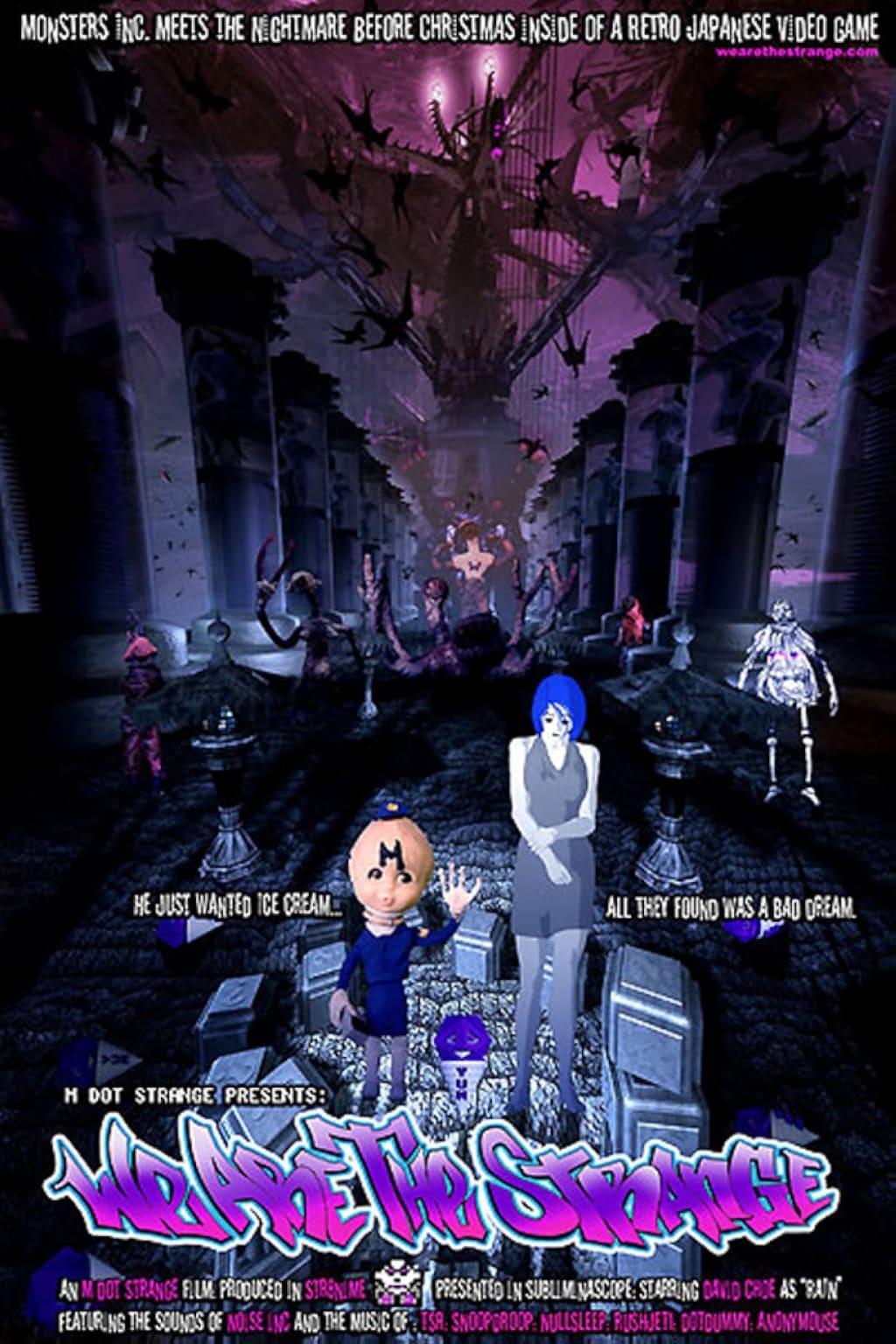
Now, I've never done acid before, but watching indie filmmaker M dot Strange's frenetic fever dream of a passion project We Are The Strange feels like what I would see on the best trip of my life.
And what a trip it is! This cult piece of animated magic blends both computer and stop-motion techniques to create a setting unlike anything I've seen before. Against the backdrop of an abandoned arcade game, an unconventional story of social outcasts fighting the system that rejected them plays out; these outcasts - including a 3D-animated young woman, a boy with a plastic doll head, an origami circus performer, and a notorious stop-motion fugitive - fight to survive a decaying, monster-ridden city, which culminates in a mega-robot battle to reclaim their home.
But, at the same time, it can also be summarized as "A bunch of outcasts come together to fight monsters and survive long enough to get some ice cream".
Yep, we're dealing with an experimental oddball here.
Though, I imagine the film's creator wouldn't have it any different. We Are the Strange was the debut film of animator, filmmaker, musician, and self-proclaimed "professional weirdo" M dot Strange, premiering at Sundance in 2007 and later releasing on DVD. Since then, Strange has made a multimedia career out of exploring the weird and, well, strange, with the help of his creative studio Imagination Rabbit; this includes the follow-up film Heart String Marionette, interactive film M doll, video games Derp Souls and Nightmare Puppeteer, and upcoming animated musical Living My Life set to release this year.
It's clear from this bibliography that Strange enjoys playing with medium conventions and has a passion for the unusual in art. Material that may be deemed too weird or too confusing is always on the table in his work, and for me this is a breath of fresh air in the fog of mainstream animated films lately. I've always loved unconventional stories, and how can I say no to a film that was written, directed, produced, and animated by just one guy?
For comparison, Strange has cited David Lynch as inspiration, and has described We Are The Strange as "Nightmare Before Christmas meets Monsters Inc"; this is where I expect the film to divide folks, since it uses surreal horror and unnerving character designs that aren't to everyone's taste. If you don't like experimental filmmaking, this one might not be for you.
However, as implied by the title: the strangeness is the point. The oddness is the point. The film invites the viewer into this bizarre world and encourages them to open their eyes to these quirky characters. The film is patient with the viewer and asks them to be patient back.
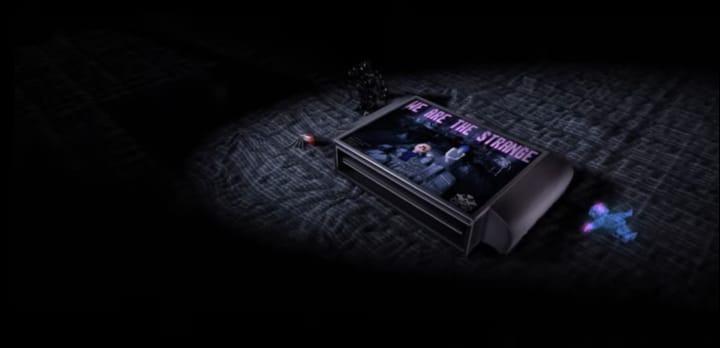
The film begins by framing itself as a story within an abandoned videogame, which both helps suspend disbelief and cleverly sets up its interactive themes. The robotic narration introduces each protagonist as if reading summaries from a character guide, even including alignments like “not so bad” and “pure evil”; to a modern viewer, this might seem cheap and lazy character development, but this is an unconventional film telling a very unconventional story, so it establishes some much needed context for an admittedly hard-to-follow experience.
(I honestly welcome these small pieces of backstory because, without them, I imagine most viewers would be even more lost in the plot)
Instead of the aforementioned characters, however, the player (implied to be us, the audience, watching) chooses to play as the camera, an “objective” point of view who “just watches and does not participate in the game”. Not only is this a unique and meta way to set up the film, but it emphasizes right away how to watch it: from an open, objective perspective. It feels like the film is self-aware of its oddities, and unashamedly invites the viewer to experience those oddities for themselves.
From there, we meet the lonely and abused Blue (Halleh Seddighzadeh), a young animesque-looking woman who works at Stopmo City’s local gentleman’s club. She supposedly suffers from a degenerative disease that turns her skin scaly every time she smiles or speaks, and this apparently makes her so ugly that Him – the glitchy 3D-animated dictator of the city, voiced by M dot Strange himself – casts her out until she makes herself “look perfect as the girls on [his] video screen”. Blue flees to the Forest of Still Life nearby, where she meets eMMM, a mute stop-motion orphan with a doll head and only his toy collection for company. Their scenes together had to be some of my favorites; while shy and wary at first, Blue and eMMM are drawn to each other for company, and their bond only grows as eMMM invites Blue into his innocent world of toys and videogames.
Meanwhile, a duo of fugitives roam the city - consisting of Rain (David Choe), a masked stop-motion man with a mysterious past, and Ori (Stuart Mahoney), a shapeshifting origami man and psychological wild card. They engage in most of the film's action scenes, fighting gory monsters from the city's underbelly while searching for something - or someone - important to them. While their role is ambiguous at first, it eventually culminates in a revelation that, admittedly, ties the film's overarching conspiracy together by the end.
There's also a shadowed organization known as the Cult of the Strange, but they'll be working mainly in the background.
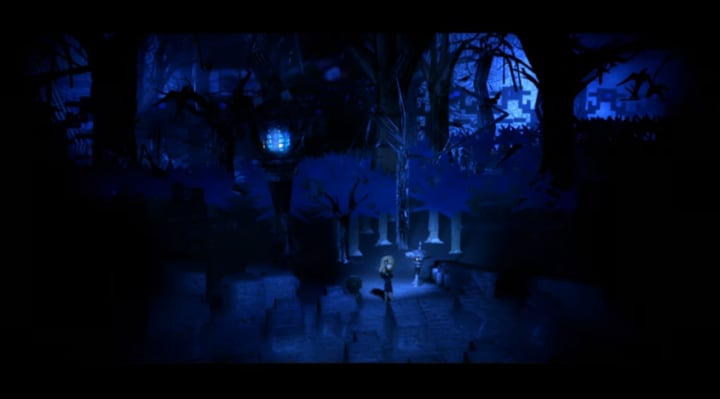
It's worth mentioning now how much legwork the soundtrack and the visuals do for the storytelling. Several scenes, especially the quiet ones, are long and uneventful, but in the spirit of classic films with minimal dialogue, Strange uses animation's strength as a visual medium to his advantage. A somber, melodic violin accompanies Blue and eMMM observing one other between the forest's jagged trees and broken doll pieces, giving a sense of both foreboding and curiosity. Meanwhile, frantic techno beats play over Rain and Ori's monster battles, intercut with abstract shots of colorful silhouettes to emphasize the action. Even panning shots of the city itself tell the viewer everything without much really happening; it's clear from the sharp buildings, roiling clouds, and mechanical soundtrack that this place is dangerous and unkind to those it deems "unworthy".
(It is also very worth noting that the DVD version of We Are The Strange features several additional soundtracks, each of which give the film a distinct feeling, including a “Nightmare” soundtrack that, according to Tvtropes, turns the film into pure horror. I’m only covering the film with the original soundtrack, but it’s worth noting if you want to experience the film in vastly different moods.)
Scenes like these draw the audience into the film's world without explicitly saying it. Rather than dialogue, the settings and Noise Inc.'s accompanying music give the audience a true "show, don't tell" experience. This is what I mean when I call the film "patient"; the story is somewhat abstract in how it plays out, and it respects the audience's intelligence to put the pieces together. The closest I can compare it to is Skinamarink, a film framed as an analog horror where long, drawn-out scenes of a house from a child’s point of view maximize the tension out of anticipation for scares.
Unlike Skinamarink, however, We Are The Strange uses these techniques not just for tension but for contemplation. Especially in Blue and eMMM's scenes, there are long stretches of time where the characters stand around, uncertain what to do next, but these moments are far from boring; the lack of dialogue forces the audience to sit with the characters and feel the same emotions as them. It emphasizes their friendship's cautious but curious buildup, as Blue fears her speaking disease makes her monstrous, while eMMM immediately latches onto her as the first real person he's seen in years. This buildup culminates when eMMM offers Blue his Game Boy, and without a word between them Blue designates herself as eMMM's guardian when they head back to the city to get the boy some ice cream.
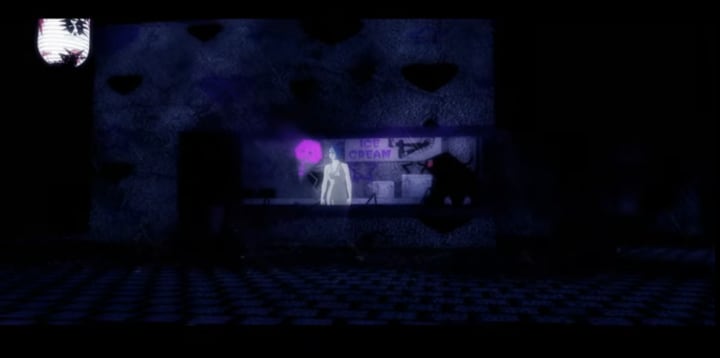
But this city isn't kind to outcasts; Blue and eMMM realize this when one of its monsters attacks the ice cream shop, and as they recover, the nearby arcade machine "SinisteRRR" - which is closely associated with Him's corruption - chants over ominously glitchy imagery: “There is no hope. For you are my prisoner. There is no escape.”
This is when I believe the film's broader themes become clearer. Though far from subtle, it commits to its celebration of outcasts rising against the toxic social order. It depicts an inherent resilience in these outcasts, which Blue and eMMM demonstrate soon after the ice cream parlor attack. Despite the danger they just escaped, they find refuge in a nearby arcade, where Blue engages with a traffic-based game while eMMM cheers and dances to its energized soundtrack. To me, this scene represents the heart of the film: in spite of their situation, these outcasts find comfort in their comradery and persevere in the face of opposition.
But, as this film demonstrates, for every so-called weirdo minding their business, there is a social order that wants to stomp them out. From here, the underlying conflict explodes, finally bringing Blue and Rain's parties together and revealing eMMM's connection to both Rain and the conspiracy behind Stopmo City's corruption.
I cannot explore this too deeply without spoiling the film's second half, but the revelations frame the rest of the film in a new light, and the final battle is legitimately triumphant. The finale ties the entire experience together, as Blue, inspired by eMMM's dauntless innocence, fights back against Him's toxic influence. I highly encourage you to watch it for yourself.
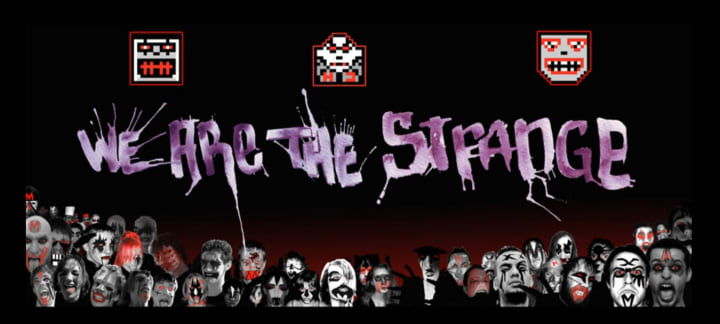
We Are The Strange is the kind of film that reminds me why I love animation. It subverts the traditional biases towards the medium to create an eclectic and unique piece of art. Granted, its interactive style doesn't always work; several scenes do go on a little too long, and some characters have stated traits that never seem to play out. I mean, according to the opening character sheets, Rain is rumored to have kidnapped Ori from the circus, but their dynamic never comes across this way - then again, Ori is also labelled as "legally insane" so its never clear what his situation really is.
But despite those elements, I still highly recommend We Are The Strange for standing out amongst the animated feature crowd and celebrating the weird and unusual sides of art. Its quirky cast holds a mirror up to ourselves and tells us to embrace our own quirks in the face of opposition. Just as the Cult of the Strange's Pasteur asks Blue: "What do you fight for?" Well, this film fights for the strange ones, the outcasts, and everyone who has ever felt rejected by the establishment. It says, "Look at us. We are losers and freaks. We are the strange - and we're not going anywhere".
____________________________________________________
Please support the official release. We Are The Strange is available on YouTube, archive.org, and DVD.
If you enjoy my work and want to support me further, please consider leaving a like or a tip and sharing this story on social media! Thanks so much!
About the Creator
Em E. Lee
Writer-of-all-trades and self-appointed "professional" nerd with an infinite supply of story ideas and not nearly enough time to write them down. Lover of all media, especially fiction and literature. Proud advocate of the short story.
Silver Screen Magic with Mae West
American actress and singer Mae West became a popular film actress during the Great Depression. She started entertaining in vaudeville, then performed on Broadway, and finally went to Hollywood. She signed up with Paramount Pictures and made her debut in the 1932 film “Night After Night.” She also starred in musicals, comedies, and crime dramas. The American Film Institute named her one of the best classic Hollywood actresses.
By Rasma Raisters5 days ago in Geeks
Agnes Abdullahu's DiaMondaine Diamantaires Club partners with Isis Fashion Awards (Brings Diamonds, Luxury and Deluxe Dubai Flair to Amsterdam)
In the glittering world of high-end jewelry and haute couture, there are those who simply attend events, and then there are those who weave the very fabric of the experience. As the calendar turned toward the highly anticipated 4th edition of the Isis Fashion Awards (IFA) on May 6th, a new and formidable alliance began to take shape.
By postworldviewa day ago in Geeks
Miss Persephone's Manual to a Seemingly Ordinary Life
Miss Persephone was found at the dining table, her blue eyes swollen, her tears arriving and retreating like the tides of the ocean. Earlier that day, her family had visited her in the retirement home where she had lived for eight years. It was her eightieth birthday.
By Imola Tóth3 days ago in Fiction


Comments
There are no comments for this story
Be the first to respond and start the conversation.