
Wes Anderson
Whimsy and the Auteur


“I aimed for whimsy, but landed on twee. It’s a fine line, people, it’s a fine line.”
This is something I can picture my imaginary 1940s screenwriter persona saying. Fed-up with the intensity of films noir, set in the mean streets of dimly-lit cities, she has turned her hand to some light comedy. It doesn’t work. She knows it hasn’t worked. It’s just – well, twee. Too sweet. Lacks bite.
And I wonder what she would think about Wes Anderson. Rachel in 2025 actively hunts down new films by the Texan born auteur. But her 1940s alternate ego, would probably find Anderson’s oeuvre a little baffling.
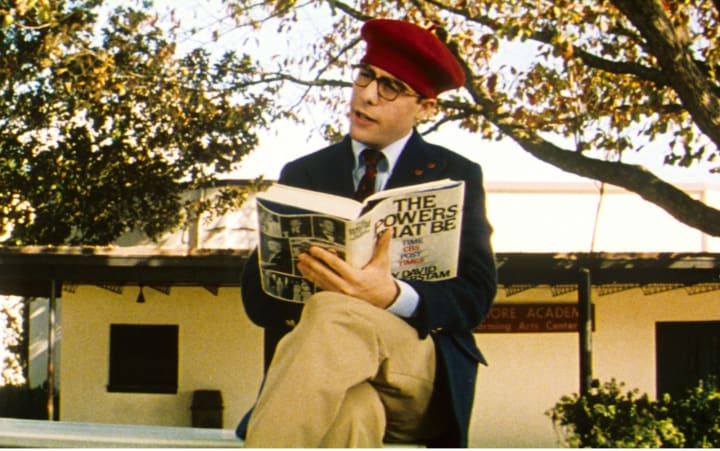
1940s Rachel would probably respond much like one of mine and Wes Anderson’s favourite critics – Pauline Kael. Anderson specifically sought her out to show her a preview of Rushmore (1998). At the end of the film she turns to the young filmmaker and says:
“I don’t know what you’ve got here. Did the people who gave you the money read the script?”
Ouch.

Having recently seen The Phoenician Scheme, I tried to explain to my alter ego why I watch his films.
“Look, I get it,” I said, “It can all seem a little weird. Like it’s style over content.”
And then I began my lengthy defence of Anderson.
The world Anderson produces is pretty, ordered, brightly coloured. But it often depicts dark narratives of loss, disorder and violence. The Phoenician Scheme, for example, centres a series of attempted assassinations. There are murders and suicides on screen. But it tells those stories with a simple dispassion.
It is possible to read the films as the inability to deal emotionally with trauma. Death in his films appears to leave little trace on the bereaved.
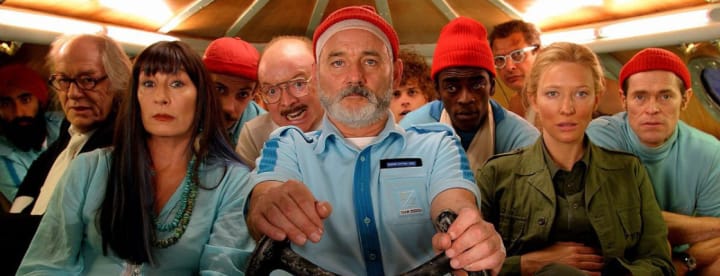
Most of the quirkiness and whimsy associated with his work comes from the visual. His films are instantly recognisable with the use of diorama displays, bold colour choices, carefully framed symmetrical shots, the aesthetic of clutter against vast spaces, and the occasional extreme close up of an actor. Sometimes, I watch his films like I’m at an art gallery. I take on the role of passive observer to another person’s vision. I revel in the imagery.

And it is only when I walk away from the work that I become aware of its impossibility, or its idiosyncrasy. Because the imagery has allowed me to enter a different world. A world I can both recognise and also feels a little alien. In particular, the alienation comes from his lack of popular culture references. There are no mobile phones, no social media, the technology is dated but also without time.
One of his big themes is inter-generational tension, considering the impossibility of childhood innocence in a world where adults don’t connect. And this is heightened by his lack of popular culture references. This allows him to avoid the tired tropes of slang, fashion or technology as proxy for the gaps between generations.

Anderson works in a visual medium, but he is also a writer. He has written or co-written most of his output. His writing has a distinctive voice with a deadpan humour, an understatement, a lack of histrionics or big speeches.
This gives me a sense of the character’s he chooses to put on screen. They are usually outsiders, with a hint of paranoia. They have peculiar and particular quests. They have schemes and plots that require them to bring order to their world. They talk in short, snappy sentences as if they don’t want to give too much away.
I finish by saying how I love the whimsy, that treads that fine line with the twee.
“I mean we just watched Tom Hanks playing basketball, what’s not to love?”

“So, now do you get it?”
I ask 1940s Rachel, a little too eagerly.
“Sure kid. I get that you sound a little pretentious.”
“But, but…” I say a little crestfallen, searching for another insight. Yet, I know it is hopeless. Wes Anderson is not a mainstream filmmaker. He is meant to be niche. And you either get him or you don’t. I can’t convince you if he’s not for you.
“It’s alright,” says the imaginary 1940s screenwriter. “Do you know what you need? A good slug of whiskey.”
She’s right, of course.
If you've enjoyed what you have read, consider subscribing to my writing on Vocal. If you'd like to support my writing, you can do so by leaving a one-time tip or a regular pledge. Thank you.
About the Creator
Rachel Robbins
Writer-Performer based in the North of England. A joyous, flawed mess.
Please read my stories and enjoy. And if you can, please leave a tip. Money raised will be used towards funding a one-woman story-telling, comedy show.
Keep reading
More stories from Rachel Robbins and writers in Geeks and other communities.
Sinners and the Doris Day Fan
Originality, I have been told, is mashing together two separate things or ideas to generate something new. Sometimes it really is that simple. Have you tried a Reese’s Peanut Butter Cup? Two good things mashed together. Chocolate yumminess meets the salty splendour of Peanut Butter to produce something delicious.
By Rachel Robbins8 months ago in Geeks
Marvel Zombie
The last entry into our 2025 superhero projects catalogue is Marvel Zombies. This was a show that was anticipated by absolutely no one and it disappeared from the public consciousness as quickly as it was released. There was nothing special about the project that made it a must see, or a must remember. In fact if anything it's a must forget.
By Alexandrea Callaghan15 days ago in Geeks
The Night I Stopped Waiting for Wings
I was fifteen the first time I saw the wings. It was 2009. My best friend and I huddled in her basement, sharing a bag of chips, eyes glued to the TV as women in glitter and lace walked like they owned the air itself. They were radiant, powerful, untouchable. One wore wings so wide they brushed the stage lights; another smiled like she held the secret to happiness itself.
By KAMRAN AHMAD8 days ago in Geeks


Comments (5)
I get why some find Anderson's style over content, but his visuals tell dark stories well.
This is perhaps the best summation of Wes Anderson I've ever read. We absolutely love his work. My brothers wouldn't know what to do with it.
I loved the banter between 1940s Rachel and present day Rachel! This was such a charming piece! Several elements of the film are intriguing to me. Thx 4 sharing!🌸
I love Wes & you are so right: "I can't convince you if he's not for you." I've learned this lesson the hard way (still learning it). I met him at the premiere of Darjeeling Limited & offered him my screenplay. He declined & told me what I already knew: he writes & shoots his own stuff. But he did autograph the copy of my screenplay I had at the ready! Great piece, Rachel!
He gets the stellar casts, that's for sure. I remember watching "The Royal Tenenbaums" and it being completely lost on me. I wonder now though, if I might view it differently.