
"Unveiling the Mind-Boggling Complexity of Chess: Why There Are More Possible Chess Games Than Atoms in the Universe"
Random fact of the day.

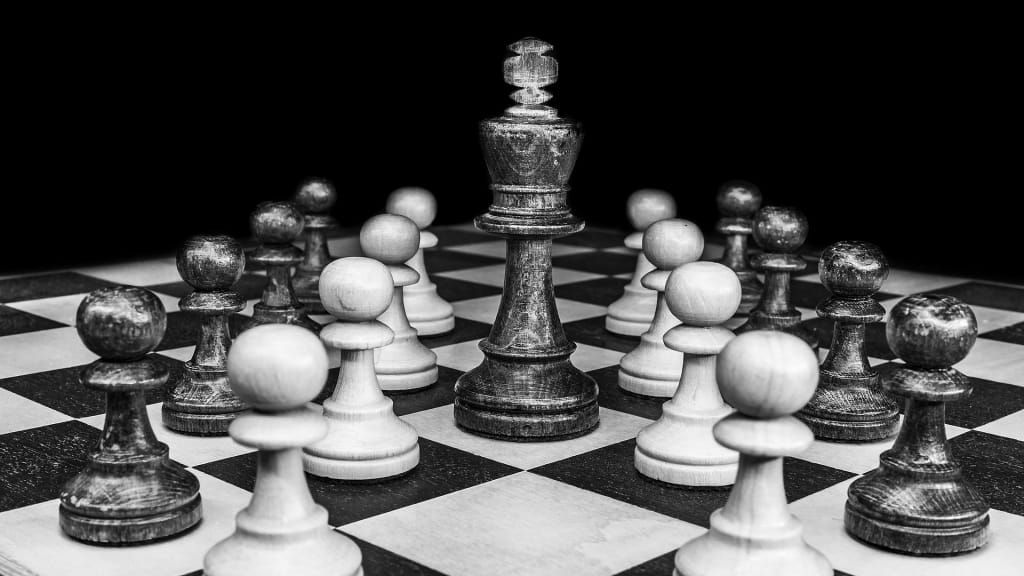
Chess is one of the most popular and enduring games in the world, with a history that stretches back over a thousand years. While the basic rules of the game have remained largely unchanged over that time, the sheer number of possible moves and game states is staggering. In fact, it's estimated that there are more possible iterations of a game of chess than there are atoms in the observable universe.
To understand how this is possible, it's important to take a closer look at the game of chess itself. At its most basic level, chess is a two-player game played on a board consisting of 64 squares, arranged in an 8x8 grid. Each player starts with 16 pieces, including a king, a queen, two rooks, two knights, two bishops, and eight pawns. The goal of the game is to checkmate the opponent's king, meaning that the king is under attack (in "check") and cannot escape capture on the next move.
The sheer number of possible moves and game states in chess is what makes it such a complex and challenging game. For example, in the opening position of a chess game, there are 20 possible moves for each player, leading to a total of 400 possible game states after the first move. After the second move, there are 20 possible responses to each of those 400 game states, leading to a total of 8,000 possible game states after two moves. This exponential growth continues as the game progresses, with more and more possible moves and game states emerging with each turn.
So just how many possible iterations of a game of chess are there? The number is difficult to calculate precisely, but estimates range from around 10^40 to as many as 10^120. To put that in perspective, the number of atoms in the observable universe is estimated to be around 10^80. That means that there are potentially more chess games than there are atoms in the universe!
One way to think about the sheer complexity of chess is to consider the so-called "Shannon number". This is a rough estimate of the number of possible games of chess, calculated by the mathematician Claude Shannon in the 1950s. Shannon estimated that there are around 10^120 possible games of chess, based on the number of possible moves and game states. To put that in perspective, he noted that the number of atoms in the universe is estimated to be around 10^80, and the number of elementary particles in the universe is estimated to be around 10^90. So even if every particle in the universe were to play a game of chess every second since the beginning of time, it still wouldn't be enough to exhaust the number of possible games.
Of course, the vast majority of these possible games of chess are nonsensical or strategically unsound. For example, a game where one player moves their queen back and forth between two squares for 50 moves would technically be a legal game of chess, but it wouldn't be a particularly interesting one. Similarly, there are many game states that are unlikely to arise in practice, either because they require both players to make highly unlikely moves or because they involve so much material being captured that the game would end long before that point was reached.
Nonetheless, the sheer number of possible chess games is a testament to the incredible complexity and richness of the game. Chess has been played for centuries by people from all walks of life, from grandmasters and world champions to casual players and hobbyists. The game has inspired countless books, movies, and other forms of art, and has even been used as a metaphor for war, politics, and other aspects of life.
In the end, the fact that there are more possible iterations of a game of chess than there are atoms in the observable universe is a testament to the incredible power of the human mind and the depth of our intellectual curiosity. It's a reminder that even the most seemingly simple things can contain hidden depths and complexities that we are only just beginning to uncover. And perhaps most importantly, it's a call to keep exploring, to keep asking questions, and to keep pushing the boundaries of what we know and what we can imagine.
About the Creator
Todays fact
"Join me for daily fun facts and satisfy your curiosity. From science to pop culture, I'll bring you fascinating tidbits to brighten up your day and expand your knowledge. Let's explore the world together!"
Keep reading
More stories from Todays fact and writers in Geeks and other communities.
So how is popping your knuckles different from standing up quickly?
Cracking your knuckles can be a fun habit, but it's not without risks. Synovial fluid is this lubricant-like substance that's found between your joints. When you stretch out your joint, you're releasing gas, and that gas forms a bubble and it collapses and pops. In order to crack the same knuckle again, you have to wait about 20 minutes for the gas to return back to that fluid. So how is popping your knuckles different from standing up quickly?
By Todays fact3 years ago in Humans
Silver Screen Magic with Mae West
American actress and singer Mae West became a popular film actress during the Great Depression. She started entertaining in vaudeville, then performed on Broadway, and finally went to Hollywood. She signed up with Paramount Pictures and made her debut in the 1932 film “Night After Night.” She also starred in musicals, comedies, and crime dramas. The American Film Institute named her one of the best classic Hollywood actresses.
By Rasma Raisters6 days ago in Geeks
28 Years Later: The Bone Temple Review
The Bone Temple Review: A Wild, Gruesome, Surprisingly Solid Sequel Well… That Was Not What I Expected Twist my eyebrows and mail me to Alaska, because The Bone Temple was absolutely not the experience I thought I was walking into.
By Bella Anderson2 days ago in Geeks



Comments
There are no comments for this story
Be the first to respond and start the conversation.