
Unlocking the Stone Age: The Mystery and Majesty of the Ness of Brodgar
“How a 5,000-year-old archaeological wonder is rewriting the story of prehistoric Britain.”

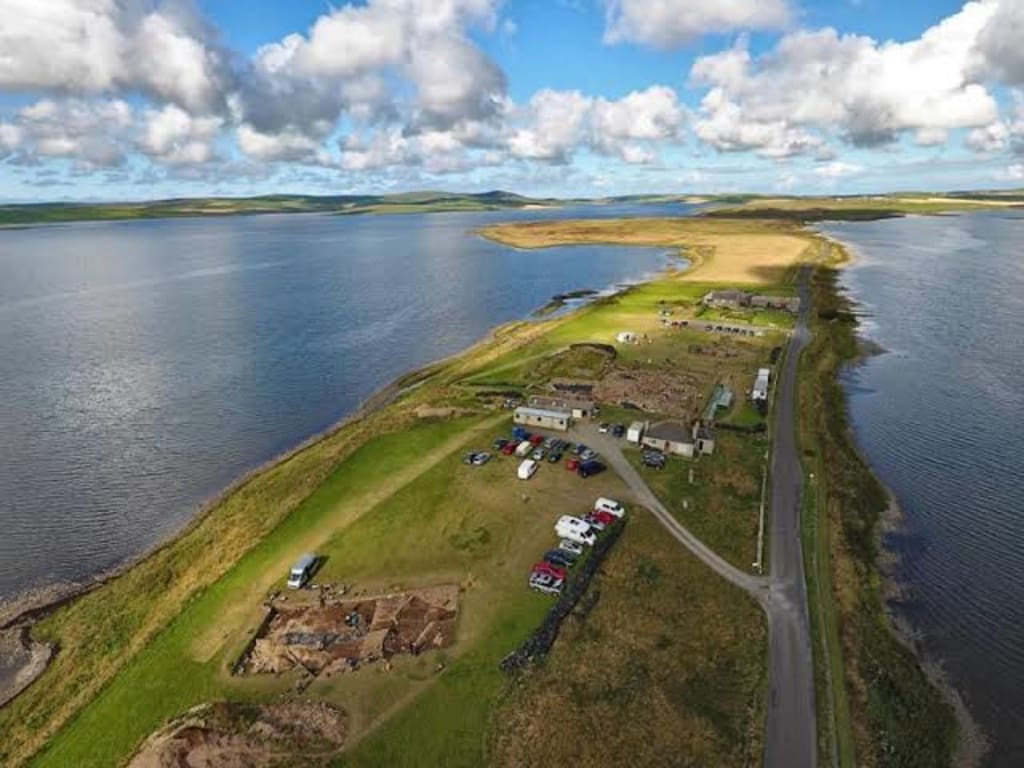
For centuries, Scotland’s Orkney Islands have been known for dramatic landscapes, wild seas, and ancient secrets buried beneath the soil. But among these mysteries, one site stands out for completely transforming our understanding of prehistoric life — the Ness of Brodgar. More than just scattered stones or forgotten ruins, the Ness is a vast complex filled with temples, homes, artworks, and ceremonial structures that are older than the pyramids of Egypt. Its discovery has reshaped archaeology, forcing experts to rethink what life in the Stone Age was really like.
Located between two dark, still lochs — Harray and Stenness — the Ness of Brodgar sits on a strip of land that would have been as meaningful to early humans as any sacred place today. Archaeologists began major excavations in 2003, and what they found revealed a thriving, complicated, and artistic society. The site isn’t one building — it is an entire campus of ceremonial structures that date back 5,000 years. This makes it older than Stonehenge and just as important.
When excavation began, the first surprise was the sheer size of the complex. Over 100 structures once stood there, arranged with careful planning. Some were large halls with thick stone walls, while others were smaller rooms used for gatherings or rituals. The discovery of colored paint — red, yellow, and even purple pigments — shows that Neolithic people were not just builders; they were visual artists. They decorated walls, carved markings, and created patterns that may have held symbolic or spiritual meaning.
One of the most famous structures, Structure 10, is a massive building at the heart of the site. Scholars believe it may have been used for major ceremonies, feasts, and important community events. Inside, archaeologists found animal bones, pottery, polished stones, and tools that suggest people traveled from far across the islands to participate in gatherings here. The Ness may have been a place where different tribes came to connect, trade, celebrate, and honor their beliefs.
The site also reveals one of the earliest examples of complex architecture. Builders carved stones to fit perfectly together, created straight walls, and aligned structures with astronomical events. The accuracy is striking for a time when there were no metal tools. Everything was shaped by hand, using stone, bone, and sheer human effort.
One of the most fascinating finds at the Ness of Brodgar is the artwork. Archaeologists discovered hundreds of carved stones — swirling patterns, geometric shapes, and mysterious symbols. These markings show that the people who lived here valued creativity and expression. Some symbols appear repeatedly, hinting that they may have been part of a cultural language or ritual system. Combined with the painted walls, the site becomes a rare gallery of prehistoric art.
Another remarkable discovery came from pottery fragments. The designs on the pottery match styles found in other parts of the UK and Ireland, proving that the people of the Ness were connected to neighboring regions. Instead of being a remote island community, Orkney was a cultural center — a place where ideas and traditions were shared.
The location of the complex also appears intentionally chosen. It sits in line with two major stone circles — the Ring of Brodgar and the Stones of Stenness. Together, these landmarks form a ceremonial landscape that stretches for miles. This suggests the area was a powerful spiritual hub where people believed the physical and spiritual worlds connected.
Despite over 20 years of excavation, experts say they have only uncovered a small portion of the entire site. Much remains hidden underground, waiting for future research. Each summer, new discoveries add to the story — tools, art, animal remains, and pieces of everyday life that reveal how advanced these early people truly were.
What makes the Ness of Brodgar so compelling is not just its age or size. It is the humanity behind it — the creativity, community, and cultural significance. It reminds us that even thousands of years ago, people were building, celebrating, dreaming, and creating beauty. They were not simple or primitive. They were innovators, artists, and thinkers.
As research continues, the Ness of Brodgar remains one of the world’s most exciting archaeological sites. It offers a rare window into a civilization that helped lay the foundations for human culture in Europe. And with every new discovery, the story of the Stone Age becomes richer, deeper, and far more fascinating than anyone expected.
About the Creator
Fiaz Ahmed Brohi
I am a passionate writer with a love for exploring and creating content on trending topics. Always curious, always sharing stories that engage and inspire.
Keep reading
More stories from Fiaz Ahmed Brohi and writers in Geeks and other communities.
“10 Kilo Khoon Kam Ho Gaya”: Sachin Tendulkar Pays Heartfelt Tribute to Dharmendra
When a legendary star passes away, the grief rarely stays limited to the world of cinema. It spills into sports, politics, and ordinary households across the country. That is exactly what happened when Bollywood’s beloved Dharmendra, fondly known as the He-Man of India, breathed his last.
By Fiaz Ahmed Brohi2 months ago in Geeks
Silver Screen Magic with Mae West
American actress and singer Mae West became a popular film actress during the Great Depression. She started entertaining in vaudeville, then performed on Broadway, and finally went to Hollywood. She signed up with Paramount Pictures and made her debut in the 1932 film “Night After Night.” She also starred in musicals, comedies, and crime dramas. The American Film Institute named her one of the best classic Hollywood actresses.
By Rasma Raisters6 days ago in Geeks
Global Socks Market Size & Forecast 2025–2033: Fashion, Fitness, and Function Drive a US$ 84.91 Billion Industry
Global Socks Market Outlook Once considered a simple necessity, socks have evolved into a high-growth lifestyle and performance product. From fashion statements and athletic essentials to medical-grade solutions, socks today play a critical role in comfort, health, and personal style. According to Renub Research, the Global Socks Market is projected to grow from US$ 49.33 billion in 2024 to US$ 84.91 billion by 2033, expanding at a CAGR of 6.22% from 2025 to 2033.
By Aaina Oberoiabout 19 hours ago in Geeks
Miss Persephone's Manual to a Seemingly Ordinary Life
Miss Persephone was found at the dining table, her blue eyes swollen, her tears arriving and retreating like the tides of the ocean. Earlier that day, her family had visited her in the retirement home where she had lived for eight years. It was her eightieth birthday.
By Imola Tóth5 days ago in Fiction



Comments
There are no comments for this story
Be the first to respond and start the conversation.