
Trap
A Deeply Symbolic, but Largely Impenetrable Viewing

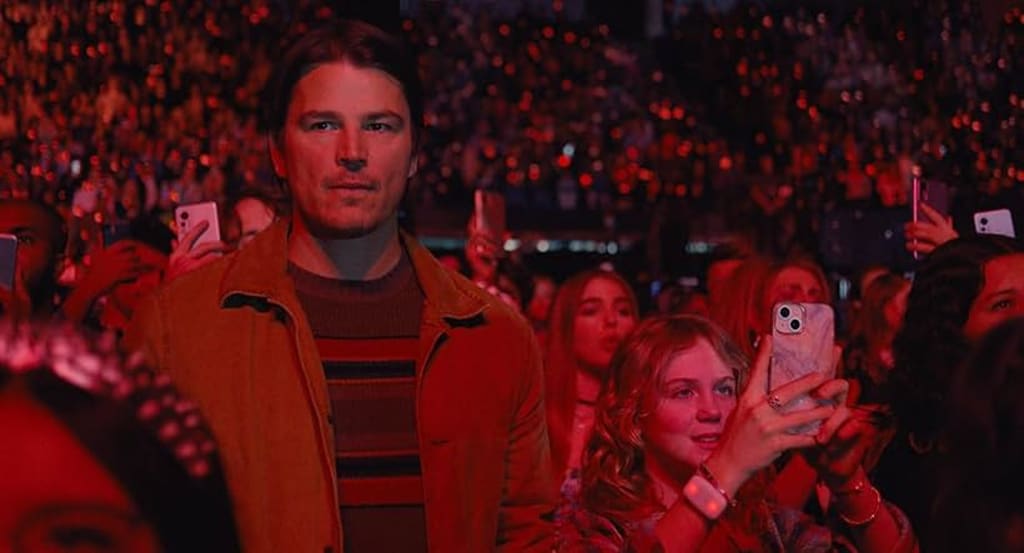
Trap (2024) is M. Night Shyamalan’s latest thriller, released August 2, 2024 to mostly mixed reviews. The film stars Josh Hartnett as Cooper, a dad who’s secretly a serial killer known as “The Butcher.” The biggest surprise of the film is that there is no real “twist ending” in the way we’ve come to expect from all of Shyamalan’s movies, but it is instead a more straightforward thriller. Another notable feature is that the movie is drenched in imagery and symbolism, and yet we leave uncertain as to what any of it was supposed to mean.
The movie runs 1 hour, 45 minutes, and we spend the whole first hour of it trapped at a pop concert, along with the protagonist. This feels like it’s meant to be a joke: what’s a middle-aged father’s idea of horror? Being stuck at a pop concert surrounded by screaming teenage girls. Except in this case, it actually is a nightmare come to life for the main character, as the whole concert (as explained via exposition) is secretly supposed to be a trap set to catch the Butcher.
This first portion of the film features at least two, maybe three, recurring themes. The problem is that it’s never clear why any of them are happening, except as plot devices to move the story along, but it feels like there’s intended to be more depth than that.
The first obvious one is futility. Everything that Cooper attempts to do (or even thinks about doing) to escape is thwarted at every turn. He keeps leaving his teenage daughter, Riley (Ariel Donoghue), and having to come up with excuses as to why he’s abandoning her at the concert while he looks for a way out. However, every exit is being patrolled by law enforcement who know he’s there and likely trying to escape.
Another, less obvious, motif is vulnerability, or at least perception of it. This is perhaps because we are seeing most of the movie through the lens of a “psychopath,” so he’s constantly looking for weaknesses in the people around him. The odd thing is how frequently it crops up. One person uses a wheelchair, another has asthma, another is lactose intolerant, and so on. The implication would seem to be that the camera lingers on these moments because Cooper notices them and is thinking about how to exploit them, and yet, returning to the point above, he almost never does because the opportunities don’t present themselves.
This brings us to perhaps one of the biggest problems with the film: it’s almost a zero-sum story, which makes the opening feel long and boring. It seems like it’s going to lead somewhere, but it doesn’t ever actually get there. On the other hand, this might actually contribute to one of the best features of what essentially equates to an hour-long prologue: the entire experience is cringe-inducing. We’re clearly not meant to empathize with the protagonist, since he is a literal psycho killer, and we actually even wish he would get caught and get the tension over with, and yet it never happens even when it looks like it’s about to.
This, then, leads us to the other plot issue in that there are numerous times when Cooper should be stopped, and yet, is not mainly because everyone around him is less competent than he is. Again, this is another point that feels intentional, and yet we don’t know what it’s supposed to be telling us. Because it is not that Cooper is a super human (at least that we can tell), but simply bigger, stronger, and smarter than most people around him, which leads him to behave as if he were unstoppable. The film gives the explanation (during more exposition) for why he is the way he is that Cooper was mistreated by his mother who realized what he is from a young age, giving him an almost dual personality, having both a superiority complex and suffering OCD and perfectionism at the same time.
Now, overlaying this plot is an abundance of images and symbols, which likewise feel like they’re supposed to have a deeper meaning, and yet we never learn what that is. The two biggest and most obvious examples are the uses of color and animals.
Every single scene is heavily color-coded. This technique is more similar to earlier Shyamalan films such as Sixth Sense and The Village. The problem here is we don’t necessarily know why which coloring appears to be happening at any given moment. Again, though, it feels intentional.
One whole scene will be ominously red-tinted, another briefly rendered black and white, and so on. Even if we’re looking at a full color palette, certain costuming and props will be specifically placed in the frame to where the eye is drawn to them, and they’ll frequently feature two-color schemes: red and blue, purple and black, black and white, purple and green, and so on. The only things that immediately come to mind, however, that these specific color combinations traditionally invoke are the fall season and Halloween. The only other thing I can personally think of, of which it reminds me is the color-coding on the costumes of super heroes and villains, which might come to mind because of Shyamalan’s Unbreakable trilogy.
The other obvious symbolic imagery we see throughout the movie is the frequent use of animals. Again, though, it is generally unclear exactly what the animals are supposed to mean, and we never receive an explanation. Cooper has a sheep tattoo on his arm. There’s a lion statue, which serves as major plot point. These two animals have clear Biblical connotations, but beyond that, the meaning is unclear. Cooper also has an app on his phone (another major plot device), which is also either a sheep or a goat, which in the context would seem to represent a sacrifice, as it’s what he uses to monitor and torture his victims.
Then there is Lady Raven (Saleka Night Shyamalan, M. Night’s daughter) herself, the fictional pop diva whose concert they’ve come to see. Ravens commonly symbolize variously: messengers, Death, messengers or omens of death, sorrow, the souls of the dead, divination or fortune telling, wisdom, and intelligence. They also are commonly associated with fall and Halloween, as well as “Lady Raven” sounds like a superheroine name, thus fitting in with the above motifs, though it is still unclear as to why.
While most of the movie is shown from Cooper’s perspective, it’s clear that certain moments are supposed to be centered around Riley, and from Riley’s viewpoint, Lady Raven is speaking directly to her the entire movie. Of course, teenage girls are supposed to feel like their idols are directly addressing them, but if we follow the raven symbolism above, then in context, Lady Raven is meant to warn Riley, “Your father is the Butcher!”
That much actually was clear, unlike the rest. The least clear and least noticeable symbolism, however, is the frequent use of numbers. Throughout the movie, random numbers will visibly appear hanging over characters’ heads or as tattoos or on street signs, ticket stubs, house numbers, or as number codes called out over the police radio, and so on. Once again, it feels like this was intentional, and yet we don’t know what they represent.
Overall, Trap is not a bad film, but its meandering plot and twist-less ending made the rest of the movie stand out more, and most of the movie functions largely on atmosphere and some kind of impenetrable metanarrative. It has an A to B plot in which the only thing that really changes is [major spoiler alert] the world finds out Cooper’s dark secret, and yet, we’re still left with more questions than answers.
About the Creator
David Pilon
I'm a self-published author from Oklahoma.
Keep reading
More stories from David Pilon and writers in Geeks and other communities.
Joker: Folie à Deux
(Warning: Contains spoilers) Joker: Folie à Deux (2024) released October 4, 2024 is the sequel to the much more successful Joker (2019), both starring Joaquin Phoenix in the titular role. The film has received mostly negative reviews and low rating scores amongst critics and audiences alike. It also has been a flop at the box office and even allegedly had audience members walking out mid-showing. This negative response is due largely to the fact that it was a musical, and a lot of people apparently didn’t go in prepared for it to be a musical.
By David Pilonabout a year ago in Geeks
Marvel Zombie
The last entry into our 2025 superhero projects catalogue is Marvel Zombies. This was a show that was anticipated by absolutely no one and it disappeared from the public consciousness as quickly as it was released. There was nothing special about the project that made it a must see, or a must remember. In fact if anything it's a must forget.
By Alexandrea Callaghan20 days ago in Geeks
Book Review: "Madness Explained" by Richard P. Bentall
Some books take longer than others, and for me that means any books where there is a lot of in-depth science terminology. This book took me a while and so, instead of taking it around with me, I left it on my bedside table and read a few chapters here and there if I didn't have a headache. I had to go back and forth to an online dictionary sometimes and yes, there are tables and graphs in this book. BUT atop of all of this, I got through it and now here we are, with more knowledge and more understanding of the history of mental illness, and what that means for humanity.
By Annie Kapurabout 3 hours ago in Geeks


Comments
There are no comments for this story
Be the first to respond and start the conversation.