
The Woman Who Was a Muse to Nietzsche, Rilke, and Freud
The first female psychoanalyst - Lou Andreas-Salomé

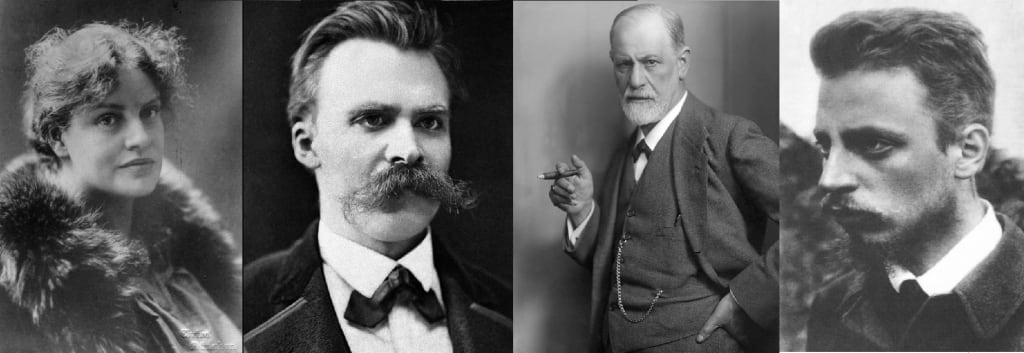
In an era when women of geniuses were not given exposure to showcase their talent or intellect, Lou Andreas-Salomé was one such woman who broke conventional barriers and carved her own journey. She was the first female psychoanalyst in the world and a lady philosopher of the 19th century when women were neither expected nor allowed to study philosophy.
Her intellectual gravity and creative potency made her a muse to some of the most phenomenal thinkers of the 19th century.
To Nietzsche, she was the "the smartest person I ever knew," the perfect heir to his philosophy, "the best and most fruitful ploughland" for his ideas. To Rainer Maria Rilke, she was an "extraordinary woman" without whose influence "my whole development would not have been able to take the paths that have led to many things." And to Sigmund Freud, she was "an understander par excellence," the second woman in his life (after his beloved sister-in-law Minna Bernays) and the only woman among his colleagues with whom he would maintain a long and continuous correspondence.
This article will take you through her body of work and the brief relationships she had with the most intellectual minds.
The early life of Andreas-Salomé
Salomé was born in St. Petersburg, Russia, in 1861, the youngest of six children and the only daughter of a German-Baltic family. Being brought up in a strict protestant family, at the age of 17, she rejected the restrictions and officially left the Church.
Her knack for literature and philosophy lead her to Hendrik Gillot, a Dutch pastor, who became Salomé's private instructor and spiritual guide, without her parents' knowledge. She gained vast knowledge in comparative theology and philosophy under his guidance until Gillot,42, and a husband with two children proposed her for marriage.
She refused his proposal and after her father's death moved to Rome. There she joined a group of people who were avid readers of Schopenhauer's philosophy and through that group, she met Paul Rée.
Rée was a philosophical historian and 12 years senior to Salomé. Through Paul, Salomé met Friedrich Nietzsche, then 37 years old and still unknown to the world as a philosopher.
Salomé's relationship with Nietzsche
Both Rée and Nietzsche became friends with Salomé. They were mesmerized by her intellect and beauty and eventually both proposed to her for marriage - which she declined.
Rée moved into an apartment in Berlin with Salomé and they lived together for over three years, remained friends and Salomé was his unrequited love.
While Nietzsche was her rigorous teacher in philosophy for over half a year and believed Salomé to be his intellectual heir, he was too smitten by her. Denying the proposal of marriage and their subsequent break in the friendship, Salomé had huge respect for Nietzsche's mind and work.
Though their relationship ended on a bitter note, more than two decades later, Salomé included Nietzsche's ten rules of writing in her novel which portrayed his extraordinary thinking, psyche, and personality. As both of them were fond of aphoristic predilection, this novel reflected the same.
Nietzsche created, so to speak, a new style in philosophical writing, which up until then was couched in academic tones or in effusive poetry: he created a personalized style; Nietzsche not only mastered language but also transcended its inadequacies. What had been mute, achieved great resonance.
Salomé's relationship with Rilke
In 1886, Salomé was engaged to Friedrich Carl Andreas. Andreas was a literary scholar and passionately in love with her. Even with her resistance to marriage, somehow Andreas emotionally blackmailed her, and eventually, she agreed on a condition that they would abstain forever from having sex together. Though both were married until Andreas's death in 1930, they had an estranged relation and gradually settled for a polite co-existence.
Salomé met Rainer Maria Rilke in 1897. Rilke was 21 years old, an art-history student, and establishing his feet into the creative realm while Salomé was 36 years old and a renowned author. After three months of togetherness, both were attracted to each other and became lovers. "Rene" became "Rainer" to give a German tone to his name and by which Salomé chose to call him.
They were in an intense relationship for over 3 years until Rainer married Clara Westhoff in 1900. For over the next two decades, both of them exchanged over 200 letters that were deeply poetic and creative - Rilke and Andreas-Salomé: A Love Story in Letters.
In the summer of 1914, Rilke confessed her creative block and his struggle with depression in a letter to Salomé.
I am like the little anemone I once saw in the garden in Rome; it had opened so wide during the day that it could no longer close at night. It was terrible to see it in the dark lawn, wide open, still taking in through its calyx, which seemed as if frantically flung open beneath an all-overpowering night that streamed down on it undiminished….
In response to this, Salomé writes -
While you are perpetually feeling sick and miserable you are also perpetually finding expressions for that experience, and those expressions, in the distinctive form you give them, would be quite impossible unless somewhere inside you there is a flowing together, an experiencing in unison, of what you feel as so torn into one impulse fleeing outward and another burrowing inward, with only an empty, self-deserted middle space between them. Those words with which you articulate this condition, and that passage, for example, about the anemone - they are nothing if not works, works accomplished, the coming about of deepest unities in you!
Salomé's relationship with Freud
At the age of 50, Salomé realized that human problems are now examined through the lens of psychology rather than philosophy and so she studied psychology and became the world's first female psychoanalyst.
In the fall of 1911, when she attended the Weimar Psycho-Analytical Congress, she met Sigmund Freud, the founder of psychoanalysis, whom she had met a decade earlier. They both had a reverence for each other's work.
The two of them discussed each other's research papers and their patients, exchanged perspectives from narcissism to anxiety to masturbation, and also ruminated on the psychology of an artist.
Salomé addressed him by "Dear professor" and Freud respected her intellect and knowledge. Both of them shared letters too on religion, death, war, etc in the book Sigmund Freud and Lou Andreas-Salome Letters.
In one of the earliest letters from Freud to Salomé on the cusp of WWI, he writes -
I do not doubt that mankind will survive even this war, but I know for certain that for me and my contemporaries the world will never again be a happy place. It is too hideous. And the saddest thing about it is that it is exactly the way that we should have expected people to behave from our knowledge of psycho-analysis. Because of this attitude to mankind, I have never been able to agree with your blithe optimism. My secret conclusion has always been: since we can only regard the highest present civilization as burdened with enormous hypocrisy, it follows that we are organically unfitted for it. We have to abdicate, and the Great Unknown, He or It, lurking behind Fate will someday repeat this experiment with another race.
Last thoughts
Lou Andreas-Salomé was indeed a fiercely independent woman who constantly challenged human thinking with her rational beliefs. Choosing the decision to study psychoanalysis at the age of 50 in itself shows her grit and intellectual passion.
Salomé's life might be controversial in her times but she chose to live a spirited and liberated one.
"All feminine frailties, and perhaps most human frailties, were foreign to her or had been conquered by her in the course of her life." - Sigmund Freud
References
1. Rilke and Andreas-Salomé: A Love Story in Letters
2. Books of The Times; Her Friends Included Nietzsche, Rilke and Freud
3.Lou Andreas-Salomé, the First Woman Psychoanalyst, on Depression and Creativity in Letters to Rilke
4. Nietzsche's 10 Rules for Writers, Penned in a Letter to His Lover and Muse
About the Creator
Kamna Kirti
Art enthusiast. I engage with art at a deep level. I also share insights about entrepreneurship, founders & nascent technologies.
https://linktr.ee/kamnakirti
Keep reading
More stories from Kamna Kirti and writers in Geeks and other communities.
5 Famous Artists Who Camouflaged Themselves in Their Own Paintings
Before impressionism and modernism took over, artists were never keen to draw their self-portraits. Unlike Rembrandt, Van Gogh, Picasso, or Frida Kahlo who had a panache to feature themselves in their own canvasses, the 16 & 17th-century artists never took the spotlight. Rather, they camouflaged their identity within the paintings - almost like a signature to endorse the artwork. Sometimes, artists deliberately used this technique to convey complex narratives which they could never portray since most of these artworks were commissioned by patrons with a different ideology or by the iron-handed church.
By Kamna Kirti4 years ago in Geeks
Silver Screen Magic with Mae West
American actress and singer Mae West became a popular film actress during the Great Depression. She started entertaining in vaudeville, then performed on Broadway, and finally went to Hollywood. She signed up with Paramount Pictures and made her debut in the 1932 film “Night After Night.” She also starred in musicals, comedies, and crime dramas. The American Film Institute named her one of the best classic Hollywood actresses.
By Rasma Raisters5 days ago in Geeks
Sania Mirza flags structural gaps in Indian Women’s tennis at Australian Open
New Delhi, Jan 16: India U19 pacer Henil Patel credited former South Africa pacer Dale Steyn as his inspiration behind his match-winning performance against the USA at the ICC Under-19 Men’s Cricket World Cup.
By Dena Falken Esq2 days ago in Geeks


Comments
There are no comments for this story
Be the first to respond and start the conversation.