
The Werewolf at Dusk
The Illustrated Storybook by David Small (2024)

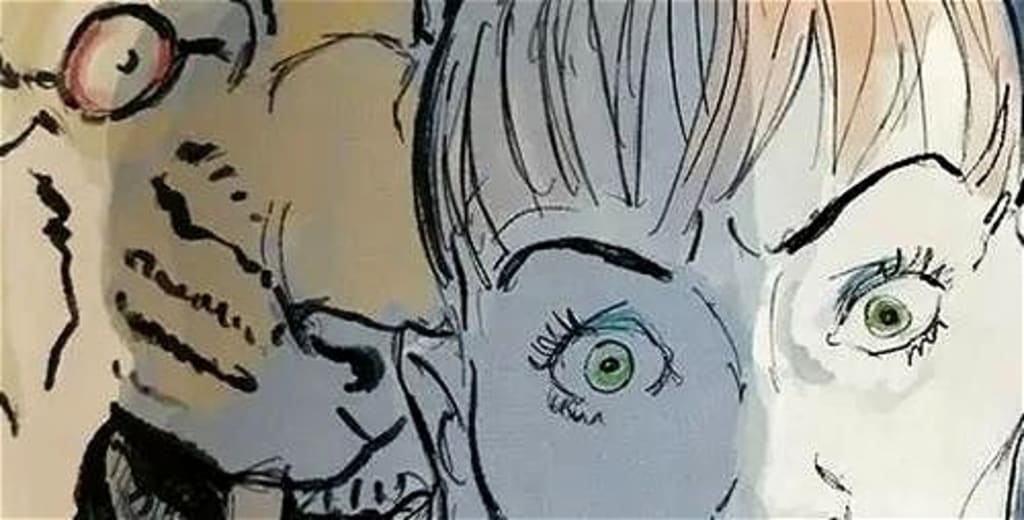
Permit us, if you will, to make an observation.
We often try to distract ourselves with illusions—of a past or present buried beneath the rubble of diversion and self-deception. Delusion: we all live in little rings of it, orbiting nothing. But then something bubbles to the surface, reminding us—plainly, brutally—of our own personal extinction. Nullification by circumstance. Erasure by time. This is our journey, and it is not one of earthly tread.
Sometimes a book is like a journey—an inner sojourn toward some as-yet-undefinable destination. The mind, the subconscious, moves like a slow rowboat approaching a barren, rocky, unexplored shoreline. Werewolf at Dusk, by veteran cartoonist David Small, is such a book.
Ironically, the first story—an adaptation of Lincoln Michel, and the title piece of the trio—is the least effective. "Werewolf at Dusk" concerns an elderly man sliding into senility, haunted by memories of his former glory as a werewolf: a blood-besotted beast who once awoke after ravaging delectable prey. Now, time hunts him. The metaphor—for fading sexual prowess, lost identity, the erosion of purpose—is familiar. It doesn’t linger. The premise is better than its execution, and the symbolism too on-the-nose to gnaw at the reader’s bones for long.
A Walk in the Old City
Far more immersive is "A Walk in the Old City," an original story by Small. A psychoanalyst awakens from a strange dream and follows a twisting side street into a walled dream-city, its cobbled paths echoing with a Kafkaesque hush. There, he is led by an increasingly sinister old man to a home where, over the symbolic ritual of breaking bread, he finds the man lives with an infestation of grotesque, looming spiders.
The man is at first mute, cataract-blinded, hunched over his bread loaf like a priest at some profane communion. But then the dream flips—he becomes animate, and the psychoanalyst, our protagonist, becomes the dream. The sense of identity slides, like footing on those stone streets. The analyst flees in horror, not wishing to be cast into the dark ichor of a canal—plunged into his own black ink of living death. The metaphor is precise: the old man as shadow-self, the spiders as internal tormentors, spinning webs across the mind’s hidden rooms.
Hitler as Hypnotist
The third and final story, "The Tiger in Vogue" by Jean Ferry, is a surrealist fable with a haunting punch. It flirts with sentimentality but ultimately swerves into something colder, darker: a critique of fascism’s seduction and the bourgeois tendency to disguise rot with a fashionable jacket. In Weimar Germany, an unnamed man—another non-entity, another dreamer—attends a theater show titled The Tiger in Vogue, which feels cursed, almost The King in Yellow-adjacent in tone.
A woman appears onstage with a tiger in a dandy’s clothes, walking upright like a gentleman suitor. He’s hypnotized. The spellbinder sits in a private box above—Adolf Hitler. The allegory is clear: barbarism tamed and made palatable, paraded as culture while the audience claps.
Small’s artwork—a blend of sketchy minimalism and brooding ink—deepens the disquiet. Greys and voids fill the white space. The full-page illustrations pull us into a shadowed cinema, somewhere between early David Lynch and Jean Cocteau’s mythic dreamscapes. At first, the tiger might be mistaken for a man in costume. But no—it is a tiger. The illusion breaks. The horror remains.
The book ends with a door closing, a lock clicking shut. But nothing is resolved. The dream lingers. This slim volume, read in a sitting but echoing far longer, inhabits a liminal space—both destination and departure.
And when is the return? Do we return at all?
Follow me on Twitter/X: BakerB81252
About the Creator
Tom Baker
Author of Haunted Indianapolis, Indiana Ghost Folklore, Midwest Maniacs, Midwest UFOs and Beyond, Scary Urban Legends, 50 Famous Fables and Folk Tales, and Notorious Crimes of the Upper Midwest.: http://tombakerbooks.weebly.com
A Knight of the Seven Kingdoms Series Review (Season 1)
As one of the biggest properties in fantasy, A Song of Ice and Fire remains immensely popular with audiences. After reaching far into the past with House of the Dragon, a second spin-off was on the cards. A Knight of the Seven Kingdoms serves up a bite-sized slice of action and drama, but it still claims a spot among the best small-screen titles.
By Robert Cain4 days ago in Geeks
Rereading Review: "Against Nature" by J.K Huysmans
It's been about a decade or so since I read Against Nature by JK Huysmans and so, I wanted to dive in once again. Unfortunately, my copy with some brutish annotations in which I exclaim my dislike for the main character resembling a young Morrissey in his attitudes has since been lost to time and so, I had to buy another copy. Emile Zola would probably sum up the book in the best way as it was, in fact, a charged novel against the naturalist movement - hence the title Against Nature. But then again, it is packed full of emotions that are generally against the nature of human feeling - they are against the progressive and free-willed, against the whimsical, against the want for redemption and joy. The main character's journey to discovering this is a pained one yes, one that usually drops him into the central problem of melancholic thinking and perhaps reminds us that we don't want to shovel this novel into our mouths all in one go. It is one of those books that can really weigh one's mind down.
By Annie Kapur3 days ago in Geeks



Comments
There are no comments for this story
Be the first to respond and start the conversation.