

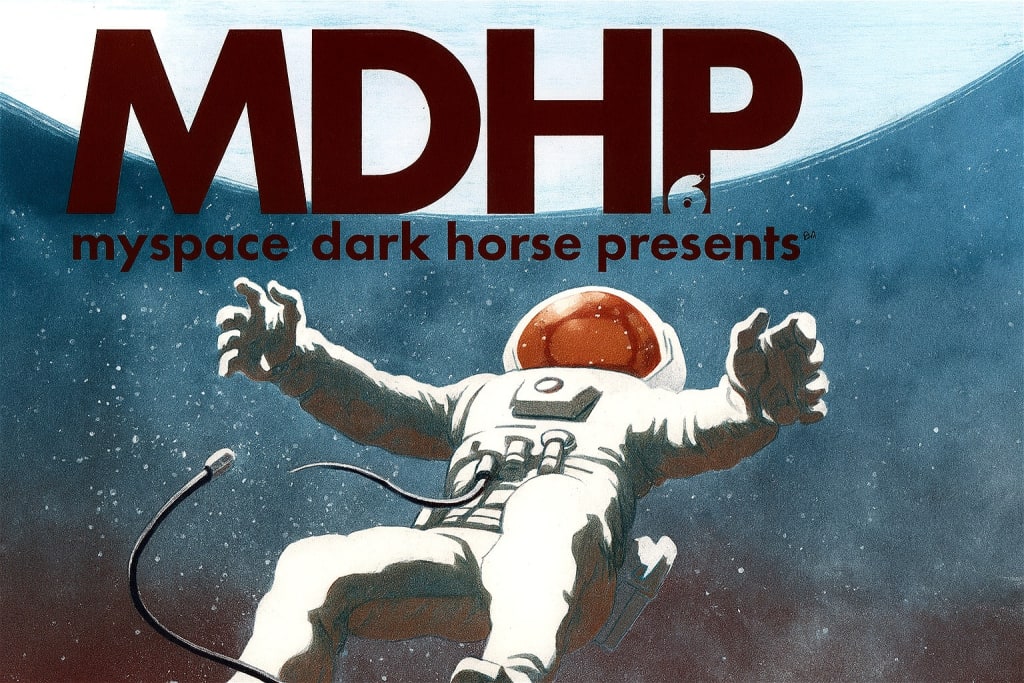
Dark Horse Presents was an anthology comic that debuted in 1986, the august year of my wayward youth. It was almost a decade before the internet took off, but the internet iteration Myspace Dark Horse Presents, so named because it tapped potential comics talent from the denizens of the now-defunct social media platform, extenuated the indie comics anthology to the cyber realm. The series, six volumes long, eventually pulled in big-name talents such as Mike "Hellboy" Mignola, but still managed to retain the status of being a vehicle to showcase new talent.
Volume 6 still has the touch of Heavy Metal or Epic Illustrated-style adult comics newsstand anthology about it, beginning with a space opera sci-fi actioner, Mass Effect: "Incursion", written by Mac Walters with art by Eduardo Francisco. It features an intergalactic hottie throwing down in a space station cantina (I think) with a bunch of putative alien slavers ("The Collectors"), and we're informed at the end, somewhat puzzlingly, that, "Mankind has made a new enemy." The art is full-throttle, highly detailed and expert sci-fi graphic novel territory.
The next story, "Con-CERNed", is the comics debut of LeVar Burton (with Mark Wolfe) of Star Trek and Reading Rainbow fame. The artwork by David Hahn is a little stiff, not up to the detailed polish of Incursion, but the story is intriguing. A young scientific genius uses a super-collider to open up a portal or gateway to another dimension, finding himself suddenly able to call forth desired objects (in Spiritualism, this is referred to as "apports"), and also finding that between this world and ours is a doorway through which those "over there" can gain egress.
"Rick Shambles Is Forever Adrift" by Frank Stockton is a play on the famous scene from Star Wars where Luke Skywalker enters the holding cell of Princess Leia, assuring her, "I'm here to rescue you!" after she observes that he's "a little short for a stormtrooper." The punchline is less than obvious, and this almost seems like a throwaway piece from an old Heavy Metal.
A long section of kiddie comics, meta-referencing the genre of cartoon animals and weird stick figure worlds follows—bright and garish and completely changing direction from the preceding. Here we have creations from solo artists, such as Art Baltazar ("Meteor Mite"), Larry Marder, who produced Beanworld, and Chiptie Butternut: "The Fastest Squirrel in the World!!!" by Scott Morse, which presents us with a squirrel and a dog in a car race. Usagi Yojimbo: "Cut the Plum" by Stan Sakai gives us samurai rabbits; Tobb: "The Sling" by Ron Chan has a rodent-riding dungeon crawler rescuing a runic carving from a giant stone ogre.
Jaime Hernandez of Love and Rockets fame gives us a chica superheroine team and their admittedly otherwise weirdly humdrum existence in "La Primas Controla." "Bee in...The Ramble" by Jason Little is a surrealistic walkabout by two women who fixate on the sex life of statues and silent film comedian Harold Lloyd (of whom they have nude pictures).

"Love Note" by Graham Annable is a riff on Poe and the gothic in a quick, sketchbook, cartoon strip style. "Fiction" presents us with a writer at a book signing who seemingly lives two different existences—in the literal sense.
"Giant Man in the Philippines" by Matt Kindt is an intensely weird vignette of a human giant used for political purposes by the U.S. government, who transport him by aircraft carrier and feed him through a hose. (But who, the Reader wonders, changes the giant diaper?)
Mark Crilley’s Brody’s Ghost gets an entire section by itself (the others being "Contact," "Story Time," and "Dark Horse Originals") and presents us with Brody, who in four separate vignettes reveals himself to be a supernatural, psychic superhero haunted by a particularly mischievous and irritating ghostly Gen Z cutie, in separate tales wherein he hunts murderers, rescues women on the subway, and gets thwarted from eating wings and watching the game with his buddy on a new flat-screen monster TV which Ghost Hottie threatens to demolish. It's manga-style artwork married to Western comic book story sensibility.
Talk to the Hand
"Part 5: Drawing on Your Nightmares" is by far the best, most satisfying section, although it begins with the insufferable "S.H.O.O.T. First: The Wooden Saint," which annoyed me as puerile parody. "In Fetu", a story by Simon Spurrier with art by Christopher Millen, is by far the best story in this anthology—a short, ugly, and nightmarish tale of a man who finds the "infants" of his guilt gestating in the folds of his flesh; i.e., faces growing out of his shoulder and hands. This is the karmic upswing of his hidden guilt and sin, and on the whole it's vaguely reminiscent, in tone and theme, of the season two episode of Monsters, which was titled "The Face."
In that television show, two bumbling burglars kill an old woman, only to have the image of her begin to "grow" in the palm of the sadistic leader's hand. In "In Fetu," a guilty man has such a growth due to a hidden secret guilt—his cosmic debt given manifestation in the irritant of his possessed flesh, as the phantom limbs and faces begin to come forth to torment him. The artwork here has a curious longing aspect, a certain verisimilitude that, while not overly photorealistic, still hints at the hideous depths of body horror explored here.
The final horror, Buffy the Vampire Slayer: Tales of the Vampires – "Carpe Noctem", is a story by Laurie Kessler with art by Paul Lee. In it, two vampiric female roommates—one who is committed to walking the new path put out by reality TV in a world where vampires are accepted as de rigueur and “real,” a world in which humans line up to be bitten playfully and sensually by the undead—butts grotesque, undead heads with her dour, goth-girl roomie, who wants to return to the old path of killing for fun and profit. In the end, the twist is worth the dance.
The short "Coda", which features a legion of The Mask clones—one of which is supposed to obviously parody Tarantino—in a bloodily violent revolution in which the scenes of various films and directors are paid homage by writing in the spaces between the panels (along with soundtrack shout-outs, such as one to Celtic Frost!).
As much fun as you're likely to have cracking open a graphic novel anthology, MSDHP is, was, and will be the successor to HM. The first time I ever picked one up, decades ago, I was struck by the excellent storytelling of such things as the band "Sugarshock," which featured a character that was a cute little Asian girl with a serious bad thing against VIKINGS. Also, a killer who changes identities down through the years, as every notorious bloodletter you can imagine, up to and including Carl Panzram and Ed Gein. Ten years later, I still wonder what the hell that gal had against those Vikings. I mean: did she feel the same way about Vandals and Visigoths?
This anti-Viking bigotry is so 1987. But MSDHP is, to quote the inestimable Jesus Christ Allin, “You're f*king history! I'm right now!”
Excelsior!
Author website
Follow me on X/Twitter: BakerB81252
About the Creator
Tom Baker
Author of Haunted Indianapolis, Indiana Ghost Folklore, Midwest Maniacs, Midwest UFOs and Beyond, Scary Urban Legends, 50 Famous Fables and Folk Tales, and Notorious Crimes of the Upper Midwest.: http://tombakerbooks.weebly.com
A Knight of the Seven Kingdoms Series Review (Season 1)
As one of the biggest properties in fantasy, A Song of Ice and Fire remains immensely popular with audiences. After reaching far into the past with House of the Dragon, a second spin-off was on the cards. A Knight of the Seven Kingdoms serves up a bite-sized slice of action and drama, but it still claims a spot among the best small-screen titles.
By Robert Cain4 days ago in Geeks
Smiling Friends's Final Season: Why Adult Swim's Best-Selling Series Has Come to an End
Fans of the quirky Adult Swim animated comedy Smiling Friends were stunned this week when creators Zach Hadel and Michael Cusack announced that the series will conclude with its third season, effectively cancelling further seasons despite prior renewal plans. One of the decade's most talked-about adult animated films abruptly comes to an abrupt end with the surprise announcement made by the showrunners themselves.
By Raviha Imran5 days ago in Geeks
Flower Bloom 369
FLOWER Bloom 2/25/26 Wednesday By Mariann Carroll Karen had been with Tony for 7 years. Tony started acting strangely after her surgery. He would mow the lawn in the rain and be on his cellphone. He started pushing Karen away. Tony came clean about seeing someone. Karen moved out two months later. Karen moved in with a friend. She felt betrayed.
By Mariann Carroll5 days ago in Fiction



Comments
There are no comments for this story
Be the first to respond and start the conversation.