
The Problem of Susan
A Defence of "the Lost Friend of Narnia"

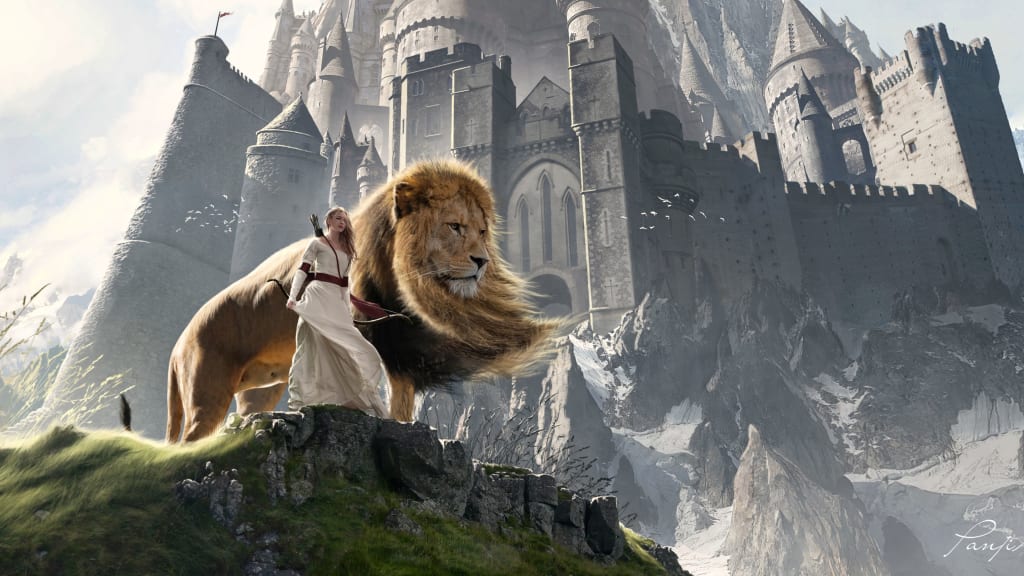
When I think back on the Chronicles of Narnia, I was always disappointed that the one character I identified with - the cautious one, the one who stopped and asked or just questioned events and the world around her - was deemed unworthy of the "happy ending" her siblings and friends got. As a child, it frustrated me - although I couldn't articulate why that was - and I took issue with how Susan was treated in the final book.
In The Last Battle, several of Susan's close relatives (including all of her siblings) were killed on the same day in a train crash. The book merely mentions that she was no longer a friend of Narnia and that she was in a ridiculous phase of life where she only cared about parties:
“My sister Susan,” answered Peter shortly and gravely, “is no longer a friend of Narnia.”
“Yes,” said Eustace, “and whenever you’ve tried to get her to come and talk about Narnia or do anything about Narnia, she says ‘What wonderful memories you have! Fancy your still thinking about all those funny games we used to play when we were children.’”
“Oh Susan!” said Jill. “She’s interested in nothing nowadays except nylons and lipstick and invitations. She always was a jolly sight too keen on being grown-up.”
“Grown-up, indeed,” said the Lady Polly, “I wish she would grow up. She wasted all her school time wanting to be the age she is now, and she’ll waste all the rest of her life trying to stay that way. Her whole idea is to race on to the silliest time of one’s life as quick as she can and then stop there as long as she can.”
I wondered why it wasn't good that Susan had indeed grown up. As a child and as an adult, who you are can drastically vary, which is fine because we are shaped differently by experiences.
The kids essentially live their entire lives throughout their time in Narnia during the Lion, The Witch and the Wardrobe, then stumble out of the wardrobe the ages they were when they stepped inside. This would have a significant impact on each character psychologically as they try to readjust to being children again - Andrew Adamson delves into this in his second Narnia film: Peter suffers from imposter syndrome, Susan becomes more pragmatic, Edmund has matured emotionally, and Lucy struggles to find her agency now she is the youngest in the group again.
Susan's previous experience in Narnia was actually explored in the Prince Caspian (2008), where Susan battles with her memories of Narnia now older and wiser. She is the most rational of her siblings, but one scene sees her confiding these feelings of insecurities to Lucy:
SUSAN: Why do you think I didn't see Aslan?
LUCY: You believe me?
SUSAN: Well, we got across the gorge.
LUCY: I don't know. Maybe you didn't really want to.
SUSAN: You always knew we'd be coming back here, didn't you?
LUCY: I hoped so.
SUSAN: I finally just got used to the idea of being in England.
LUCY: But you're happy to be here, aren't you?
SUSAN: While it lasts.
This scene foreshadows these fears of abandonment that are later confirmed when Susan and Peter are told they can never return to Narnia. There is a loss of innocence there, where Susan officially sheds her Narnian life and accepts her life in London.
C.S. Lewis' characters are pretty blank - as in they are intentionally that way for the readers' to insert themselves into the story and identify with a particular character. However, aside from religious allegory and heavy Christian themes, Susan and her siblings represent one's faith: Peter and Lucy are solid and consistent believers. Edmund finds his faith after "sinning", and Susan questions and ultimately rejects her faith.
But the Seven Friends of Narnia don't actually get a happy ending, in my opinion. They all die. Aslan casually informs them that they all died in the final pages, which they all seem oddly glad about. Once the group died, they were immediately transported to Aslan's Country, presumably the Narnian name for Heaven. Since they were essential to Narnia and Aslan, they earned their spot in his country.
Yet is this a happy ending? They didn't get to choose to stay in Narnia or return to England. That decision was taken away from them. The Seven Friends, particularly the five younger ones, were rewarded by remaining in their childhood innocence. Looking back on this as an adult, I think the characters were actually robbed of finding a happy ending themselves. Many readers thought Susan was denied of the "wonders" of Aslan's Country, but I read it as the opposite. It was a sad ending to lose so many loved ones in such a tragic way, but her story still had time to be rewritten.
From my research, I can't say for sure whether C.S. Lewis actually put this much thought into Susan's arch. In one letter he wrote to a reader asking this very question: “The books don’t tell us what happened to Susan. She is left alive in this world at the end, having by then turned into a rather silly, conceited young woman. But there’s plenty of time for her to mend, and perhaps she will get to Aslan’s country in the end… in her own way”.
An article written on Fabulous Realms analyses the treatment of Susan and points out the inconsistences of this character in the final book:
What has caused Gaiman and other critics to question this is that Lewis is not consistent enough with his characterisation of Susan for his insistence upon her lack of faith (in Aslan, as Jesus) to be supported. Indeed, Susan is the most doubting character in the books. Upon first entering Narnia, she says, “I-I wonder if there is any point going on”, and she also has a moment of doubt in Prince Caspian. In both instances, however, she overcomes her fears, and in this sense, doubts are part of her overall journey – indeed, she is forgiven for them by Aslan. But Susan’s lack of faith and willingness to doubt do not emerge in the conversation wherein the Kings and Queens in The Last Battle discuss her exclusion from Narnia – she dismisses Narnia as “all those games we used to play as children”. Is Susan’s lack of belief in Narnia, therefore, linked, not to lack of faith, but to a different transgression – the desire to “grow up”? Or is it something else altogether?
Feminist critic Laura Miller focuses on Lewis’s purportedly anti-female line, maintaining that on one level, Susan does not get to the heaven of Further Up and Further In because she is just like the two witches – White and Green – who similarly wear dresses and look pretty. The suggestion that Lewis is anti-female is borne out by the presence of a number of villains in Narnia who are beautiful women – the original incarnation of the White Witch as Queen Jadis of Charn is perhaps another example. This is problematic, as there are of course plenty of examples of females – pretty or otherwise – who are portrayed positively in The Chronicles. Lewis’s letters suggest that his prejudice is not necessarily towards women or the idea of beauty, it is towards vanity and particularly adolescent vanity. For example, he once decries what he calls the “pitiful attempt to prolong what, after all, is neither [life’s] wisest, its happiest, or its most innocent period”. This is echoed quite strongly by Polly in the The Last Battle, who criticises the fact that Susan’s “whole idea is to race on to the silliest time of one’s life as quick as she can and then stop there as long as she can”.
Which again raises many more questions? What does Susan need to be forgiven for? Independent thought or wanting to distance herself from painful childhood memories. That is not really a bad thing; many readers can identify with wanting to learn from past mistakes and grow from them.
This surprised me when I came across Neil Gaiman's short story and read it as a graphic novel that indeed explores Susan's life as an adult.
The Problem of Susan depicts its protagonist, Professor Hastings (who strongly resembles an adult version of Susan), dealing with the grief and trauma of her entire family’s death in a train crash, as she is interviewed by a university literature student regarding her opinion on Susan’s place in the Narnia books. Gaiman himself has said of the story that there is much in Lewis’s books that he loves, but each time he read them (or read them aloud to his own children), he found the disposal of Susan to be intensely problematic and deeply irritating.
Dealing with this problem was one inspiration for the story, while the other was “to talk about the remarkable power of children’s literature” in Gaiman's own words. Hence Professor Hastings comments on “the Victorian notion of the purity and sanctity of childhood demanded that fiction for children should be made… well… pure… and sanctimonious”. This observation is important because, while the story is primarily focused on the ‘problem of Susan’, Gaiman also illustrates that Lewis’s beliefs seem to be similar to those of the Victorians. Lewis’s Narnia tales are, on the surface, moralistic adventure books – but they also rely heavily on Christian allegory, and this is what Gaiman and other critics seem primarily to have taken issue with.
The story was dark, bloody, heart-breaking and gruesome, particularly with two dream sequences of Narnia and a twisted Aslan/White Witch dynamic. Yet Professor Hastings brings a perspective of Susan that even C.S. Lewis did not want to write - as he acknowledged it would be an adult story, and he did not want to write that.
So Gaiman's short story is left on a dark, ambiguous note but explores the power of telling and retelling stories. Susan is given the complexity she deserved in this story as an accomplished retired university professor and writer, but still haunted by the deaths of her family.
Although Lewis created this magical world and books that had been read for generations, I believe he wrote Susan’s ending rather naively.
When you think of that time for a young woman, Susan would have to face more battles than her siblings did in Narnia. Gaiman gives Susan that complexity that explores her last day but offers readers a darker take on Narnia.
The Problem of Susan gives readers an insight into an older Susan. It leaves enough space for the reader to imagine what happened next to a beloved and unintentionally feminist character.
About the Creator
Ted Ryan
Screenwriter, director, reviewer & author.
Ted Ryan: Storyteller Chronicles | T.J. Ryan: NA romance
Socials: @authortedryan | @tjryanwrites | @tjryanreviews
The Author Diaries #1: The Storyteller’s Curse — Exclusive Prologue Reveal
Author’s Note: Dear Readers, Thank you for being here — for reading, subscribing, and stepping back into the world of The Storyteller Chronicles. When I finished Book One, I truly thought the story was done. Silas was defeated. The grimoire was safe. Lauren had saved the day — in two worlds — and her family were reunited.
By Ted RyanExclusive • 6 months ago




Comments
There are no comments for this story
Be the first to respond and start the conversation.