
The Man Without Talent
The Classic Manga by Yoshiharu Tsuge (1985-1987)


“A human being like me is not adapted to the world we live in. If I took up reading, it was because living was difficult for me, and I wondered if there might exist a more peaceful way of life.”
— Yoshiharu Tsuge
The Man Without Talent is Yoshiharu Tsuge's haunting, bitterly detached, yet oddly poetic shōsetsu, or "I-Novel." It is partly autobiographical, partly confessional—a reckoning, even an exorcism, of deeply held neurotic and situational grief. Its protagonist, failed mangaka Sukezo Sukegawa, is a forlorn "little man," derided by his wife as an "insignificant worm... a loser." His inability to make a go of anything marks him out as wandering, isolated, eternally seeking. Like his creator, Sukezo is a man who wishes to evaporate, his soft, unheard footsteps moving through the world with bitter self-recrimination.
He tries his hand first as a ferryman, then as a bridgebuilder—fantasies as doomed as they are fleeting. His wife, whose face is initially obscured from the reader, despises him. She ignores him in the street, earning money handing out flyers. His grand dream of building a bridge across the Tama River to the Velodrome evaporates into nothing. Next, astonishingly, he decides he might succeed selling rocks.
The stones are his mirror. Some are naturally formed into pleasing shapes; others are carved into stylized forms by human hands. Yet no one will buy them—they can be plucked freely from the riverbank. At a stone-seller’s convention, Sukezo is cursed with bad luck and disappointment. His wife rails at him; his son Sansuke, asthmatic, wheezes in a home suffocated by resentment. The image of the father, seated by the river with his unsellable stones, is as bleak as it is absurd—a picture of futility masquerading as work.
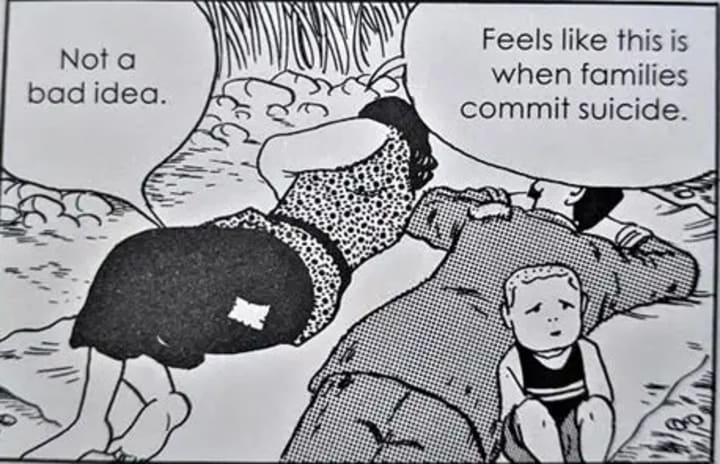
From stones he moves to cameras, collecting and peddling vintage novelties. This too fails. Along the way, he meets fellow outsiders: bird catchers, rock collectors, failed poets. Each laments indifference—the bird catcher ignored because his species are too plain, the poet overlooked because no one cares. Tsuge peoples his margins with these drifting souls, showing a community of men united by defeat.
The reader begins to question the title: is he really “without talent”? Sukezo refuses to draw again, to seek work in manga. To his wife he insists that to do so, as a veteran, would mark him as “desperate.” He argues she doesn’t understand the business. Yet the truth is simple: he is indisputably talented, and his refusal to use that talent ensures his absence. If he draws nothing, no one will see him at all. The real tragedy is not the world’s rejection, but his own deliberate retreat from it.
Threaded through is a note of cultural rage. The failed “salaryman” sneers:
Anything that's traditional and Japanese is immediately dismissed as "uncool," while every bullshit thing from the West is worshipped as the bee's knees. Write something in the Roman alphabet and voilà—it’s instantly oh-so-lovely...
These shallow modernists.
The book closes with grotesques—flatulence, fecal humor, nudity—as raw honesty. And finally, Tsuge invokes Inoue Seigetsu, the nineteenth-century vagabond poet who starved, covered in lice, dying despised and alone in a manure field. A grotesque life, capped by a grotesque death.
Tsuge himself had a habit of disappearing, as translator Ryan Holmberg notes. He would vanish for months: to rural hot springs, forgotten villages, anonymous Tokyo hotels. Editors despaired. Like Sukezo, Tsuge longed to evaporate, to fade into the background of a world that held little appeal for him.
The Man Without Talent, first serialized in the experimental manga Garo, may be his material footprint. A stone on the riverbank, shaped by his hand, left behind as testament to his ultimate disappearing act. In its pages, the emptiness of a single man expands outward into the broader despair of modern existence, and through its bleakness, Tsuge creates a strange, bitter poetry of vanishing.

Comic Book and Graphic Novel Playlist
About the Creator
Tom Baker
Author of Haunted Indianapolis, Indiana Ghost Folklore, Midwest Maniacs, Midwest UFOs and Beyond, Scary Urban Legends, 50 Famous Fables and Folk Tales, and Notorious Crimes of the Upper Midwest.: http://tombakerbooks.weebly.com
Phyllis calls Daniel a traitor on The Young and the Restless
Will Daniel and Phyllis become estranged again? When is enough enough? It appears that Daniel Romolatti might be answering this question on Monday on The Young and the Restless. Phylis Summers will turn on her son and call him a traitor which is the pot calling the kettle black.
By Cheryl E Preston7 days ago in Geeks
Magic
Note from the Author: I want to let you know that this is an unusual story, and it has been written purely from whatever is in my unconscious mind, because before I start writing, I get into a flow state that reaches my unconsciousness. I also write in my subconscious mind, which is like a mid-flow state between the conscious and unconscious mind.
By Denise Larkin5 days ago in Fiction



Comments (1)
I need to read this!