
The Magician by W. Somerset Maugham
Why It's a Masterpiece (Week 78)

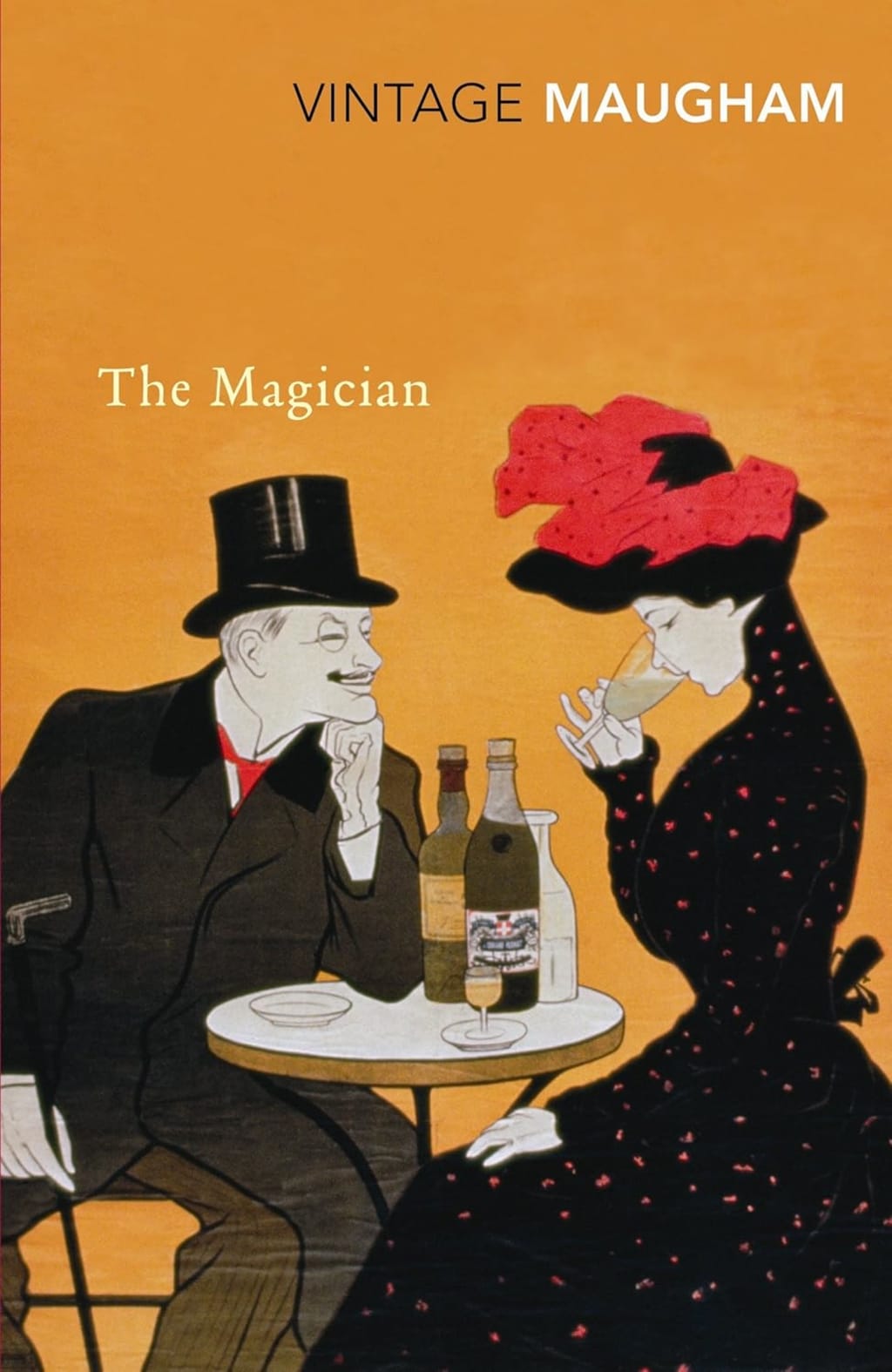
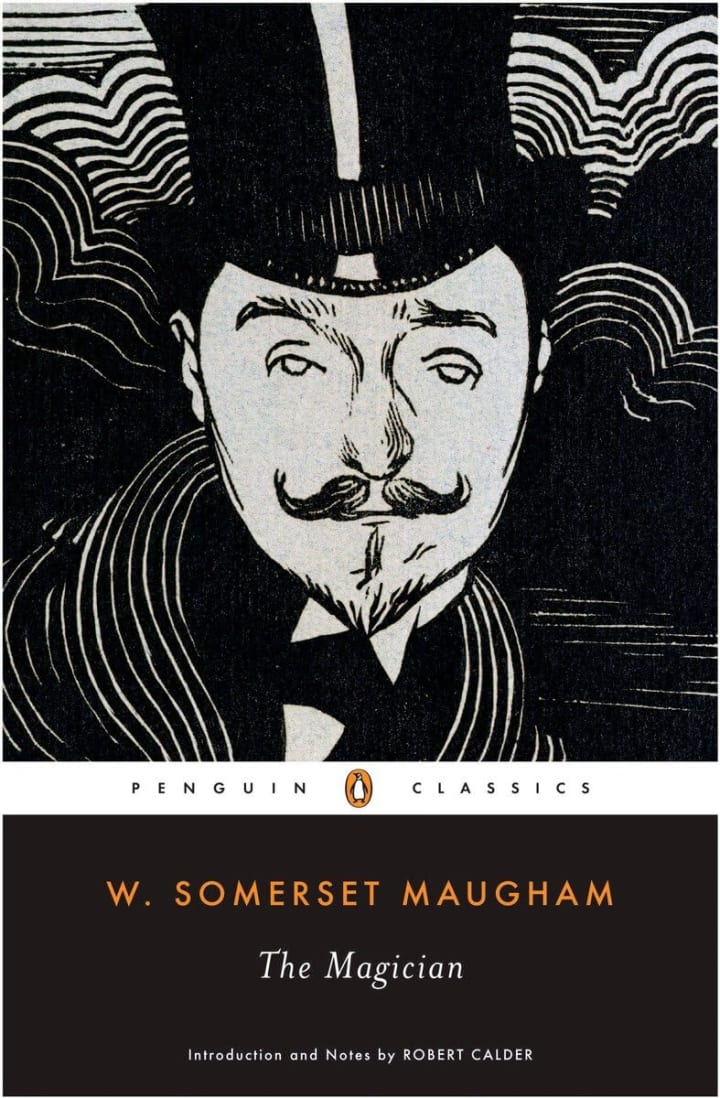
Published in 1908, W. Somerset Maugham's The Magician was inspired by Maugham's fascination with the occult and his encounters with Aleister Crowley, a notorious figure in the world of mysticism and esotericism. Crowley’s eccentric personality and controversial reputation heavily influenced the character of Oliver Haddo, the titular magician in the novel. Maugham reportedly observed Crowley's mannerisms and lifestyle during their interactions in Paris, and these details contributed to Haddo's vividly unsettling character.
Set against the backdrop of Paris and rural England, The Magician blends elements of Gothic horror, satire, and psychological drama. Maugham was intrigued by the intersection of science and mysticism, particularly as it was debated in the early 20th century. This interest is reflected in the novel’s portrayal of Haddo’s grotesque experiments and arcane rituals. At the same time, Maugham critiques both blind superstition and the arrogance of scientific rationalism, reflecting broader anxieties of the era.
Initially, The Magician received mixed reviews, with some critics dismissing it as derivative of earlier Gothic works like Mary Shelley’s Frankenstein or the writings of Edgar Allan Poe. However, others praised Maugham’s sharp wit and his ability to weave a compelling, atmospheric narrative. I am one of those people who absolutely adore this novel. It is a perfect addition to any gothic bookshelf.
Plot
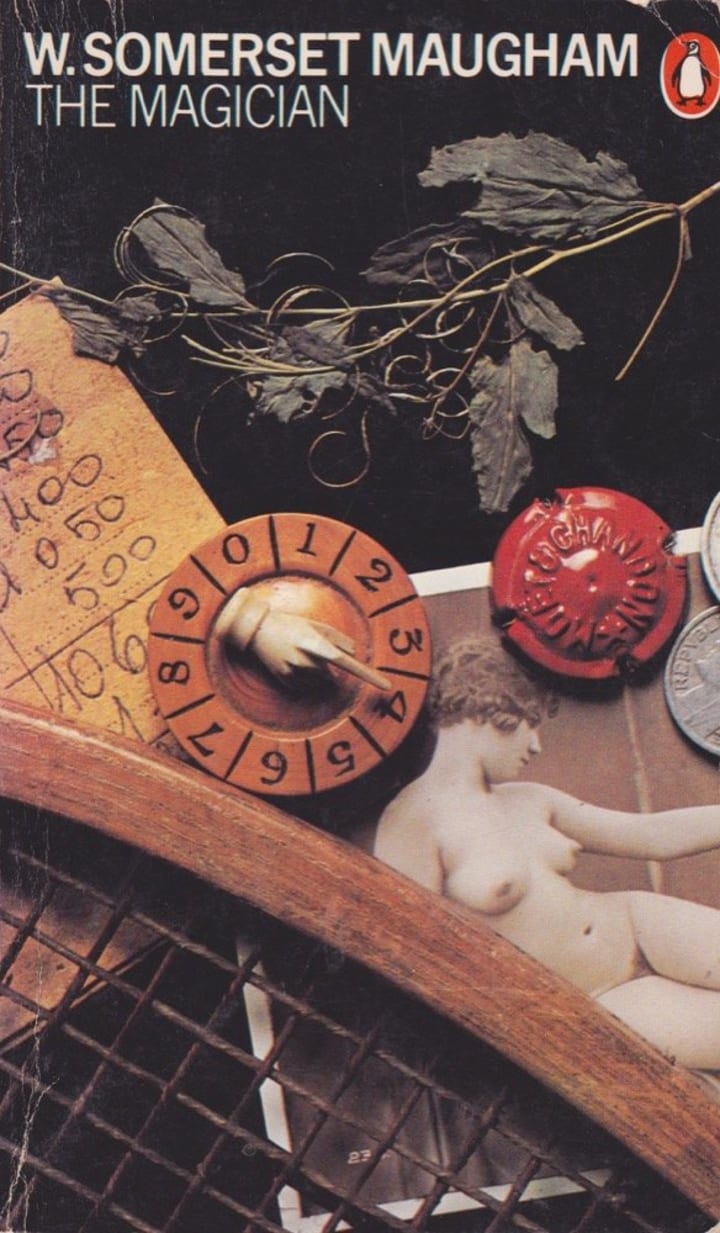
The story begins in Paris, where Arthur Burdon, a skilled surgeon, is engaged to Margaret Dauncey, a young Englishwoman recovering from a traumatic illness. The couple lives among an expatriate artistic circle that includes Dr. Porhoët, a French scholar with an interest in the occult. Their seemingly idyllic lives are disrupted by the arrival of Oliver Haddo, a strange and flamboyant man with a sinister air. Haddo, claiming to be a magician, makes an immediate impression with his eccentric behaviour and outlandish stories.
Haddo’s initial interactions with Arthur and Margaret are antagonistic, particularly when he ridicules Arthur’s scientific worldview and boasts of his mystical powers. Haddo demonstrates his abilities in unnerving ways, such as causing pain with a glance or seemingly conjuring a snake, leaving the group unsettled. Margaret is particularly disturbed but also inexplicably drawn to Haddo’s dark charisma.
As the story unfolds, Haddo becomes obsessed with Margaret and uses hypnotic powers to manipulate her. Under his influence, she abruptly leaves Arthur and marries Haddo. Arthur, devastated, enlists Dr. Porhoët to uncover Haddo’s true nature. Their investigation reveals Haddo’s involvement in grotesque experiments, including attempts to create life through occult rituals, echoing the alchemical legends of the homunculus.
Arthur and Dr. Porhoët travel to Haddo’s remote estate, where they discover the horrifying truth about Margaret’s condition and Haddo’s plans. Arthur confronts Haddo in a climactic struggle, during which Haddo meets his demise in a dramatic fire that consumes his laboratory. Despite Arthur’s efforts, Margaret succumbs to the physical and psychological toll of Haddo’s influence, dying tragically at the end.
The novel concludes with Arthur returning to Paris, a broken man. It's all pretty much over.
Into the Book
Knowledge without Ethics:
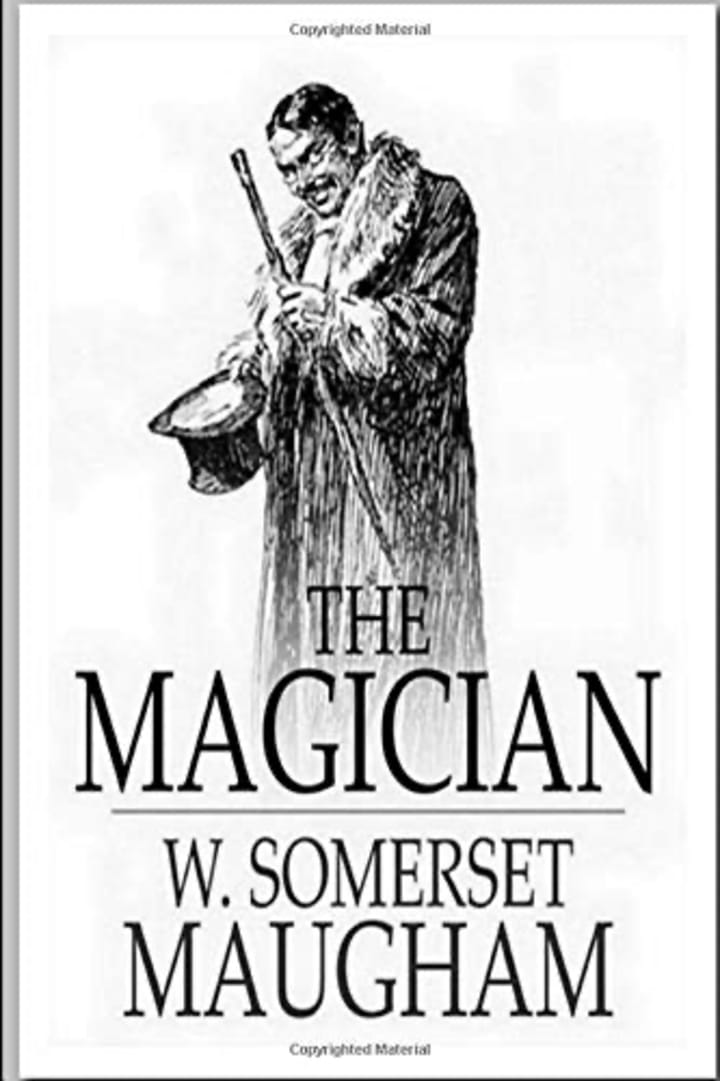
A central theme of The Magician is the corrupting potential of knowledge, particularly when pursued without ethical restraint. Oliver Haddo embodies this theme through his relentless quest for forbidden knowledge. Haddo’s experiments in creating life parallel the hubris of figures like Victor Frankenstein, as he attempts to transcend human limitations through both science and magic. Haddo’s assertion, “The pursuit of knowledge is sacred, even when it delves into the darkest mysteries,” reflects his dangerous belief that morality is secondary to intellectual ambition.
Arthur, representing scientific rationality, initially dismisses Haddo’s claims as absurd, but he is ultimately forced to confront the limits of his understanding. Maugham critiques both Haddo’s reckless mysticism and Arthur’s rigid materialism, suggesting that unchecked ambition leads to destruction.
“Yet magic is no more the art of employing consciously invisible means to produce visible effects. Will, love, and imagination are magic powers that everyone possesses; and whoever knows how to develop them to their fullest extent is a magician. Magic has but one dogma, namely, that the seen is the measure of the unseen.”
- The Magician by W Somerset Maugham
Manipulation and Power Dynamics:
Haddo’s ability to manipulate others highlights the theme of power dynamics, particularly in his relationship with Margaret. Haddo’s hypnotic control over Margaret reflects the Gothic trope of a vulnerable woman preyed upon by a dominant male figure. Margaret’s transformation from a strong, independent woman to a passive victim underscores the devastating impact of psychological coercion.
Maugham uses Haddo’s predatory behaviour to explore broader questions of control and agency. Haddo’s declaration that “Men like me are the architects of their own morality” underscores his sociopathic worldview, where power justifies any action. Arthur’s failure to protect Margaret highlights the limitations of reason and the destructive potential of unchecked dominance.
“The Magus,the sorcerer, the alchemist, are seized with the fascination of the unknown; and they desire a greatness that is inaccessible to mankind.”
- The Magician by W Somerset Maugham
Science vs. Mysticism:
The novel juxtaposes science and mysticism, portraying both as imperfect approaches to understanding the world. Arthur, a staunch believer in scientific rationality, initially dismisses Haddo’s occult practices as charlatanism. However, as the story progresses, Arthur is forced to confront the inexplicable, challenging his rigid worldview.
Haddo, conversely, represents the seductive but dangerous allure of the supernatural. His experiments blur the line between scientific inquiry and mystical ritual, illustrating the novel’s central conflict. Maugham’s portrayal of Haddo’s grotesque laboratory, filled with both scientific equipment and arcane symbols, embodies this tension.
“He was no longer the awkward man of social intercourse, who was sufficiently conscious of his limitations not to talk of what he did not understand, and sincere enough not to express admiration for what he did not like.”
- The Magician by W Somerset Maugham
Why It's a Masterpiece
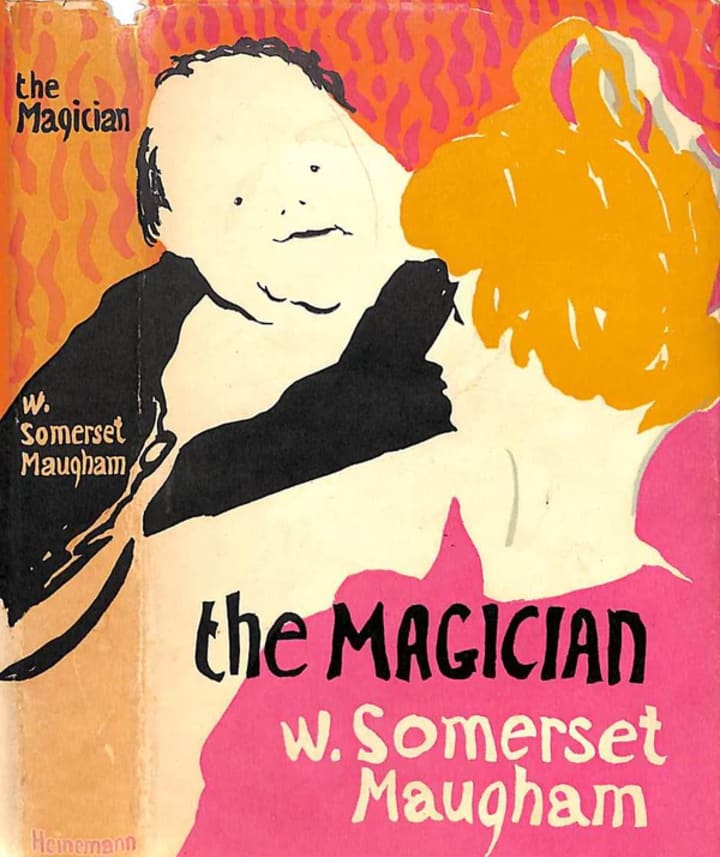
Whilst The Magician is not as widely celebrated as some of Somerset Maugham’s latter works, it is considered a masterpiece of its genre for its ability to blend Gothic horror, philosophical inquiry, and sharp characterisation. The novel’s atmospheric writing captures the foreboding allure of Haddo’s world, creating a sense of unease that permeates the story. It has a haunting quality that I think is a special experiment in his bibliography.
Haddo, as a character, is a fascinating study in amorality and charisma, making him one of Maugham’s most memorable creations. I would say that he is perhaps one of Maugham's most interesting characters because of his complexity and the social commentary on the age he presents to the reader.
Conclusion
Maugham’s The Magician is a chilling and thought-provoking exploration of ambition, power, and morality akin to a Shakespearean tragedy. The novel’s atmospheric prose and intricate blending of Gothic and philosophical elements make it a captivating work that transcends its era, spilling over into the latter modern horror age. It is truly an absolute masterpiece by a heavily underrated writer of the century.
Fun fact is that I share a birthday with this guy too. So there's another reason to read the book.
Next Week: The Wind in the Willows by Kenneth Grahame
About the Creator
Annie Kapur
I am:
🙋🏽♀️ Annie
📚 Avid Reader
📝 Reviewer and Commentator
🎓 Post-Grad Millennial (M.A)
***
I have:
📖 280K+ reads on Vocal
🫶🏼 Love for reading & research
🦋/X @AnnieWithBooks
***
🏡 UK
Keep reading
More stories from Annie Kapur and writers in Geeks and other communities.
Book Review: "Found You" by Sarah Jules
Sarah Jules is a pretty good writer. When I say 'pretty good' I actually mean I'm trying very hard not to become obsessed. She's written great books like You Invited It In (which I reviewed here) and You Need to Leave (which I reviewed here). I've often been reluctant from reading too many books by the same author in such a short time span but honestly, I don't think that Sarah Jules is going to disappoint me soon. With her fast-paced scenes, her brilliant alternating perspectives and her great way with character, I am pretty sure Sarah Jules is going to still go strong with this book.
By Annie Kapur5 months ago in Geeks
Silver Screen Magic with Mae West
American actress and singer Mae West became a popular film actress during the Great Depression. She started entertaining in vaudeville, then performed on Broadway, and finally went to Hollywood. She signed up with Paramount Pictures and made her debut in the 1932 film “Night After Night.” She also starred in musicals, comedies, and crime dramas. The American Film Institute named her one of the best classic Hollywood actresses.
By Rasma Raisters6 days ago in Geeks
Grant Gustin's Chances Of Returning As The DC Universe's Flash Have Just Increased After New Update
The Flash has yet to be cast for the new DC Universe, and after a new update, the rumors of Grant Gustin's return as Barry Allen in the new franchise have gained strength once again. Gustin made history by playing Barry for The Flash's nine seasons. The actor also starred in multiple Arrowverse crossovers, becoming one of the franchise's fan-favorites.
By Dena Falken Esq4 days ago in Geeks
Ludacris and Nelly draw backlash over bookings at MAGA-coded music festival
Ludacris and Nelly headlining a mostly right-wing event is good for them. It’s also great for the genre of hip hop. The two rap veterans have showcased their talents on other stages. Why can’t they perform for mostly MAGA folks and grab that bag?
By Skyler Saunders4 days ago in Beat


Comments
There are no comments for this story
Be the first to respond and start the conversation.