
The Magic Mountain by Thomas Mann
Why It's a Masterpiece (Week 89)

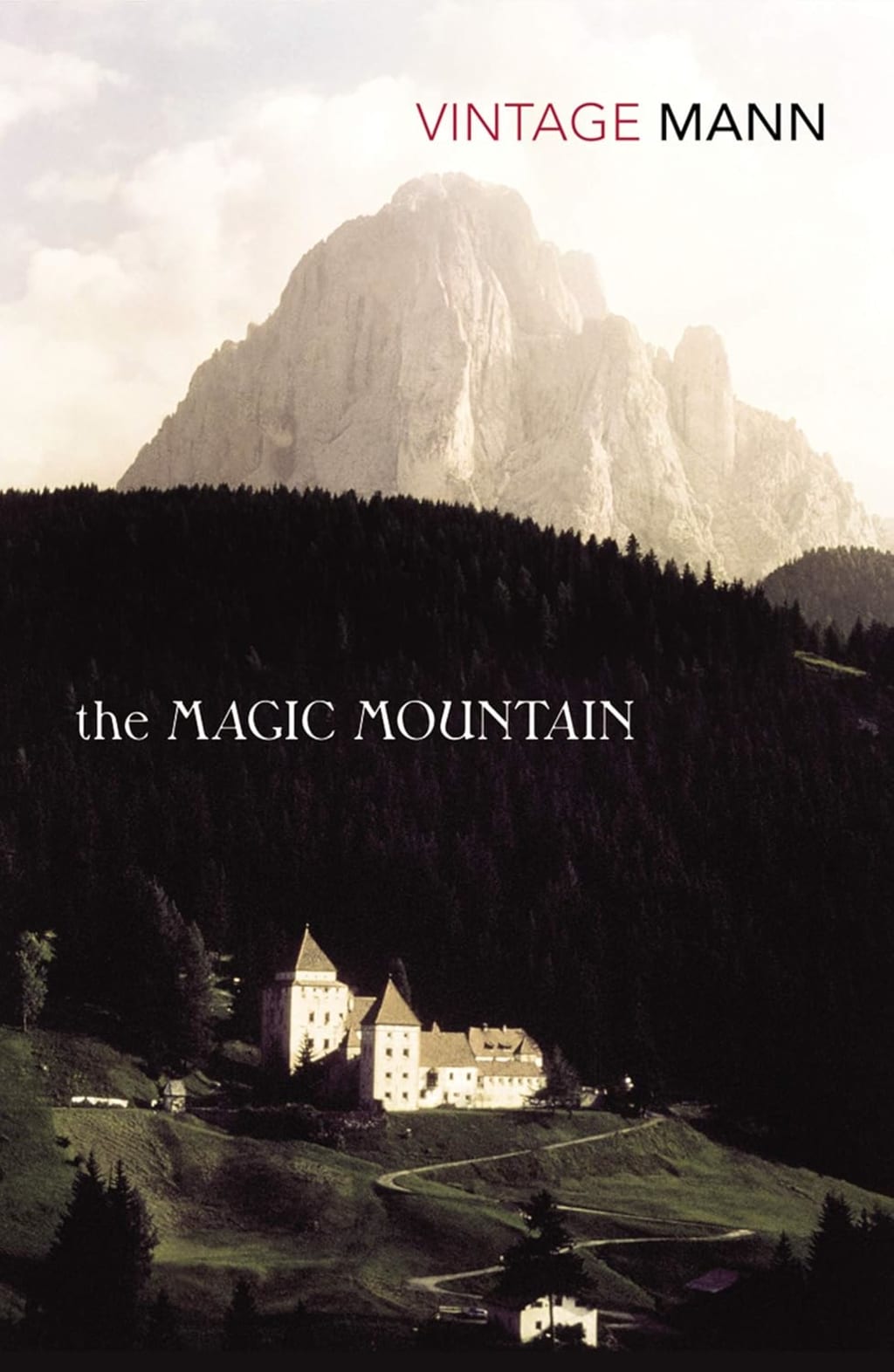
Thomas Mann’s The Magic Mountain (Der Zauberberg) was published in 1924 after more than a decade of writing and revision. The original thought was to write a short story in 1912. It was inspired by Mann’s visit to a Swiss tuberculosis sanatorium where his wife was recovering, and the novel grew into a philosophical and symbolic epic, exploring themes of: time, illness, and the intellectual and ideological conflicts of pre-World War I Europe.
Mann was influenced by German Romanticism, the Bildungsroman tradition, and philosophical debates of his time, particularly the ideas of Nietzsche, Schopenhauer, and Freud. His protagonist, Hans Castorp, goes through an existential and intellectual transformation during his extended stay at a sanatorium in the Swiss Alps, mirroring the cultural and ideological sickness of Europe before the war.
The outbreak of World War I delayed the novel’s completion, and the post-war world reshaped its meaning. Instead of a simple Bildungsroman, The Magic Mountain became a meditation on European decline, the allure of death, and the tension between humanist ideals and radical ideologies.
Plot

The novel follows Hans Castorp, a young, unremarkable Hamburg engineer, who travels to the Berghof Sanatorium in the Swiss Alps to visit his tubercular cousin Joachim Ziemssen. What is meant to be a three-week visit turns into a seven-year stay, as Castorp gradually succumbs to the timeless, seductive world of the sanatorium.
At Berghof, Castorp is introduced to a cast of eccentric, intellectual, and symbolic characters who expose him to conflicting ideologies. Among them are:
- Ludovico Settembrini, an Italian humanist who champions progress, democracy, and enlightenment values.
- Leo Naphta, a radical Jesuit and Marxist who preaches totalitarianism, destruction, and nihilism.
- Clavdia Chauchat, a mysterious and alluring Russian woman with whom Hans becomes infatuated, symbolising eroticism and irrational desire.
- Dr. Behrens and Dr. Krokowski, the sanatorium’s physicians, who embody the medicalisation of life and the Freudian exploration of illness and repression.
As Castorp settles into sanatorium life, he experiences a transformation of perception, influenced by the slow passage of time, the philosophical debates he engages in, and his romantic longing for Clavdia. He becomes detached from the outside world, drawn into an existential and intellectual limbo, where illness is elevated to a spiritual experience.
Over time, Castorp flirts with both Settembrini’s rationalism and Naphta’s extremism, mirroring the ideological battle that will soon consume Europe. Naphta and Settembrini’s philosophical conflict culminates in a duel, in which Naphta kills himself, a symbolic foreshadowing of Europe’s self-destruction in World War I.
Eventually, Castorp’s long stay is abruptly ended by the outbreak of World War I. He descends from the mountain and joins the battlefield, where he disappears into the chaotic violence of history, leaving his fate unknown. The novel ends ambiguously, questioning whether Castorp has gained wisdom or been utterly lost in the abyss of time and ideology. The philosophical questioning overwhelms the reader.
Into the Book

Time:
A key theme in The Magic Mountain is the fluid and deceptive nature of time, particularly as experienced by the sick. Castorp’s initial three-week visit extends to seven years, illustrating how time, when detached from the rhythms of ordinary life, becomes distorted and meaningless.
The mountain becomes a world outside of time, where illness offers an escape from responsibility. Castorp, like many of the sanatorium’s residents, falls under the spell of illness, seduced by the idea that suffering elevates the soul. This shows Mann’s fascination with decadence, decay, and the appearances of sickness.
“A man lives not only his personal life, as an individual, but also, consciously or unconsciously, the life of his epoch and his contemporaries.”
- The Magic Mountain by Thomas Mann
Clashing Ideologies in 20th Century Europe:
The novel depicts the clash of ideologies that defined early 20th-century Europe, embodied by Settembrini and Naphta. Settembrini, a rationalist and champion of humanism, believes in progress, liberal democracy, and scientific enlightenment: “The only moral way of life is one that fights for freedom and the dignity of man.”
Naphta, in contrast, represents fanaticism, destruction, and totalitarian ideology. He argues that violence and dogma are necessary to overthrow decadence. Their debates, often taking place before Castorp, mirror the ideological battles that would soon culminate in the horrors of World War II. Castorp is caught between their perspectives, symbolising Europe’s inability to choose between enlightenment and extremism.
“Terror is the instrument of true virtue.”
- The Magic Mountain by Thomas Mann
The Romanticised Nature of Illness and Death:
Illness and death in The Magic Mountain are not merely feared but romanticised. The sanatorium becomes a place of transformation, where characters embrace their decline as aesthetic and existential experiences.
Castorp’s attraction to Clavdia Chauchat is deeply tied to this deathly eroticism. Clavdia’s languid, consumptive beauty embodies the allure of the irrational and destructive. This theme of Eros and Thanatos (love and death) reflects a broader preoccupation in the novel: the idea that modernity itself is drawn to decadence and destruction, much like pre-war Europe.
“He desired her because she was unattainable, as fleeting as time itself.”
- The Magic Mountain by Thomas Mann
Why It's a Masterpiece

Mann’s novel is a masterpiece because it is a profound meditation on time, illness, ideology, and the fate of European civilisation. One of its greatest achievements is its portrayal of time as a subjective experience. The sanatorium becomes the home of European decay, where characters debate reason vs. radicalism, health vs. illness, and progress vs. decadence.
The novel’s philosophical depth also sets it apart. Mann weaves in ideas from Nietzsche, Schopenhauer, and psychoanalysis, creating a work that is as much an intellectual exploration as it is a narrative. Also, the novel’s characters function as archetypes. For example: Settembrini and Naphta embody political ideologies, Clavdia represents eroticised death, and Castorp himself becomes a stand-in for modern man, caught between conflicting worldviews.
Conclusion

The Magic Mountain remains essential reading because it explores universal human dilemmas: the passage of time, the nature of illness, and the battle between reason and fanaticism. Its philosophical depth, allegorical richness, and psychological insight ensure its continued relevance. In an era of global crises, pandemics, and ideological division, The Magic Mountain resonates as a warning and an invitation. It is a novel that asks us to reflect on the sickness of society, the seduction of ideologies, and the need for intellectual engagement. Its questions remain as urgent today as they were in 1924. Possibly, even more so...
Next Week: Three Lives by Gertrude Stein
About the Creator
Annie Kapur
I am:
🙋🏽♀️ Annie
📚 Avid Reader
📝 Reviewer and Commentator
🎓 Post-Grad Millennial (M.A)
***
I have:
📖 280K+ reads on Vocal
🫶🏼 Love for reading & research
🦋/X @AnnieWithBooks
***
🏡 UK
Keep reading
More stories from Annie Kapur and writers in Geeks and other communities.
Book Review: "The Loved One" by Evelyn Waugh
Rereading Evelyn Waugh is definitely the flavour of the season and I am quite surprised that I didn't think about doing this earlier. So far, I've reread books like Scoop and A Handful of Dust among others. Today, it's The Loved One. Evelyn Waugh's wit never seeks to amaze me and to me, he is perhaps one of the greatest literary voices of the 20th century. It really is only Evelyn Waugh that can make such a great satire about America, across the ocean from us and probably further away back then. It is also really only Evelyn Waugh who can make a satire out of death. This has been one of my favourites to reread and now you'll see why...
By Annie Kapur2 months ago in Geeks
Premier League in Switzerland: How to Watch
The 2025–26 Premier League season is underway, marking the 34th edition of the competition and the 127th year of top-flight English football. Liverpool start their title defense with confidence after lifting their second Premier League trophy last season, but the return of Leeds United, Burnley, and Sunderland ensures fresh rivalries – including the long-awaited Tyne–Wear derby, back for the first time since 2015–16.
By David Cooka day ago in Geeks




Comments
There are no comments for this story
Be the first to respond and start the conversation.