
Book Review: "The Loved One" by Evelyn Waugh
4/5 - Evelyn Waugh gets deep into the rich, American psyche...

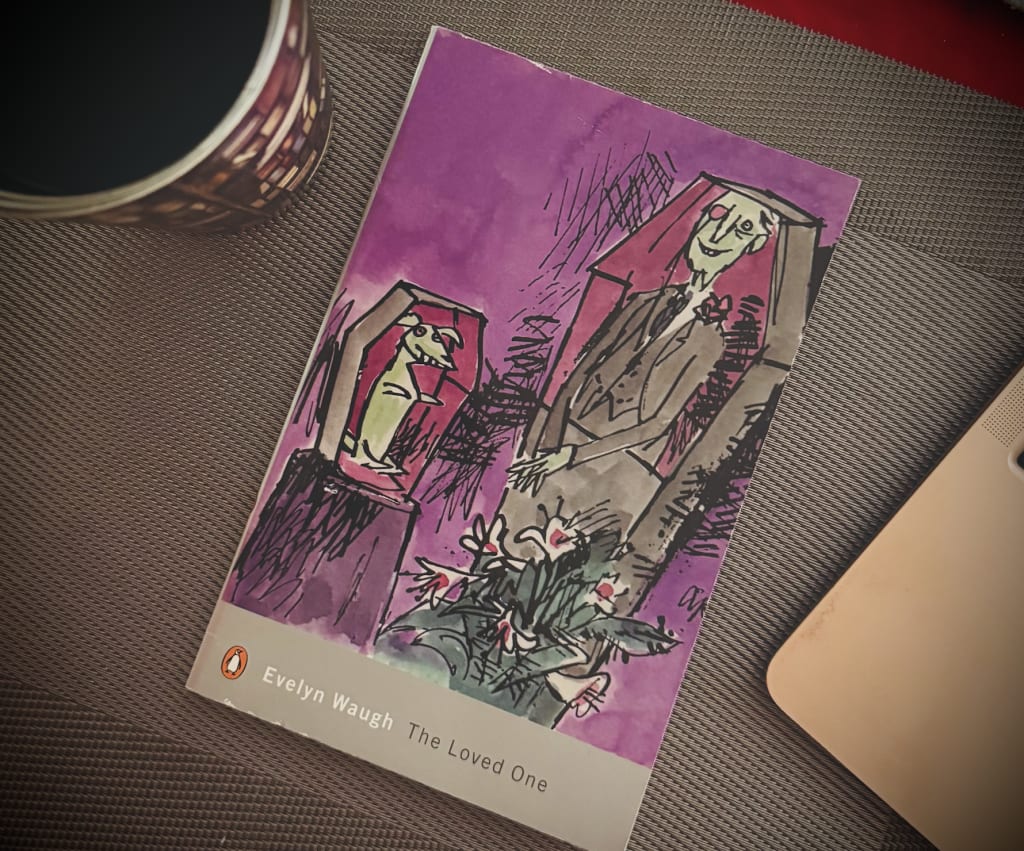
Rereading Evelyn Waugh is definitely the flavour of the season and I am quite surprised that I didn't think about doing this earlier. So far, I've reread books like Scoop and A Handful of Dust among others. Today, it's The Loved One. Evelyn Waugh's wit never seeks to amaze me and to me, he is perhaps one of the greatest literary voices of the 20th century. It really is only Evelyn Waugh that can make such a great satire about America, across the ocean from us and probably further away back then. It is also really only Evelyn Waugh who can make a satire out of death. This has been one of my favourites to reread and now you'll see why...
Unlike the more 'English' novels by Waugh, this one opens in Los Angeles where Dennis Barlow is a poet who has struggled to find any success whatsoever, so he works in a luxurious cemetery for pets. His work, while odd and slightly macabre, provides stability in a grotesque, sentimental society obsessed with appearances and themselves. There's something really ironic with the face of death being in the city of angels. Everyone here is so obsessed with themselves, so glamorous and so narcissistic that the very nature of the person (Dennis) we get is one that makes us wonder about what Waugh's message is.
Dennis’s friend and housemate, Sir Francis Hinsley, an aging British scriptwriter, becomes a victim of Hollywood’s cruel disposability. He is very suddenly fired before descending into a weird sense of despair in which he can see no possible way forward. Hinsley finally hangs himself in a fit of depression. Dennis is the guy who must arrange the funeral but he also notices that when it comes to death, nobody really reacts with genuine emotion - everyone just deflects and copes behind something. This is quite important because reading this a second time made me see the connection between the graveyard that Dennis works in (one of luxury and opulence) and the reactions to the death of Francis Hinsley. There is so much commercialisation when it comes to death that everything is an advertisement for something (or someone). The people 'putting on' their reactions are advertising themselves. The funeral is an advertisement for the industry. And yes, even Dennis falls into this trap even though he likes to believe he is an outside observer.

Dennis meets Aimée Thanatogenos, a naïve, idealistic cosmetician who tends to corpses. Aimée believes in the cemetery’s spiritual mission, idealising both death and love. To be honest, she is really one of these perfect Waugh characters who embodies a sense of horrific irony. She ultimately ends up confused between artificiality and sincerity, emotion and image - taking it all in as something quite real when it is something that is part of this larger, narcissistic problem with Los Angeles and especially, Hollywood. The underlying message we can see here is that just as easy as it is for Hollywood to cover its truths and tracks, it is also easy enough for someone to fall for their manipulations under the guise of doing 'real' and 'important' work. The reality of that 'real' and 'important' work however, is very different to how its being portrayed and understood.
Dennis courts Aimée in a parody of romantic idealism, mixing genuine attraction with self-serving manipulation. Dennis, the detached intellectual, sees Aimée’s naïveté as both charming and ridiculous. Meanwhile, Aimée projects onto him a fantasy of refined, poetic Englishness - everything she believes America lacks. The British cynical prose mixed with the American sentimentalities of romance and glamour make for the perfect stage on which Waugh sets his satire. I'm not going to lie to you, I wasn't actually thinking about rereading this book because it's so short I thought it would be a bit of a waste. However, the more I look into it now, the more I discover for the first time - pretty much proving that it is never a waste.
Aimée is also courted by Mr. Joyboy, chief embalmer. A timid, mother-dominated man, he represents the grotesque domestication of death. His professional skill in beautifying corpses is contrasted with his private life, he lives with an overbearing, gluttonous mother whose grotesque eating habits disgust Aimée. I always love it when these male protagonists have these overbearing mothers who can't seem to understand how the changing world works. Evelyn Waugh definitely writes these characters to satirise the middle class sense of 'virtue' (which I think we've all worked out is false and a whole host of lies are involved).
I'm not going to tell you everything because there's still a whole host of grotesque stuff that happens in this book. What I will tell you though is that the satire is so strong that it's difficult not to miss it. This is definitely one of the strong Evelyn Waugh books if you want to look beneath the surface, but at the beginning it will definitely feel like 'what am I reading?' I would recommend The Loved One to all who think that The Great Gatsby is a book about American opulence.
About the Creator
Annie Kapur
I am:
🙋🏽♀️ Annie
📚 Avid Reader
📝 Reviewer and Commentator
🎓 Post-Grad Millennial (M.A)
***
I have:
📖 280K+ reads on Vocal
🫶🏼 Love for reading & research
🦋/X @AnnieWithBooks
***
🏡 UK
Keep reading
More stories from Annie Kapur and writers in Geeks and other communities.
Book Review: "Fever Pitch" by Nick Hornby
I've never read anything by Nick Hornby before and the reason for that is because I didn't think his books were written for people like me. This is the same thing I was talking about in my review of Greenlights by Matthew McConaughey. I said that I didn't think I was the intended audience of the book and so, when it came to reading it - that was probably why I didn't enjoy it as much as I thought I would. When it comes to Nick Hornby's books I definitely didn't think I was the intended audience. I despise football but I had to give it a chance. Let's have a look at how it went.
By Annie Kapur2 months ago in Geeks
Marvel Zombie
The last entry into our 2025 superhero projects catalogue is Marvel Zombies. This was a show that was anticipated by absolutely no one and it disappeared from the public consciousness as quickly as it was released. There was nothing special about the project that made it a must see, or a must remember. In fact if anything it's a must forget.
By Alexandrea Callaghan19 days ago in Geeks
Why The Last Holiday Still Resonates Even 20 Years Later
Plot Summary Georgia Byrd, a kindhearted but shy department store employee, discovers she has a terminal illness. Faced with her mortality, she decides to abandon her mundane life and take a lavish vacation to Europe, determined to live life to the fullest before her passing. Along the way, Georgia embraces adventure, discovers her own courage, and forms unexpected friendships that change her outlook. Amid luxury hotels, fine dining, and breathtaking scenery, she also encounters romance and laughter, learning to cherish every moment. The Last Holiday is a heartfelt story about finding the true joy of life and self-discovery.
By TheScreenAnalystabout 2 hours ago in Geeks



Comments (1)
I really wish I liked this one, but it has never worked for me (and yes, I have reread it).