
The Great Santini’s Rocky Flight: An Unusual Release Journe
After nearly being thrown away, The Great Santini managed to escape obscurity and failure to a pair of Academy Award nominations.

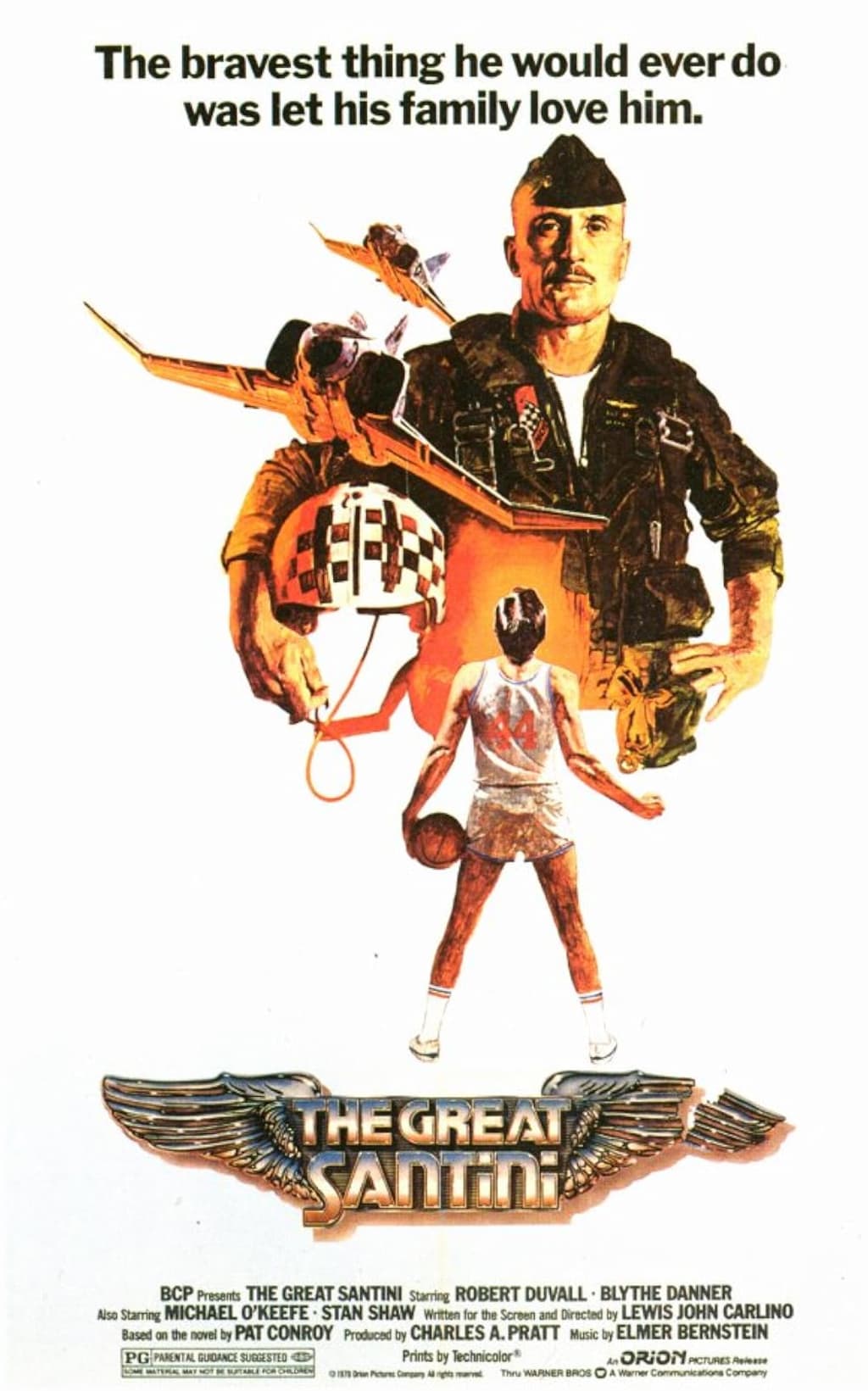
The Great Santini is now celebrated as a powerful, character-driven drama. Yet its path to critical acclaim was anything but smooth. The film’s release history is as layered and complex as the father-son dynamic it portrays.
1. Early Development and Filming
The adaptation journey began swiftly: Pat Conroy’s novel, published in 1976, was optioned in 1977 by Bing Crosby Productions, with Conroy writing the initial screenplay. Eventually Lewis John Carlino, a New York playwright and screenwriter, took over writing and directing duties.
Filming commenced on October 18, 1978, at Marine Corps Recruit Depot on Parris Island, South Carolina, with an estimated $4 million budget. After an eight-week shoot, production moved to Samuel Goldwyn Studios in Hollywood and wrapped by mid-December 1978.
2. Initial Release: Missteps and Misfires
Warner Bros., concerned that the film lacked a “bankable” star and had a difficult storyline for post-Vietnam audiences, opted against a conventional rollout. Instead of launching in New York, they rolled out the film quietly in rural areas—specifically North and South Carolina—where attendance was virtually nonexistent.
Adding to the confusion, the title was tested under alternative names, including Sons and Heroes, Reaching Out, and The Ace—the latter tested in Peoria, Illinois, and briefly adopted—but none stuck; box office results remained disappointing.
The official limited release date was October 26, 1979, under Warner Bros.—but the opening weekend grossed only around $83,527 domestically, barely covering its budget.
3. Withdrawal and Cable Alternative
With theatrical failure evident, Orion Pictures stepped in, withdrawing the film from theaters and selling cable rights to HBO and in-flight rights to airlines as a recoup strategy.
4. A Second Chance: New York Redemption
Producer Charles A. Pratt refused to let the film go quietly. Gathering additional funding—including support from Orion—he arranged for a New York City revival screening under the original title. Reviews were glowing, and attendance modest but consistent. However, just two weeks later, the film premiered on HBO, drawing theatergoers away and undercutting momentum for wider theatrical expansion.
Critic and industry analysis attributed the film’s box-office failure to an unorthodox release strategy, especially the absence of a traditional New York launch that could generate national press and word-of-mouth buzz.
5. Critical Kudos and Awards Recognition
Despite its commercial struggles, The Great Santini found its stride critically. Both Robert Duvall (as Lt. Col. “Bull” Meechum) and Michael O’Keefe (as his son, Ben) earned Academy Award nominations—Duvall for Best Actor, O’Keefe for Best Supporting Actor—at the 1981 Oscars  .
Duvall’s performance also garnered multiple awards and honors: he won Best Actor at the Kansas City Film Critics Circle and the Montreal World Film Festival, was runner-up for New York Film Critics Circle, and placed in the National Society of Film Critics polls .
6. Legacy and Resurgence
Over time, The Great Santini earned its place as a deeply affecting drama exploring father-son tensions, emotional suppression, and military life. On Rotten Tomatoes, it holds a strong 95% based on 20 reviews, with critics like Roger Ebert praising its emotional authenticity and character depth.
Intrigue around the film’s availability endures among cinephiles. One fan on a forum recalled its HBO outings under the alternate title “The Ace”, then its later retitled theatrical release as a testament to its complex distribution story.
7. What Went Wrong—and What Could’ve Been
The erratic release strategy of The Great Santini stands as a cautionary tale:
• Skipping a traditional New York premiere robbed the film of essential press coverage and buzz.
• Title experimentation sowed confusion rather than building brand recognition.
• Premature HBO release cannibalized theatrical audiences just as word-of-mouth momentum was building.
Adapted from a respected author, helmed by a skilled director, and anchored by a powerful lead performance, the film’s release missteps overshadowed its artistic merits—at least at first.
Conclusion: From Misfire to Cult Classic
Ultimately, The Great Santini soared where it mattered—as a lasting piece of emotional and cinematic craftsmanship. Its unusual release pattern underscores how fragile theatrical success can be, especially for character-driven, drama-heavy films without immediate commercial hooks. Yet it also demonstrates the power of critical conviction—when a producer refuses to give up, a film can still find its audience, even if it’s retracing a longer, more convoluted path.

Want more Movies of the 80s? Join on our YouTube Channel, linked here.
About the Creator
Movies of the 80s
We love the 1980s. Everything on this page is all about movies of the 1980s. Starting in 1980 and working our way the decade, we are preserving the stories and movies of the greatest decade, the 80s. https://www.youtube.com/@Moviesofthe80s
Keep reading
More stories from Movies of the 80s and writers in Geeks and other communities.
Movies of the 80s: Federico Fellini and Woody Allen in 1980
In researching Federico Fellini's 1980 film, City of Women, a lesser known piece of Fellini's canon, I stumbled upon a quote that I cannot find anywhere else that illustrates, apparently, that Federico Fellini hated Woody Allen, well before hating Woody Allen became a universal feeling. I have searched high and low for other sources regarding Fellini's feelings about Woody Allen but nothing on Google or other search engines returns any results regarding Fellini having negative feelings towards Allen before it became common cause.
By Movies of the 80sabout a year ago in Geeks
Silver Screen Magic with Mae West
American actress and singer Mae West became a popular film actress during the Great Depression. She started entertaining in vaudeville, then performed on Broadway, and finally went to Hollywood. She signed up with Paramount Pictures and made her debut in the 1932 film “Night After Night.” She also starred in musicals, comedies, and crime dramas. The American Film Institute named her one of the best classic Hollywood actresses.
By Rasma Raisters4 days ago in Geeks
Julian Barnes Says Goodbye to the Novel: A Literary Icon Reflects on a Storied Career
In the world of contemporary literature, few authors have commanded as much respect and admiration as Julian Barnes. Known for his incisive wit, keen psychological insights, and elegant prose, Barnes has spent decades shaping modern fiction, producing works that blend philosophical inquiry with human storytelling. Now, the celebrated novelist has announced that he is saying goodbye to the novel, signaling the end of an era for readers who have long followed his literary journey. A Career Defined by Curiosity and Elegance Julian Barnes, born in Leicester in 1946, has been one of Britain’s most distinguished literary figures since the 1980s. Over his career, he has authored a remarkable array of novels, essays, and short stories, earning accolades including the prestigious Man Booker Prize for his 2011 novel The Sense of an Ending. His works frequently explore themes of memory, love, mortality, and the elusive nature of truth, often inviting readers to examine the complex moral and emotional layers of human experience. Barnes’ decision to step away from the novel comes as both a surprise and an inevitability for many of his devoted readers. In interviews discussing his forthcoming farewell, he emphasized that the decision was not born from fatigue, but from a desire to conclude his career on his own terms, rather than letting external pressures dictate his creative output. “I feel I have said what I wanted to say in fiction,” Barnes explained. “The novel has been my lifelong companion, but it is time to part ways with it gracefully, rather than cling to it.” The End of an Era Barnes’ departure from the novel is significant not only for its timing but also for what it represents in the literary landscape. Over the past four decades, Barnes has been part of a cohort of writers who elevated modern British literature, combining literary sophistication with widespread accessibility. His ability to blend narrative innovation with philosophical depth has influenced a generation of authors, from novelists exploring the intricacies of memory to those experimenting with metafiction and historical inquiry. Works like Flaubert’s Parrot and Arthur & George exemplify Barnes’ talent for merging intellectual curiosity with human emotion. In Flaubert’s Parrot, he dissected the life of the French novelist Gustave Flaubert, blending biography, literary criticism, and narrative playfulness in a way that challenged conventional storytelling. Arthur & George, meanwhile, retold the story of a real-life legal case in Edwardian England, illuminating themes of justice, identity, and the human desire for truth. Such novels have left an indelible mark on literary studies and popular reading alike. A Reflection on Literary Form Barnes’ farewell also prompts reflection on the state of the novel itself. In recent years, traditional literary forms have faced pressure from emerging technologies, the rise of digital media, and shifting reading habits. Barnes’ choice to retire from the novel underscores a sense that the literary form is evolving, and that authors must navigate these changes while remaining true to their artistic vision. Critics suggest that Barnes’ departure may inspire readers and writers alike to reassess what the novel can achieve in a rapidly changing cultural landscape. His works have demonstrated that fiction can simultaneously entertain, educate, and provoke deep contemplation—a standard that future authors may strive to uphold. Legacy Beyond the Page Although Barnes is stepping away from the novel, his influence will persist across literary circles and classrooms worldwide. His essays, critical writings, and memoirs offer further insight into his philosophical and aesthetic approach, while his novels will continue to be studied, enjoyed, and debated for generations. Students of literature often cite his deft handling of narrative perspective, temporal shifts, and moral ambiguity as exemplary, showcasing the enduring power of the written word to capture the complexities of life. Barnes’ announcement also raises questions about what comes next for an author who has spent his entire adult life shaping fictional worlds. While he may no longer write novels, he has hinted at the possibility of exploring essays and non-fiction, channels through which he can continue to engage with ideas, culture, and history. A Farewell to Fiction, Not to Thought Julian Barnes’ goodbye to the novel is bittersweet for readers, critics, and literary enthusiasts alike. It marks the close of a chapter not just in his career but in contemporary literature, reminding the world of the profound impact one writer can have over decades of dedicated craft. Yet even as he steps away from the novel, Barnes’ commitment to inquiry, reflection, and storytelling will continue to resonate. “Books have given me a lifetime of joy,” Barnes said. “I hope they have done the same for my readers. Now it is time to let the novel rest, while the conversation it has inspired continues.” In bidding farewell to the novel, Julian Barnes leaves a legacy defined by intellectual rigor, emotional depth, and narrative brilliance. His works will remain essential reading for anyone who seeks to understand the human condition through the lens of literature. And while the novel may no longer see new works from him, the world of fiction will forever bear the imprint of his extraordinary voice.
By Fiaz Ahmed Brohi4 days ago in Geeks
A Dart at Dusk
Seconds ago, the sullen sun set on the two of us… my exuberant furry companion and me. A fresh breeze embraces us, delivering welcome relief from the day’s oppressive heat. His typical stumbling and staggering along — apace with a sloth — has turned into trip-trapping, high-stepping, almost skipping along.
By Angie the Archivist 📚🪶4 days ago in Petlife



Comments (1)
What a compelling read on the bumpy road 'The Great Santini' took to find its audience. I appreciate how you unpacked the missteps—like the baffling title experiments and bypassing a proper New York launch—that nearly buried a gem anchored by Duvall's raw, unforgettable turn as Bull Meechum.