
The Evolution of Batman Movies: The Dark Knight on the Big Screen
From Gotham’s Shadows to Silver Screen Glory – Tracing Batman’s Cinematic Journey Through Decades of Drama, Darkness, and Legend

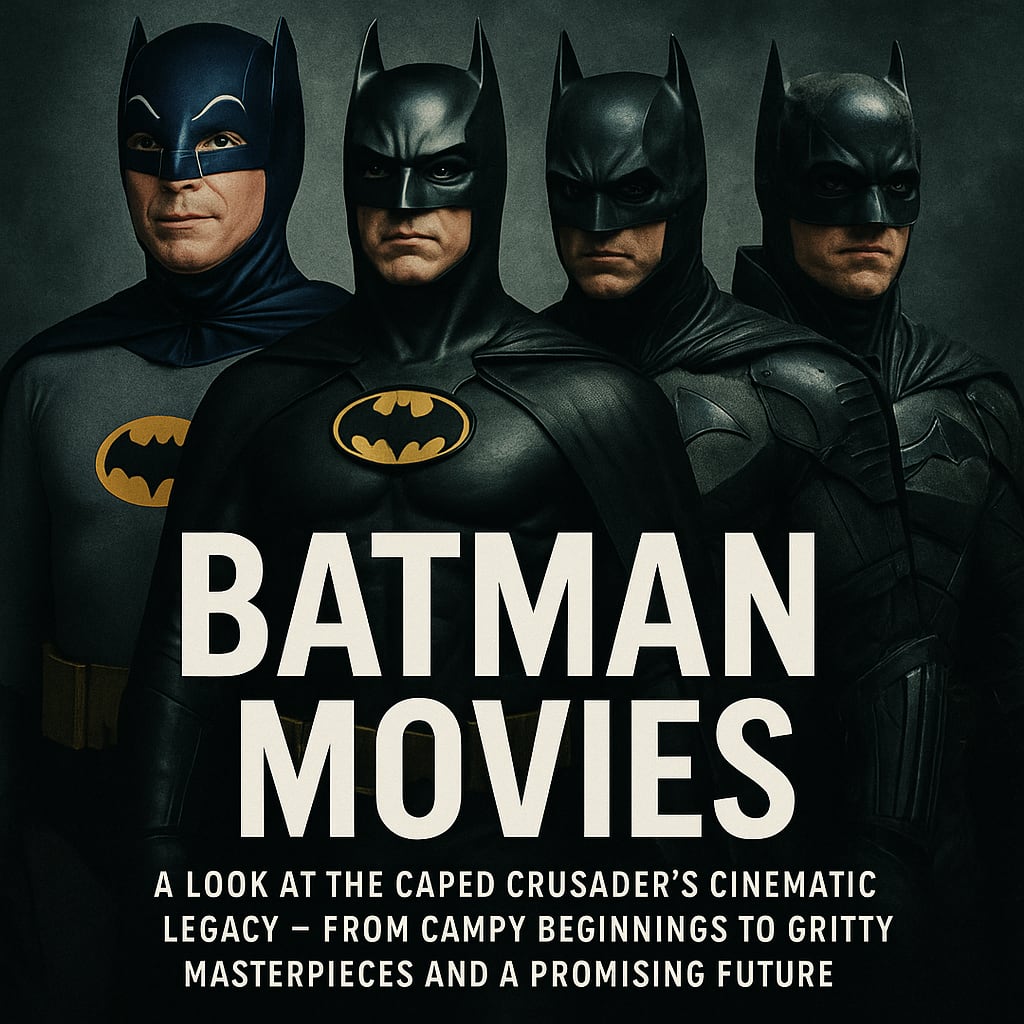
A Look at the Caped Crusader’s Cinematic Legacy — From Campy Beginnings to Gritty Masterpieces and a Promising Future
Batman is more than just a comic book character—he is a cultural icon. First appearing in Detective Comics in 1939, Batman has evolved into one of the most compelling and versatile superheroes in cinema history. His dual identity as billionaire Bruce Wayne and Gotham’s dark protector offers filmmakers an opportunity to explore themes of justice, vengeance, and morality.
Over the decades, Batman movies have taken audiences from lighthearted adventures to psychological thrillers. This article traces the cinematic journey of the Dark Knight, highlighting his impact on Hollywood and superhero storytelling.
1. The Early Years – Camp and Color
Batman: The Movie (1966)
Based on the hit TV series starring Adam West, Batman: The Movie was the first full-length theatrical Batman film. It leaned heavily into campy humor and outlandish villains like the Joker, Penguin, Riddler, and Catwoman. With its colorful sets and over-the-top action, the 1966 film captured the playful spirit of the time.
Though not critically revered, it played a crucial role in popularizing Batman outside of comic books and remains a nostalgic favorite for many.
2. Tim Burton’s Gothic Batman (1989–1992)
Batman (1989)
Directed by Tim Burton and starring Michael Keaton, Batman was a bold reinvention. Gone were the jokes and bright colors; Burton introduced a gothic, noir Gotham City and a brooding Batman. Jack Nicholson’s iconic performance as the Joker brought mainstream credibility to comic book villains.
The film was a box office smash, proving that superhero movies could be serious, stylish, and profitable.
Batman Returns (1992)
Burton’s sequel took a darker, more fantastical approach. Keaton returned alongside Michelle Pfeiffer’s seductive Catwoman and Danny DeVito’s grotesque Penguin. While praised for its visual flair, the film’s grim tone sparked controversy among parents, leading Warner Bros. to rethink the franchise’s direction.
3. The Schumacher Era – Style Over Substance (1995–1997)
Batman Forever (1995)
Directed by Joel Schumacher and starring Val Kilmer, Batman Forever introduced a more colorful, toy-friendly version of the Dark Knight. Jim Carrey’s Riddler and Tommy Lee Jones’ Two-Face brought chaos, while the film tried to balance action with camp.
It performed well at the box office but received mixed critical feedback.
Batman & Robin (1997)
Starring George Clooney, this installment is infamous for its campiness, awkward one-liners, and excessive use of neon. Arnold Schwarzenegger as Mr. Freeze and Uma Thurman as Poison Ivy couldn’t save the film from critical failure. It’s often considered one of the worst superhero films ever made—and effectively killed the franchise for nearly a decade.
4. The Nolan Trilogy – Redefining Superhero Cinema (2005–2012)
Christopher Nolan’s Dark Knight Trilogy was a game-changer, bringing realism, philosophical depth, and cinematic prestige to the genre.
Batman Begins (2005)
Starring Christian Bale, Batman Begins explored Bruce Wayne’s origin in unprecedented depth. With Liam Neeson as Ra’s al Ghul and Cillian Murphy as Scarecrow, the film examined fear, justice, and identity. It marked the rebirth of Batman on screen.
The Dark Knight (2008)
Widely regarded as the greatest superhero film ever made, The Dark Knight was a critical and commercial triumph. Heath Ledger’s legendary performance as the Joker earned him a posthumous Oscar and redefined what a villain could be. The film tackled complex themes like chaos, moral ambiguity, and sacrifice.
The Dark Knight Rises (2012)
The trilogy concluded with a massive spectacle featuring Tom Hardy’s Bane and Anne Hathaway’s Catwoman. While opinions were divided compared to its predecessor, it was a fitting end to Nolan’s grounded, epic vision.
5. The DCEU Batman – A Darker Knight
Batman v Superman: Dawn of Justice (2016)
Zack Snyder introduced Ben Affleck as an older, grizzled Batman in Batman v Superman. This version was brutal, cynical, and deeply scarred. The film explored ideological conflict between Batman and Superman, but its tone and pacing divided fans and critics.
Justice League (2017) & Zack Snyder’s Justice League (2021)
Affleck reprised his role in the ensemble Justice League, though the theatrical version was criticized for tonal inconsistency. Zack Snyder’s Justice League, released in 2021, gave a more cohesive and impactful portrayal of Batman as a team leader and strategist.
Despite strong performances, Affleck’s Batman was part of a divisive era, and plans for a solo film with him were eventually shelved.
6. The Batman (2022) – A New Noir Vision
Directed by Matt Reeves and starring Robert Pattinson, The Batman was a return to the character’s detective roots. Set in a gritty, rain-soaked Gotham, the film leaned heavily into noir influences and psychological drama.
Paul Dano’s chilling Riddler, Zoe Kravitz’s stylish Catwoman, and a brooding Pattinson offered a fresh take on familiar characters. Critics praised the film’s mood, cinematography, and its portrayal of a younger, more vulnerable Batman.
A sequel and spin-offs (including an HBO series centered on the Penguin) are already in development, solidifying this new Batman universe.
7. The Future of Batman on Film
As of 2025, Batman is expected to exist in multiple universes on screen. James Gunn’s DC Universe reboot will feature a new Batman in The Brave and the Bold, focusing on Bruce Wayne and his son Damian (Robin). Meanwhile, Pattinson’s version will continue in Reeves' separate universe.
This multiverse approach allows for creative freedom and the chance to explore different tones and stories simultaneously.
The Cultural Impact of Batman Films
Batman’s cinematic history reflects evolving tastes in storytelling, technology, and culture:
- Versatility: Batman films range from campy fun to dark realism, showcasing the character’s adaptability.
- Villain Depth: Unlike most heroes, Batman’s rogues’ gallery—Joker, Bane, Riddler, Catwoman—are as compelling as he is.
- Artistic Credibility: Directors like Nolan and Reeves have proven that Batman stories can be high art as well as blockbuster entertainment.
- Inspiration: Batman films influenced not just superhero cinema, but filmmaking as a whole—from practical effects to narrative structure.
Conclusion
Batman’s film journey is as complex as the character himself. From the whimsical charm of Adam West to the brooding genius of Christian Bale, and the gritty detective work of Robert Pattinson, each era has left its mark.
What remains consistent is Batman’s core appeal: a flawed man using intellect, willpower, and heart to fight darkness in the world—and within himself. As the cinematic landscape continues to evolve, one thing is certain: the Dark Knight will always rise again.
About the Creator
Savio Silva
Savio Silva is a skilled content writer known for crafting engaging, SEO-friendly content across niches. With a passion for storytelling and a sharp eye for detail, he delivers impactful writing that connects with readers and drives results
Keep reading
More stories from Savio Silva and writers in Geeks and other communities.
The Evolution of Superman Movies: A Legendary Cinematic Journey
Superman, the Man of Steel, is not just one of the most iconic superheroes of all time—he’s also a symbol of hope, strength, and justice. Since his first comic appearance in 1938, Superman has leaped from the pages of DC Comics onto screens worldwide. The character has seen numerous portrayals and cinematic evolutions over the decades. From classic portrayals to modern CGI-filled blockbusters, Superman's film history is rich and fascinating.
By Savio Silva7 months ago in Geeks
Silver Screen Magic with Mae West
American actress and singer Mae West became a popular film actress during the Great Depression. She started entertaining in vaudeville, then performed on Broadway, and finally went to Hollywood. She signed up with Paramount Pictures and made her debut in the 1932 film “Night After Night.” She also starred in musicals, comedies, and crime dramas. The American Film Institute named her one of the best classic Hollywood actresses.
By Rasma Raisters5 days ago in Geeks
In the Blink of an Eye: A Forgotten Thriller That Explores How Fast Life Can Shatter
Some movies don’t rely on spectacle or big budgets to leave an impression. Instead, they unsettle you quietly, planting a sense of unease that lingers long after the credits roll. In the Blink of an Eye (1996) is one such film—a made-for-television thriller that may not be widely remembered today, but one that delivers a chilling message about how quickly trust, identity, and safety can disappear.
By David Cook4 days ago in Geeks
Miss Persephone's Manual to a Seemingly Ordinary Life
Miss Persephone was found at the dining table, her blue eyes swollen, her tears arriving and retreating like the tides of the ocean. Earlier that day, her family had visited her in the retirement home where she had lived for eight years. It was her eightieth birthday.
By Imola Tóth3 days ago in Fiction


Comments
There are no comments for this story
Be the first to respond and start the conversation.